Africa
Angola Flag
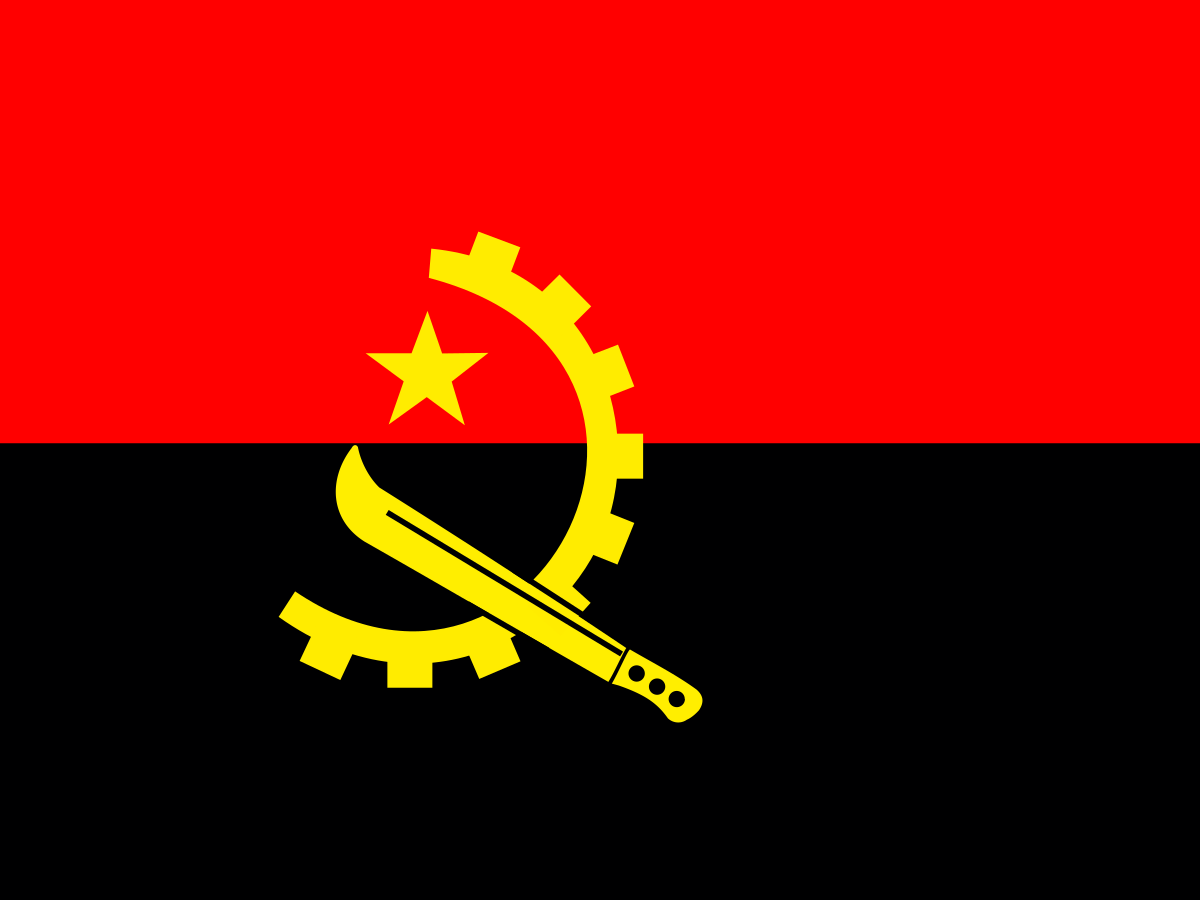
Angola is a large country on the west coast of southern Africa. Its distinctive red-and-black flag carries a yellow emblem of a machete, cogwheel and star, reflecting the country's independence struggle and the political ideas that shaped the modern state.
Capital
Luanda
Continent
Africa
Population
34.0 million
Development indicators
GDP per capita
$3,270
USD per year (approx. 2023)
Human Development Index
0.590
Medium development
World Bank income classification
Lower-Middle Income (LMIC)
LMIC
🌡️ Climate: Tropical / Savanna
Flag symbolism
Red represents the blood shed during the independence struggle, black represents Africa. The machete and cogwheel in the centre represent workers and peasants (similar to communist symbols). The star represents international solidarity.
emblem
Did you know?
Angola is one of Africa's largest countries and is one of the continent's major oil-producing states. It also has a long Atlantic coastline and the exclave of Cabinda to the north.
Test your knowledge
Think you know your world flags? Try the FlagAtlas daily challenge, speed quiz, or explore all Africa flags.
📚 Revising for GCSE Geography? Visit our free revision page →
About Angola
Angola is a large country on the west coast of southern Africa, bordered by the Atlantic Ocean. Its territory includes the main part of Angola as well as the separate exclave of Cabinda to the north.
Luanda is the capital and largest city. Angola is rich in natural resources, particularly petroleum and diamonds, while agriculture, fishing, construction and services also contribute to the economy.
CapitalLuanda
RegionSouthern Africa
PopulationAbout 37m
Area1,246,700 km²
CurrencyKwanza (AOA)
Official languagePortuguese
The flag of Angola
Angola's flag is divided horizontally into two equal halves: red above and black below. In the centre is a yellow emblem made up of a machete, a cogwheel and a five-pointed star.
A flag strongly shaped by Angola's independence era.
The present design was adopted when Angola became independent from Portugal in 1975. Its symbols reflect the revolutionary and socialist ideas influential in the country's independence movement and early years as an independent state.
The red field is commonly explained as representing blood shed during the struggle for independence, while black represents Africa. The yellow emblem represents the country's wealth and productive labour, with the individual symbols carrying additional political and historical meanings.
What do the machete, cogwheel and star mean?
The machete represents peasants and the armed struggle, while the cogwheel represents industrial workers and production. Together they reflect the importance of agriculture and industry in the revolutionary symbolism of the period.
The star is associated with international solidarity and the revolutionary political tradition that influenced Angola after independence. The emblem has clear similarities to socialist iconography.
A short history of Angola
Angola has a long history of African kingdoms and states, including the Kingdom of Kongo and the Kingdom of Ndongo. Portuguese explorers reached the region in the late fifteenth century, beginning centuries of Portuguese involvement and eventually colonial rule.
Portugal formally incorporated Angola into its colonial empire. Resistance to Portuguese rule continued for generations and developed into organised nationalist movements during the twentieth century.
The Angolan War of Independence began in 1961. Portugal's 1974 Carnation Revolution accelerated the end of Portuguese colonial rule.
Angola became independent on 11 November 1975. Independence was followed almost immediately by a long civil war involving the MPLA, UNITA and other forces. The civil war finally ended in 2002.
Angola's flag history
The modern flag is closely connected with the MPLA and the independence period. Its design reflects the political ideas of the movement that became the dominant force in the new state.
Pre-colonial periodPowerful African kingdoms and societies developed across the territory that later became Angola.
1480s onward — Portuguese involvementPortuguese traders and explorers established relationships along the coast, followed by increasing colonial control.
1961 — independence warArmed conflict against Portuguese rule began and continued until the collapse of Portuguese colonial rule.
1975 — independenceAngola became independent and the red-and-black flag with its central yellow emblem became the national flag.
1975–2002 — civil warAngola experienced a prolonged civil war after independence. The flag remained a central symbol of the Angolan state.
TodayThe same national flag remains in use.
Geography of Angola
Angola has a long Atlantic coastline and a varied landscape ranging from coastal plains to high plateaus and drier regions in the south. The central highlands rise above much of the coastal area.
Angola's neighbours
Angola shares borders with the Democratic Republic of the Congo, Zambia and Namibia. Cabinda also borders the Republic of the Congo and the Democratic Republic of the Congo.
People, language and culture
Portuguese is the official language, reflecting Angola's colonial history. Many Angolans also speak Bantu languages such as Umbundu, Kimbundu and Kikongo.
Angolan culture includes traditions in music, dance, food, art and storytelling. Semba and kuduro are particularly associated with Angola.
Angola's economy
Oil is central to Angola's economy and has made the country one of sub-Saharan Africa's major petroleum producers. Offshore oil fields have played an especially important role in exports and government revenue.
Angola also produces diamonds and has significant potential in agriculture, fisheries, hydropower and other natural resources. Economic diversification remains an important challenge because dependence on oil leaves the country exposed to changes in global energy prices.
Angola today
Angola is a republic with a young and rapidly growing population. The country has invested heavily in infrastructure since the end of the civil war, including roads, housing, energy and urban development.
Luanda is a major Atlantic city and economic centre. Outside the capital, Angola's landscapes range from agricultural areas and highlands to dry southern regions and tropical forests in the north.
Why is Angola's flag unusual?
Angola's flag stands out because its central emblem combines a machete and industrial cogwheel with a star. Many national flags use stars, but relatively few place agricultural and industrial tools together in such a prominent political emblem.
The design therefore tells a story about the period in which Angola became independent. Its symbols reflect the revolutionary politics, independence struggle and economic ideals of the new state.
Explore Angola on FlagAtlas
Sources & further reading
Statistics and country indicators are dated because they can change over time. Historical and geographical information is presented as concise educational background for this FlagAtlas reference page.
Encyclopaedia Britannica — Angola · World Bank — Angola data