Americas
Antigua and Barbuda Flag
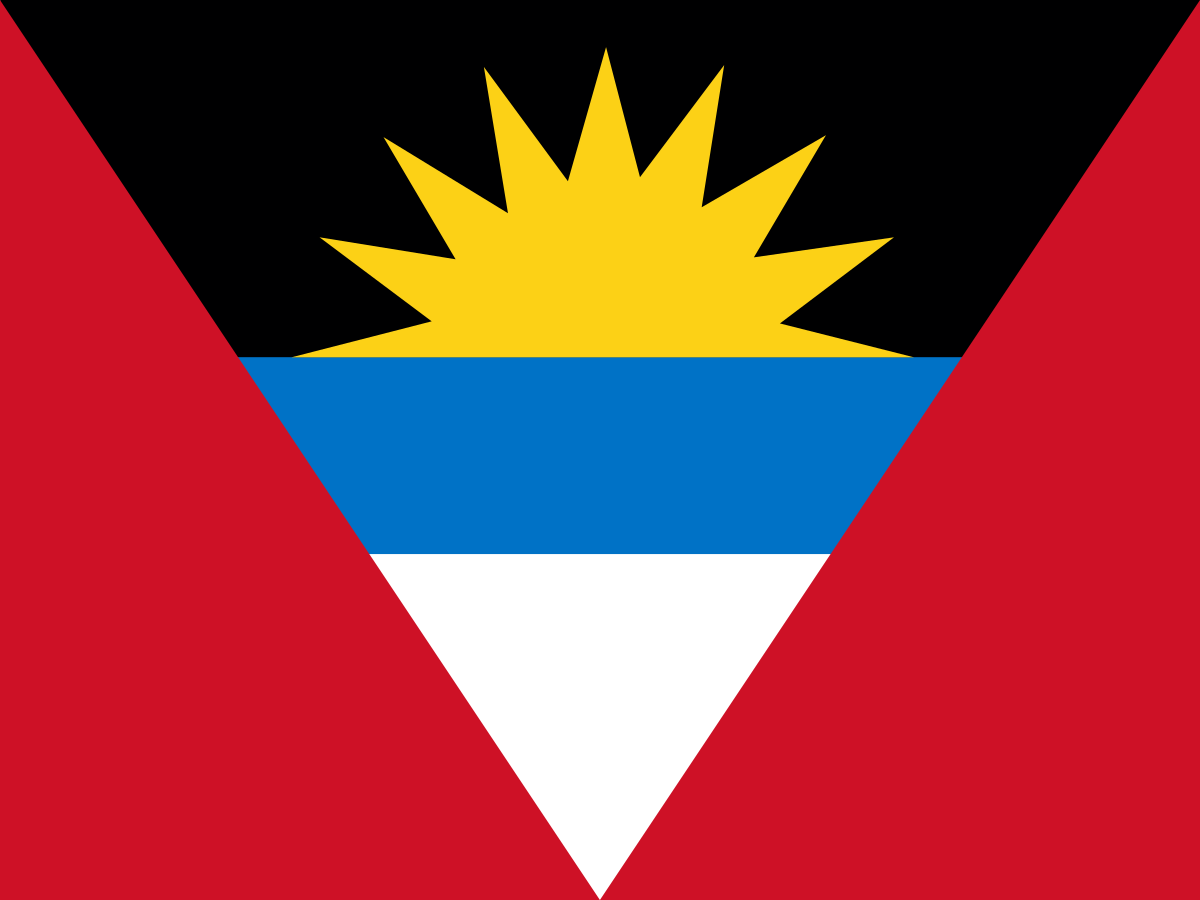
Antigua and Barbuda is a Caribbean island country whose striking flag features a golden rising sun against bands of black, blue, white and red. The design was created around the idea of a new beginning and reflects the country's African heritage, Caribbean setting and independence.
Capital
St. John's
Continent
Americas
Population
100 thousand
Development indicators
GDP per capita
$17,000
USD per year (approx. 2023)
Human Development Index
0.826
Very High development
World Bank income classification
High Income (HIC)
HIC
🌡️ Climate: Tropical
Flag symbolism
Black represents African heritage, blue stands for the Caribbean Sea, white symbolises the sand, and red represents the energy of the people. The sun has golden rising rays representing the dawn of a new era.
sun
Did you know?
Antigua is famous for its beaches and sailing traditions, while Barbuda is known for its Frigate Bird Sanctuary and relatively undeveloped natural landscape.
Test your knowledge
Think you know your world flags? Try the FlagAtlas daily challenge, speed quiz, or explore all Americas flags.
📚 Revising for GCSE Geography? Visit our free revision page →
About Antigua and Barbuda
Antigua and Barbuda is an independent Caribbean country made up of two main inhabited islands, Antigua and Barbuda, along with several smaller islands. The country lies in the eastern Caribbean and is part of the Lesser Antilles.
St. John's, on Antigua, is the capital and largest city. Tourism, services and international business are important to the economy, while the islands are also known for sailing, beaches and a warm tropical climate.
CapitalSt. John's
RegionCaribbean
PopulationAbout 100,000
Area442.6 km²
CurrencyEast Caribbean dollar
Official languageEnglish
The flag of Antigua and Barbuda
The flag was designed as a bold V-shaped composition. A rising golden sun appears above a black section, with blue and white bands and red outer areas creating the distinctive shape.
The rising sun is the key to the design.
The golden sun represents the dawn of a new era. The flag was created around the time of independence and was intended to express optimism and a new beginning for the nation.
The colours have their own symbolism. Black represents the African ancestry of the people, blue represents hope and the Caribbean, white represents sand, and red represents the energy of the people. The combination creates one of the most recognisable flags in the Caribbean.
What does the rising sun mean?
The rising sun is one of the most important features of the flag. Its position above the horizon represents the beginning of a new era following Antigua and Barbuda's independence.
The sun has seven rays. Its warm golden colour contrasts strongly with the black field behind it, making it the visual focus of the flag.
A short history of Antigua and Barbuda
The islands were inhabited by Indigenous Caribbean peoples before European colonisation. Christopher Columbus sighted Antigua in 1493 during his second voyage, and European settlement followed later.
Antigua became an important British colonial possession, with sugar plantations and the use of enslaved African labour playing a major role in its history. The legacy of this period continues to influence the culture and identity of the islands.
Slavery was abolished in the British Empire in 1834, with full emancipation following in 1838. Antigua and Barbuda gradually moved towards greater self-government during the twentieth century.
The country became independent from the United Kingdom on 1 November 1981 and has remained a member of the Commonwealth.
Antigua and Barbuda's flag history
The modern flag was chosen through a national competition during the period leading to independence. The winning design was created by Reginald Samuel and was adopted in 1967, when Antigua became an associated state of the United Kingdom. It continued as the national flag after independence in 1981.
Colonial eraAntigua and Barbuda were part of the British colonial system and developed strong links with the wider Caribbean.
1967 — associated statehoodAntigua became an associated state with internal self-government and the distinctive new flag was introduced.
1981 — independenceAntigua and Barbuda became independent from the United Kingdom on 1 November 1981.
TodayThe same striking flag remains a symbol of national independence, Caribbean identity and optimism.
Geography of Antigua and Barbuda
Antigua is the larger and more populated of the two main islands. It has a relatively dry tropical climate, rolling hills and numerous bays and beaches. Barbuda is flatter and less densely populated, with extensive beaches, wetlands and important wildlife habitats.
The country's location
Antigua and Barbuda lies in the eastern Caribbean, north of Guadeloupe and south-east of Saint Kitts and Nevis. The islands are part of the Leeward Islands group of the Lesser Antilles.
People, language and culture
English is the official language and is used in government, education and public life. Antiguan and Barbudan culture has strong African and Caribbean roots, shaped by the history of the islands and their connections with Britain and the wider Caribbean.
Cricket is especially popular, reflecting the country's British and Caribbean heritage. Music, carnival, sailing and seafood are also important parts of island life.
Tourism and the economy
Tourism is a major part of the economy. Antigua is particularly well known for beaches, sailing and yachting, while Barbuda attracts visitors interested in nature and quieter coastal landscapes.
The country also has financial services, construction, retail and other service industries. Its small size and exposure to hurricanes and global tourism trends mean the economy can be vulnerable to external events.
Why does the flag look like a V?
The V-shaped arrangement is deliberately distinctive rather than following the more familiar horizontal or vertical stripes used by many national flags. The shape directs attention towards the rising sun and gives the flag a strong sense of movement.
That visual idea fits the symbolism of the flag: the sun is rising over a new era, while the surrounding colours represent the people, the Caribbean setting and the natural environment.
Antigua and Barbuda today
Antigua and Barbuda is a parliamentary constitutional monarchy and a member of the Commonwealth. The country has close cultural and economic links with other Caribbean states and uses the East Caribbean dollar.
Its combination of beaches, sailing, tropical landscapes and historic sites makes it one of the better-known tourism destinations in the eastern Caribbean.
Explore Antigua and Barbuda on FlagAtlas
Continue exploring Antigua and Barbuda and the world's flags with these FlagAtlas resources.