Europe
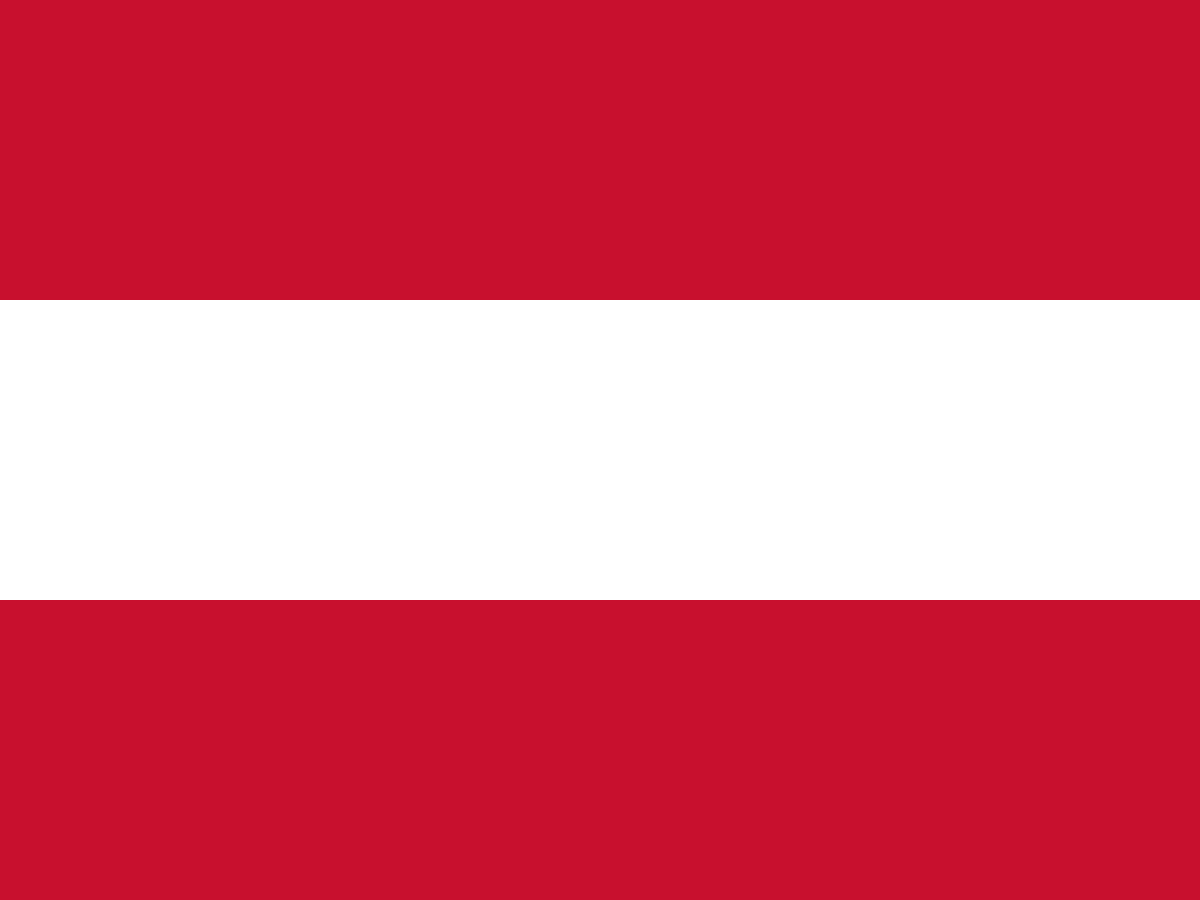
Austria Flag
Austria is a landlocked country in Central Europe, famous for the Alps, Vienna, classical music and its long imperial history. Its simple red-white-red flag is one of the oldest national flag designs still in use.
Capital
Vienna
Continent
Europe
Population
9.0 million
Development indicators
GDP per capita
$54,100
USD per year (approx. 2023)
Human Development Index
0.926
Very High development
World Bank income classification
High Income (HIC)
HIC
🌡️ Climate: Temperate continental
Flag symbolism
Legend says the red-white-red design came from a duke's blood-soaked tunic after battle, with a clean strip where his belt had been.
tricolore
Did you know?
Austria has produced many influential figures in music, science and the arts, including Wolfgang Amadeus Mozart, Sigmund Freud and Gustav Klimt.
Test your knowledge
Think you know your world flags? Try the FlagAtlas daily challenge, speed quiz, or explore all Europe flags.
📚 Revising for GCSE Geography? Visit our free revision page →
About Austria
Austria is a landlocked country in Central Europe, bordered by eight countries. Much of the country is mountainous, with the Austrian Alps dominating the western and central regions, while Vienna lies in the east on the Danube.
Vienna is Austria's capital and largest city. The country is a federal parliamentary republic and a member of the European Union, with a strong economy based on services, industry, tourism and international trade.
CapitalVienna
RegionCentral Europe
PopulationAbout 9.2m
Area83,879 km²
CurrencyEuro
Official languageGerman
The flag of Austria
Austria's national flag is made from three equal horizontal bands: red, white and red. It is an extremely simple design, but its history reaches back to the medieval period.
The famous blood-and-belt story is a legend.
The story says Duke Leopold V returned from battle with his white tunic covered in blood, except for a white strip beneath his belt. While the legend is famous, historians do not treat it as the proven origin of the flag.
The red-white-red colours are associated with the Babenberg dynasty and appear in Austrian heraldry from the medieval period. The design later became an important symbol of Austrian identity.
Why is Austria's flag red and white?
The exact origins of the red-white-red pattern are medieval. The colours became associated with the Babenberg rulers of Austria and subsequently with the Duchy and later Archduchy of Austria.
The traditional legend involving Duke Leopold V is one of the best-known stories connected with the flag. According to the tale, the duke's blood-covered tunic left a clean white band where his belt had protected the fabric.
Whether or not the story is historically accurate, it helped make the simple design memorable and remains a popular part of Austrian flag folklore.
A short history of Austria
The region that is now Austria has been inhabited for thousands of years. It became an important part of the Roman world, particularly around the Danube frontier, before later developing through Germanic and medieval political structures.
The Babenberg dynasty ruled Austria for centuries before the Habsburgs rose to prominence. The Habsburg dynasty eventually built one of Europe's most powerful ruling houses, with territories stretching across much of Central Europe and beyond.
Austria became the centre of the Austrian Empire in 1804 and later the Austro-Hungarian Empire from 1867. Following the First World War, the empire collapsed and the Republic of Austria was established.
Austria was annexed by Nazi Germany in 1938. After the Second World War it was occupied by the Allied powers before regaining full sovereignty in 1955 and declaring permanent neutrality.
Austria's flag history
The red-white-red design has medieval roots, making it one of the oldest national flag patterns still associated with a modern country.
Medieval periodRed and white became associated with the Babenberg dynasty and the Austrian lands.
13th century legendThe famous story of Duke Leopold V and the blood-stained tunic became attached to the colours, although it is regarded as legendary.
1918 — Republic establishedAfter the collapse of the Austro-Hungarian Empire, the red-white-red flag became the symbol of the new Austrian republic.
1934–1945Austria's political system changed dramatically, and the country was incorporated into Nazi Germany from 1938.
1945 — flag restoredThe Austrian national flag was restored after the Second World War.
TodayThe red-white-red flag remains a central symbol of the Republic of Austria.
Geography of Austria
Austria is dominated by mountains. The Alps cover a large part of the country, creating dramatic valleys, high peaks and extensive winter sports areas.
Austria's neighbours
Austria borders Germany, the Czech Republic, Slovakia, Hungary, Slovenia, Italy, Switzerland and Liechtenstein. Its position makes it an important link between western, central and south-eastern Europe.
The Danube is one of Europe's major rivers and flows through Austria, including through Vienna.
The Austrian Alps
The Alps are central to Austria's landscape, tourism and national identity. Many famous ski resorts are found in the Austrian Alps, and mountain tourism attracts visitors throughout the year.
Austria's highest mountain is Grossglockner, which rises to 3,798 metres. The mountain is located in the Hohe Tauern range and is a major symbol of the Austrian Alpine landscape.
People, language and culture
German is Austria's official language, with distinctive Austrian vocabulary and regional dialects. Austria has also been shaped by neighbouring Central European cultures and its former imperial connections.
Music is especially important to Austrian cultural identity. Vienna became a major centre of classical music, associated with composers such as Mozart, Haydn, Schubert and Strauss.
Austrian culture also includes famous traditions such as coffeehouse culture, Christmas markets, Alpine folk customs and Viennese cuisine.
Vienna and the Habsburg legacy
Vienna was the political and cultural centre of the Habsburg monarchy for centuries. The legacy can still be seen in the city's palaces, museums, churches and grand nineteenth-century architecture.
Schönbrunn Palace, the Hofburg and St. Stephen's Cathedral are among Vienna's best-known landmarks. The city remains one of Europe's major cultural and artistic centres.
Austria's economy
Austria has a high-income, diversified economy. Services are the largest part of the economy, while manufacturing, engineering, machinery, chemicals, vehicles, food production and other industries are also important.
Tourism is particularly significant because of the country's Alpine scenery, ski resorts, historic cities and cultural attractions.
Austria and neutrality
Austria declared permanent neutrality in 1955 as part of the arrangements surrounding the end of the post-war occupation. The country remains militarily neutral while being closely integrated with the European Union and other European institutions.
Austria joined the European Union in 1995 and uses the euro as its currency.
Is Austria's flag one of the oldest?
Austria's red-white-red design has medieval origins and is frequently described as one of the oldest national flag designs still in use. Its roots are much older than the modern Austrian republic.
That makes Austria particularly useful when studying the history of national flags: the modern flag is simple, but its story connects today's country with medieval dynasties, the Habsburg monarchy and the modern republic.
Austria today
Modern Austria is a federal parliamentary republic made up of nine federal states, known as Bundesländer. Vienna is both the capital city and one of the country's federal states.
Austria combines a strong modern economy with a rich architectural and cultural heritage. Its location in Central Europe continues to make it an important meeting point for European travel, trade and culture.
Explore Austria on FlagAtlas
Continue exploring Austria and the world's flags with these FlagAtlas resources.