Europe
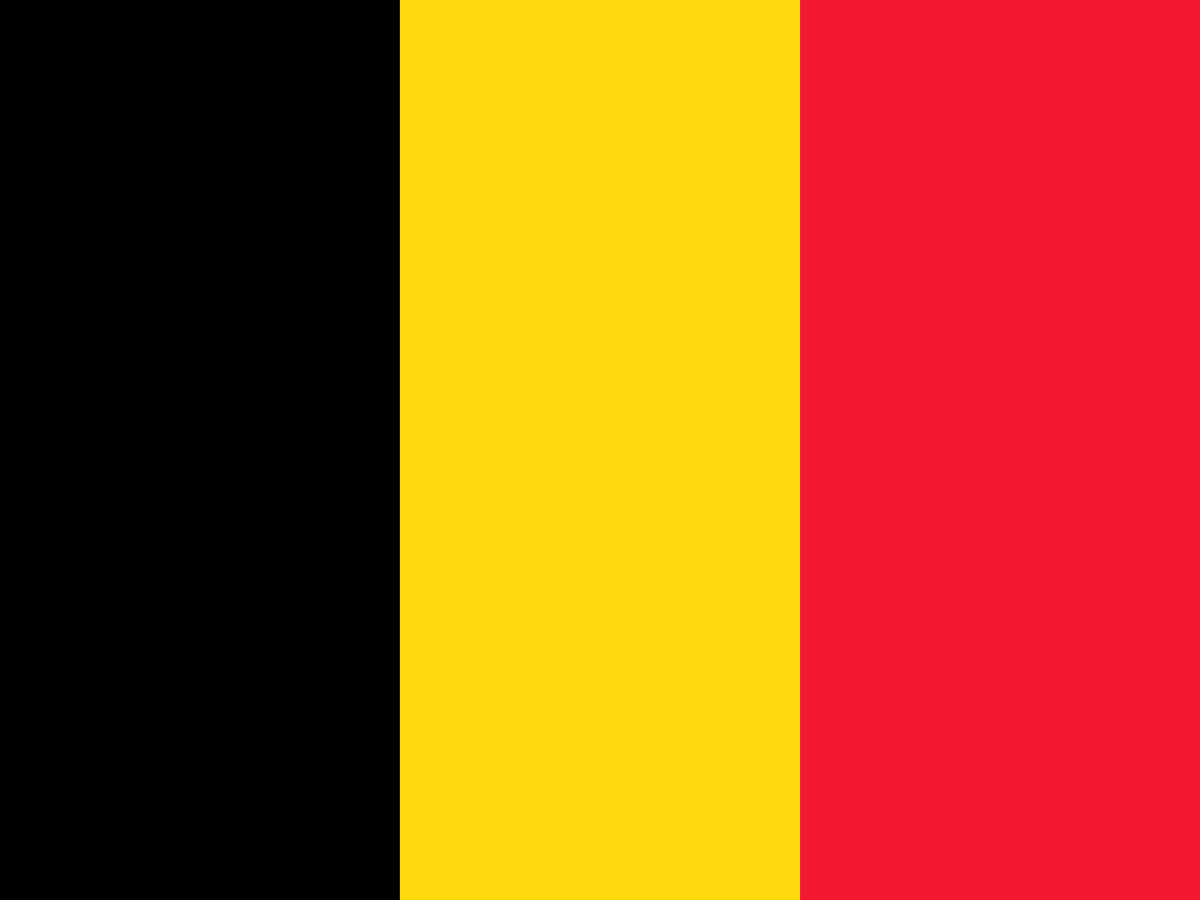
Belgium Flag
Belgium is a small country in Western Europe with a surprisingly complex history, three official languages and a distinctive black, yellow and red flag. The colours have historic roots in the Duchy of Brabant and the country's revolutionary history.
Capital
Brussels
Continent
Europe
Population
11.0 million
Development indicators
GDP per capita
$51,700
USD per year (approx. 2023)
Human Development Index
0.942
Very High development
World Bank income classification
High Income (HIC)
HIC
🌡️ Climate: Temperate oceanic
Flag symbolism
Black, yellow, and red come from the coat of arms of the Duchy of Brabant.
tricolore
Did you know?
Belgium invented French fries — despite the name, they originated in Belgium in the late 17th century.
Test your knowledge
Think you know your world flags? Try the FlagAtlas daily challenge, speed quiz, or explore all Europe flags.
📚 Revising for GCSE Geography? Visit our free revision page →
About Belgium
Belgium is a country in Western Europe bordered by France, Luxembourg, Germany and the Netherlands. It also has a short North Sea coastline. Brussels is the capital and an important centre of European politics.
Belgium is a federal state with three official languages: Dutch, French and German. Its history, architecture, food and political structure reflect its position between different European cultural regions.
CapitalBrussels
RegionWestern Europe
PopulationAbout 11.8m
Area30,689 km²
CurrencyEuro
Official languagesDutch, French, German
The flag of Belgium
The Belgian flag has three equal vertical bands of black, yellow and red. The black stripe is next to the flagpole, followed by yellow and then red.
Why these colours?
The colours are historically associated with the Duchy of Brabant. Black, gold and red appeared in the arms of Brabant and became powerful symbols during the struggle for Belgian independence.
The vertical arrangement was established during the Belgian Revolution of 1830. Belgium became independent from the Netherlands soon afterwards.
What do the colours on Belgium's flag mean?
The three colours are not simply modern symbols for ideas such as courage, wealth or peace. Their strongest historical connection is to the coat of arms of the Duchy of Brabant, whose arms featured a golden lion with black claws and tongue on a black field.
The colours were adopted as national symbols during the revolutionary period, giving the flag a direct connection with Belgian history and independence.
Why is Belgium's flag vertical?
Belgium's revolutionary flag designs were influenced by the French tricolour, but the Belgian colours were arranged vertically rather than horizontally.
The vertical design became the standard national arrangement and helps distinguish Belgium's flag from other European tricolours using the same colours.
A short history of Belgium
The territory of modern Belgium has been influenced by many European powers, including the Romans, Franks, Burgundians, Habsburgs, Spain, Austria, France and the Netherlands.
After the Napoleonic Wars, Belgium was joined with the Netherlands in the United Kingdom of the Netherlands. Religious, political and economic tensions contributed to the Belgian Revolution of 1830.
Belgium declared independence and became a constitutional monarchy. Leopold I became the first King of the Belgians in 1831.
Belgium later became a major industrial power and played an important role in European history. The country was invaded and occupied during both World Wars.
Belgium's flag history
The modern flag emerged during the Belgian Revolution and has remained the country's principal national symbol.
Medieval periodThe region was controlled by a succession of medieval states including the Duchy of Brabant.
15th–18th centuriesThe territory passed through Burgundian, Habsburg, Spanish and Austrian rule.
1815 — United Kingdom of the NetherlandsAfter Napoleon's defeat, Belgium was united with the northern Netherlands.
1830 — Belgian RevolutionRevolutionaries adopted national colours and Belgium separated from the Netherlands.
1831 — constitutional monarchyLeopold I became the first King of the Belgians.
TodayThe black, yellow and red flag remains a central symbol of Belgian identity.
Geography of Belgium
Belgium has three broad geographical regions: the coastal plain in the north-west, the central plateau and the Ardennes uplands in the south-east.
Belgium's neighbours
Belgium borders France, Luxembourg, Germany and the Netherlands. Its position places it at the crossroads of several major European transport and cultural routes.
The North Sea coastline is relatively short but has long been important for ports, fishing, trade and tourism.
Brussels — the Belgian capital
Brussels is Belgium's capital and the centre of its federal institutions. It is also one of the principal centres of the European Union and hosts major European institutions.
The city is famous for its historic Grand-Place, Art Nouveau architecture, museums, cafés and multilingual population.
Belgium's three languages
Belgium has three official languages. Dutch is mainly spoken in Flanders in the north, French is dominant in Wallonia in the south, and German is spoken by a smaller community in the east.
Brussels is officially bilingual in French and Dutch, although many other languages are also spoken there because of the city's international population.
Flanders and Wallonia
Belgium's federal structure reflects its linguistic and regional diversity. Flanders is the Dutch-speaking northern region, while Wallonia is predominantly French-speaking and occupies much of the south.
Brussels forms a separate bilingual region. Belgium also has a small German-speaking Community in the east.
Belgium's industrial history
Belgium was one of continental Europe's earliest industrialising countries. Coal mining, iron and steel production, engineering and manufacturing helped transform the country during the nineteenth century.
The industrial regions around Wallonia were particularly important during the Industrial Revolution. Today Belgium's economy is much more focused on services, manufacturing, logistics and international trade.
Belgian culture and food
Belgium is famous for chocolate, waffles, beer and fries, although Belgian cuisine is much broader than these internationally recognised foods.
The country has strong traditions in brewing, confectionery, comics, architecture, painting and music. Cities such as Brussels, Bruges, Ghent and Antwerp have major historic and cultural attractions.
Belgium and the European Union
Belgium was one of the founding participants in the European integration project that developed into today's European Union. Brussels hosts major EU institutions.
This has given Belgium an unusually important international role for a country of its size. The capital is also home to NATO headquarters.
Belgium in the World Wars
Belgium's location between France and Germany made it strategically important during both World Wars. German forces invaded Belgium in 1914, and the country was again invaded in 1940.
Belgian towns and battlefields became associated with major campaigns of the First and Second World Wars. War memorials and cemeteries remain important historical sites.
Belgium today
Belgium is a federal constitutional monarchy and a member of the European Union and NATO. The King is head of state while elected governments exercise political power.
Its combination of regional identities, three official languages and international institutions makes Belgium one of Europe's most distinctive political systems.
Why is Belgium's flag easy to confuse?
Belgium's black, yellow and red colours are shared with several other flags, but the vertical arrangement is the key to identifying it.
Germany uses the same three colours horizontally, while Belgium uses them vertically. The two flags are therefore related in colour but easy to distinguish once the layout is remembered.
Explore Belgium on FlagAtlas
Continue exploring Belgium and the world's flags with these FlagAtlas resources.