Africa
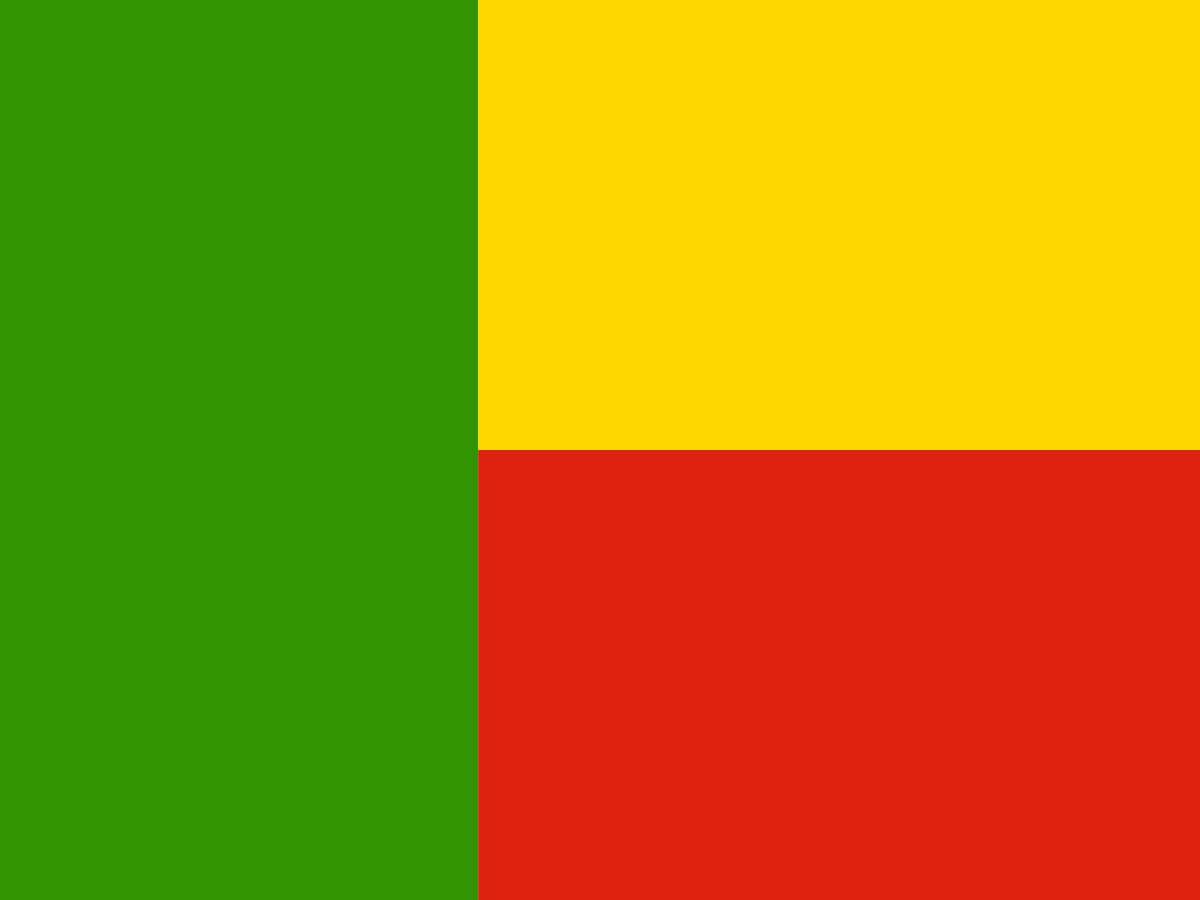
Benin Flag
Benin is a West African country with a rich history stretching from the ancient Kingdom of Dahomey to modern independence. Its green, yellow and red flag reflects national identity and the country's place within the wider Pan-African tradition.
Capital
Porto-Novo
Continent
Africa
Population
13.0 million
Development indicators
GDP per capita
$1,340
USD per year (approx. 2023)
Human Development Index
0.525
Low development
World Bank income classification
Low Income (LIC)
LIC
🌡️ Climate: Tropical / Savanna
Flag symbolism
Benin uses a vertical green band at the hoist and two horizontal bands of yellow and red. The colours are associated with national identity, hope, wealth and the courage of ancestors, and form part of the wider Pan-African colour tradition.
pan-african
Did you know?
Benin was the centre of the ancient kingdom of Dahomey, famous for its highly skilled army of women warriors called the Agojie.
Test your knowledge
Think you know your world flags? Try the FlagAtlas daily challenge, speed quiz, or explore all Africa flags.
📚 Revising for GCSE Geography? Visit our free revision page →
About Benin
Benin is a country in West Africa on the Gulf of Guinea. It borders Togo, Burkina Faso, Niger and Nigeria, and has a short coastline on the Atlantic Ocean.
Porto-Novo is the official capital, while Cotonou is the country's largest city and main economic centre. Benin is known for its historic kingdoms, diverse cultures and important role in West African history.
CapitalPorto-Novo
RegionWest Africa
PopulationAbout 13 million
Area114,763 km²
CurrencyWest African CFA franc
Official languageFrench
The flag of Benin
The Beninese flag has a green vertical band on the left and two horizontal bands on the right: yellow above and red below. The design was restored in 1990 after the country moved away from its Marxist-Leninist period.
The flag has a strong Pan-African appearance.
Green, yellow and red are widely used in African national symbolism. Benin's colours also have their own traditional interpretations connected with hope, wealth and the courage of ancestors.
The current design is closely related to the flag adopted when Dahomey became independent in 1960.
What do the colours on Benin's flag mean?
Green is associated with hope and revival. Yellow represents the nation's wealth and resources, while red is associated with the courage and sacrifices of ancestors.
The colours can also be understood within the wider Pan-African tradition, in which green, yellow and red became powerful symbols of African identity and independence.
A short history of Benin
The territory of modern Benin has been home to many societies and kingdoms. One of the most important was the Kingdom of Dahomey, which became a powerful regional state from the seventeenth century.
Dahomey developed a highly organised political and military system and became involved in regional trade. European powers increasingly expanded their influence along the West African coast during the nineteenth century.
France conquered Dahomey in the 1890s and the territory became part of French West Africa. Dahomey gained independence on 1 August 1960.
The country was renamed the People's Republic of Benin in 1975 and adopted a socialist political system. In 1990, political reforms ended the Marxist-Leninist system and the modern Republic of Benin emerged.
Benin's flag history
The national flag has changed alongside major political changes in the country's history.
Before 1890 — Kingdoms of the regionThe area was home to several African states, including the powerful Kingdom of Dahomey.
1890s — French conquestDahomey was conquered by France and incorporated into French West Africa.
1960 — independenceDahomey became independent and adopted a green, yellow and red national flag.
1975 — People's RepublicThe country was renamed Benin and adopted a different socialist-era flag.
1990 — democratic transitionThe old national colours were restored as the country moved away from Marxist-Leninist rule.
TodayThe green, yellow and red flag is the official national symbol of Benin.
The Kingdom of Dahomey
The Kingdom of Dahomey was one of the most powerful states in the region that is now southern Benin. Its capital was Abomey, where a series of royal palaces and monuments survive.
Dahomey developed a centralised monarchy, an organised army and a complex court system. The kingdom became particularly well known in European accounts for its female military units.
The Agojie — Dahomey's women warriors
The Agojie were an elite female military force serving the Kingdom of Dahomey. They became famous for their discipline, training and role in the kingdom's military campaigns.
Modern books, documentaries and films have brought the Agojie to a much wider international audience, although popular portrayals sometimes simplify the complex history surrounding the kingdom and its wars.
Abomey and its royal palaces
Abomey was the historic capital of Dahomey. The Royal Palaces of Abomey are recognised by UNESCO as a World Heritage Site.
The site preserves evidence of the kingdom's political and cultural history, including decorated buildings and objects connected with the royal court.
Benin's geography
Benin stretches from the Gulf of Guinea in the south towards the drier savanna regions of the north. The landscape changes considerably across the country.
Benin's neighbours
Benin borders Togo to the west, Burkina Faso and Niger to the north, and Nigeria to the east. Its southern coastline opens onto the Gulf of Guinea.
The country's position gives it important links between the coastal economies of West Africa and the inland Sahel.
Languages and culture
French is the official language, but Benin is home to many African languages. Fon, Yoruba and several other languages are widely used in different regions.
Beninese culture includes rich traditions of music, dance, textiles, sculpture, storytelling and religious practice. The country is particularly associated with the historical development of Vodun traditions.
Vodun and Benin
Benin is closely associated with Vodun, a family of West African religious traditions. Vodun has influenced music, ceremonies, art and cultural identity in southern Benin.
Vodun should not simply be treated as the same thing as the fictional ideas of “voodoo” often found in popular culture. It is a complex religious and cultural tradition with deep regional roots.
Cotonou and Porto-Novo
Porto-Novo is the official capital of Benin and an important centre of history and culture. Cotonou is the largest city and the main commercial and economic hub.
Cotonou's location on the coast has made it particularly important for trade, transport and links with neighbouring Nigeria.
Benin's economy
Agriculture remains important to Benin's economy, with cotton being one of the country's major commercial crops. Other agricultural products include maize, cassava, yams and other food crops.
Trade and services are also important, particularly because of Benin's location next to Nigeria. The port of Cotonou is a major gateway for regional commerce.
Benin and the slave trade
The coastal region around modern Benin was involved in the transatlantic slave trade for several centuries. Ouidah became an important port in the trade and is now a major site of historical memory.
Sites such as the Route des Esclaves and museums in Ouidah help visitors understand the scale and human consequences of the trade.
Benin today
Benin is a republic with a presidential system and is one of the countries of West Africa that has experienced significant political change since independence.
The country continues to balance economic development, agricultural production, regional trade and the preservation of its distinctive cultural and historical heritage.
Why is Benin's flag interesting?
Benin is a useful example of how a national flag can reflect political change. The country changed its flag during its socialist period and later restored the older green, yellow and red design when democratic reforms began.
It also shows how Pan-African colours can be combined with meanings that are specific to an individual country's history.
Explore Benin on FlagAtlas
Continue exploring Benin and the world's flags with these FlagAtlas resources.
Sources & further reading
Statistics and country indicators are dated because they can change over time. Historical and geographical information is presented as concise educational background for this FlagAtlas reference page.
Encyclopaedia Britannica — Benin · World Bank — Benin data