Americas
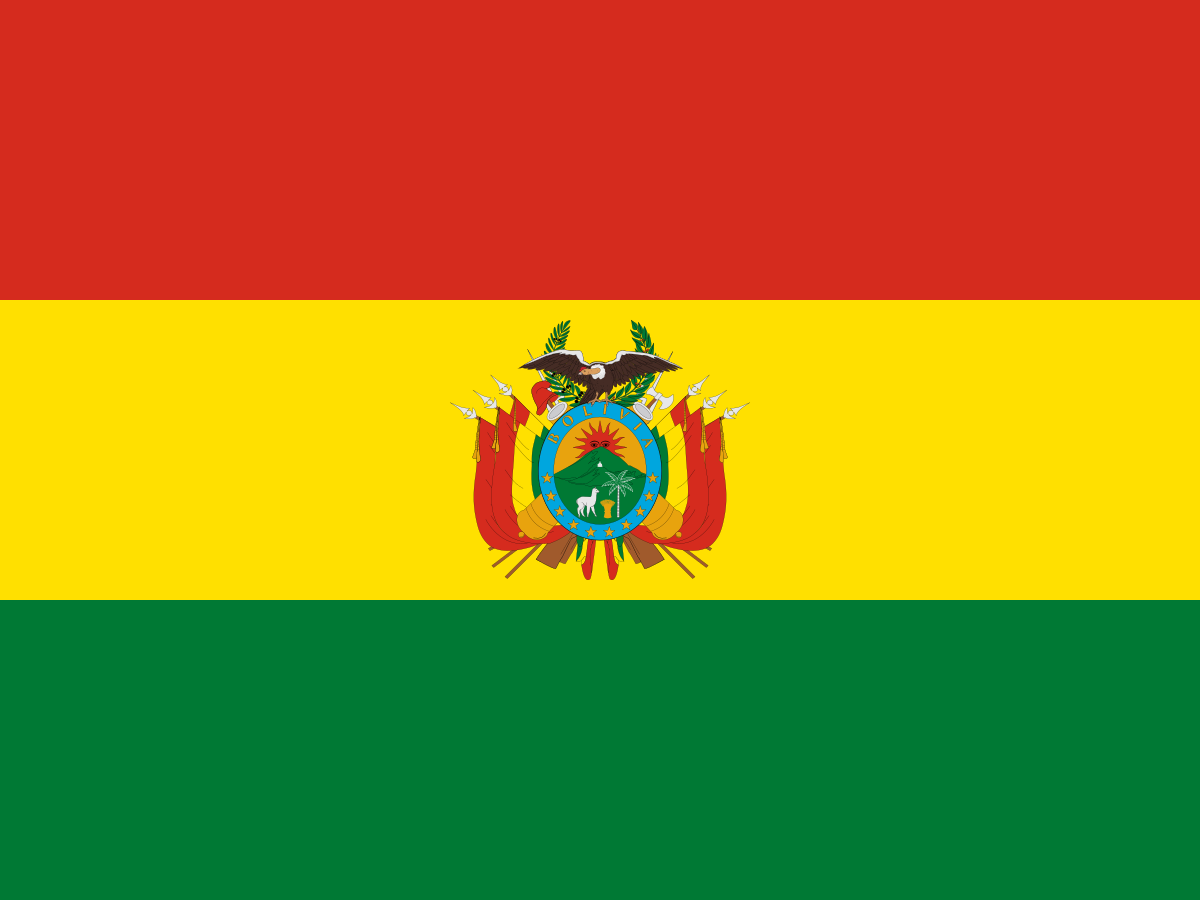
Bolivia Flag
Bolivia is a landlocked South American country with a dramatic landscape ranging from the high Andes and Altiplano to tropical lowlands. Its red, yellow and green flag reflects the country's history, natural resources and national identity.
Capital
Sucre
Continent
Americas
Population
12.0 million
Development indicators
GDP per capita
$3,690
USD per year (approx. 2023)
Human Development Index
0.698
Medium development
World Bank income classification
Lower-Middle Income (LMIC)
LMIC
🌡️ Climate: Tropical / Highland / Arid
Flag symbolism
Red is traditionally associated with the blood shed by those who fought for independence, yellow with the nation's mineral wealth and other resources, and green with the fertility of the land and agricultural wealth.
tricolore
Did you know?
Bolivia has two capitals — Sucre (constitutional) and La Paz (seat of government).
Test your knowledge
Think you know your world flags? Try the FlagAtlas daily challenge, speed quiz, or explore all Americas flags.
📚 Revising for GCSE Geography? Visit our free revision page →
About Bolivia
Bolivia is a landlocked country in central South America. It borders Brazil, Peru, Chile, Argentina and Paraguay and has some of the continent's most varied landscapes, from high Andean mountains to tropical lowlands.
Sucre is the constitutional capital, while La Paz is the seat of government. Bolivia is also one of South America's most culturally diverse countries, with a large Indigenous population and many recognised Indigenous languages.
CapitalSucre
Government seatLa Paz
PopulationAbout 12 million
Area1,098,581 km²
CurrencyBoliviano
Official languageSpanish + Indigenous languages
The flag of Bolivia
Bolivia's national flag has three horizontal bands: red at the top, yellow in the middle and green at the bottom. The design was adopted in 1851 and has remained one of the country's most recognisable symbols.
Red, yellow and green tell a simple story.
The colours are traditionally linked with the sacrifices made during independence, Bolivia's mineral and natural wealth, and the fertility of the land.
A version of the national coat of arms can also be used on the state flag, while the plain tricolour is widely used as the national flag.
What do the colours on Bolivia's flag mean?
Red is traditionally associated with the blood shed by those who fought for independence. Yellow represents the country's mineral wealth and natural resources. Green represents fertility, agriculture and the richness of the land.
These interpretations connect the flag directly to Bolivia's history and geography rather than being purely decorative colour choices.
Bolivia's coat of arms
The state version of the flag can feature Bolivia's coat of arms. The emblem contains imagery representing the country's geography, resources and history, including Mount Potosí, a landscape, a llama, sheaves of wheat and a palm tree.
The emblem also includes weapons and national symbols associated with independence and sovereignty. It is much more detailed than the simple tricolour.
A short history of Bolivia
The region that is now Bolivia was home to major pre-Columbian civilisations, including the Tiwanaku culture. Later, the area became part of the Inca Empire before Spanish conquest in the sixteenth century.
Spanish colonial rule was centred on the enormous silver deposits of Potosí. The city became one of the most important centres of the Spanish Empire in the Americas.
Bolivia declared independence from Spain in 1825. The new country was named after Simón Bolívar, one of the leading figures in South American independence.
The country's later history included political instability, military governments, economic crises and democratic reforms. Bolivia remains shaped by both its Indigenous heritage and its Spanish colonial history.
Bolivia's flag history
The flag has changed several times since independence, but the red, yellow and green colours have remained central to modern Bolivian identity.
Pre-Columbian eraPowerful cultures including Tiwanaku developed in the region before the rise of the Inca Empire.
16th century — Spanish conquestThe region was incorporated into the Spanish Empire.
1825 — independenceBolivia became independent from Spain and was named after Simón Bolívar.
1851 — current colours establishedThe modern red, yellow and green horizontal tricolour was adopted.
20th centuryBolivia experienced major political and social changes, including military rule and democratic transitions.
TodayThe tricolour remains the main national symbol, alongside the state coat of arms.
Tiwanaku — an ancient civilisation
Tiwanaku was one of the most important pre-Columbian civilisations in the Andes. Its ceremonial and architectural centre lies near Lake Titicaca in western Bolivia.
The site is famous for monumental stonework, temples and gateways. Its influence extended across a large area of the southern Andes long before the Spanish arrived.
Lake Titicaca
Lake Titicaca lies on the border between Bolivia and Peru and is one of the world's highest navigable lakes. It has played an important role in the history and mythology of Andean peoples.
Islands and archaeological sites around the lake attract visitors and provide evidence of the region's long cultural history.
The Andes and Bolivia's geography
The western part of Bolivia contains the high Andes and the Altiplano, a vast elevated plateau. This region includes snow-capped peaks, volcanic landscapes and high-altitude lakes.
East of the Andes, the land falls towards warmer valleys, forests and the lowlands of the Amazon basin. This huge change in altitude gives Bolivia an unusually wide range of climates and ecosystems.
Salar de Uyuni
The Salar de Uyuni is the world's largest salt flat and one of Bolivia's most famous natural landmarks. During the dry season it appears as an enormous white expanse, while seasonal water can create spectacular mirror-like reflections.
The salt flats are also important because Bolivia has large lithium resources, a material used in batteries and other modern technologies.
Potosí and silver
Potosí grew rapidly after the discovery of huge silver deposits at Cerro Rico during Spanish colonial rule. Silver from the mountain helped finance the Spanish Empire for centuries.
The history of Potosí also reflects the human cost of colonial mining, including forced labour systems that subjected Indigenous and other workers to extremely harsh conditions.
Bolivia's Indigenous cultures
Bolivia has one of the largest Indigenous populations in South America. Quechua and Aymara communities are particularly prominent, alongside many other Indigenous peoples.
Indigenous languages, textiles, music, festivals and food remain important parts of national culture. Bolivia's modern constitution recognises the country's plurinational character.
La Paz and Sucre
Sucre is Bolivia's constitutional capital and is known for its white colonial architecture. La Paz is the seat of government and one of the world's highest major cities.
La Paz sits in a dramatic canyon beneath the high Andes, with the snow-covered Illimani mountain forming a famous backdrop.
Bolivian culture and food
Bolivian culture combines Indigenous Andean traditions with Spanish and other influences. Festivals often include colourful costumes, music and dance.
Traditional foods include dishes based on potatoes, maize, quinoa and meats. Quinoa has become internationally popular but has been cultivated in the Andes for thousands of years.
Bolivia's economy
Bolivia has significant natural resources, including natural gas, minerals, lithium and agricultural land. Mining has been important for centuries, while agriculture remains essential to many communities.
Tourism is also important, particularly around the Salar de Uyuni, Lake Titicaca, the Andes and historic cities such as Sucre and Potosí.
Bolivia today
Bolivia is a democratic republic with a presidential system. Its 2009 constitution formally recognises the country as a Plurinational State and gives significant recognition to Indigenous peoples and cultures.
The country continues to balance economic development and natural-resource use with environmental protection and the preservation of Indigenous rights and traditions.
Why is Bolivia's flag interesting?
Bolivia's flag is a good example of a simple tricolour whose colours carry a strong historical story. The plain red, yellow and green design is immediately recognisable, while the state version adds a detailed coat of arms.
Its symbolism also connects directly with the country's geography: mineral wealth, fertile land and the history of independence all appear in the meaning traditionally given to the three colours.
Explore Bolivia on FlagAtlas
Continue exploring Bolivia and the world's flags with these FlagAtlas resources.