Europe
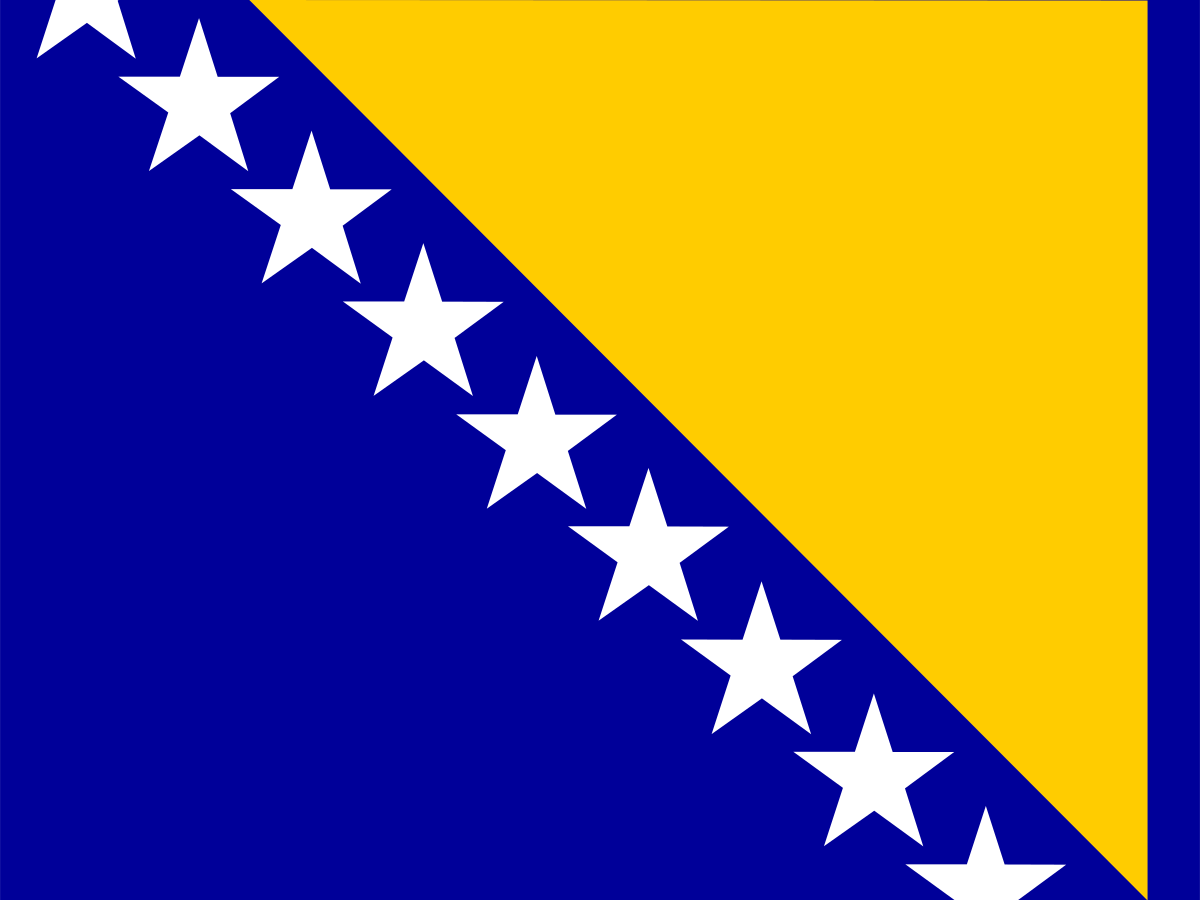
Bosnia and Herzegovina Flag
Bosnia and Herzegovina is a mountainous country in south-eastern Europe with a complex history shaped by Ottoman, Austro-Hungarian and Yugoslav rule. Its modern flag uses a blue field, a yellow triangle and a line of white stars.
Capital
Sarajevo
Continent
Europe
Population
3.5 million
Development indicators
GDP per capita
$8,000
USD per year (approx. 2023)
Human Development Index
0.779
High development
World Bank income classification
Upper-Middle Income (UMIC)
UMIC
🌡️ Climate: Temperate continental
Flag symbolism
The blue and yellow are associated with Europe and the Council of Europe, while the stars form a European motif. The yellow triangle is commonly understood as referring to the shape of the country and its three constituent peoples.
starstriangle
Did you know?
Sarajevo was the first city in Europe to have a full-time electric tram network.
Test your knowledge
Think you know your world flags? Try the FlagAtlas daily challenge, speed quiz, or explore all Europe flags.
📚 Revising for GCSE Geography? Visit our free revision page →
About Bosnia and Herzegovina
Bosnia and Herzegovina is a country in south-eastern Europe, in the western Balkans. It borders Croatia, Serbia and Montenegro and has a short coastline on the Adriatic Sea.
Sarajevo is the capital and largest city. The country is known for its mountains, rivers, historic towns and a cultural heritage influenced by Roman, Slavic, Ottoman, Austro-Hungarian and Yugoslav periods.
CapitalSarajevo
RegionBalkans / Southeast Europe
PopulationAbout 3.2 million
Area51,209 km²
CurrencyConvertible mark
LanguagesBosnian, Croatian, Serbian
The flag of Bosnia and Herzegovina
The flag has a deep blue field with a large yellow triangle along the hoist side and a diagonal row of white five-pointed stars running along the triangle's edge.
The design deliberately avoids favouring one ethnic or religious symbol.
The modern flag was introduced after the Bosnian War and was designed to provide a neutral national symbol for a diverse country.
The current flag was adopted on 4 February 1998, replacing an earlier flag used after independence.
What do the colours and symbols mean?
The blue and yellow are strongly associated with Europe and the Council of Europe. The white stars form a European motif and are arranged as an apparently continuous sequence extending beyond the visible edges of the design.
The yellow triangle is commonly interpreted as representing the shape of Bosnia and Herzegovina. Its three points are also often associated with the country's three constituent peoples: Bosniaks, Croats and Serbs.
Why does Bosnia and Herzegovina have a European-looking flag?
The modern flag was designed during the post-war period when the country needed a symbol that could represent the state as a whole rather than one particular historical or ethnic tradition.
The European colours and stars were therefore useful visual choices. The design also avoids using the Ottoman, Yugoslav or other historical symbols that could be interpreted as representing only part of the country's population.
A short history of Bosnia and Herzegovina
The region has been inhabited for thousands of years and became part of the Roman world in antiquity. Slavic peoples settled widely in the Balkans during the early medieval period.
During the medieval period, Bosnia developed as a powerful kingdom. From the fifteenth century, much of the territory became part of the Ottoman Empire, bringing centuries of Ottoman political and cultural influence.
In 1878 Bosnia and Herzegovina came under Austro-Hungarian administration. It was formally annexed by Austria-Hungary in 1908.
After the First World War, Bosnia and Herzegovina became part of the Kingdom of Serbs, Croats and Slovenes, later Yugoslavia. The country declared independence from Yugoslavia in 1992, followed by the devastating Bosnian War.
Bosnia and Herzegovina's flag history
The country's flag has changed several times as political systems changed. The current design is deliberately modern and avoids many of the symbols used by earlier governments.
Medieval BosniaBosnia developed as a distinct medieval political entity and eventually became a kingdom.
1463 — Ottoman conquestMost of Bosnia came under Ottoman rule, beginning a long period of Ottoman influence.
1878 — Austro-Hungarian administrationThe Congress of Berlin placed Bosnia and Herzegovina under Austro-Hungarian administration.
1918 — Yugoslav stateBosnia and Herzegovina became part of the new South Slav state that later became Yugoslavia.
1992 — independenceBosnia and Herzegovina declared independence following a referendum.
1995–1998 — post-war settlement and new flagThe Dayton peace settlement ended the war, and the current national flag was adopted in 1998.
Sarajevo — the capital
Sarajevo lies in a valley surrounded by mountains and has a history stretching back centuries. The city contains Ottoman mosques and bazaars, Austro-Hungarian buildings and modern neighbourhoods.
Sarajevo became internationally famous in 1914 after the assassination of Archduke Franz Ferdinand there, an event that helped trigger the First World War.
The First World War and Sarajevo
On 28 June 1914, Archduke Franz Ferdinand of Austria and his wife Sophie were assassinated in Sarajevo by Gavrilo Princip. The assassination became the immediate trigger for the diplomatic crisis that preceded the First World War.
The event is one of the most famous moments in European history, and several locations in Sarajevo now form part of the city's historical heritage.
The Bosnian War
Following Bosnia and Herzegovina's declaration of independence in 1992, a brutal war broke out involving Bosniak, Bosnian Serb and Bosnian Croat forces, with civilians suffering heavily.
The war lasted until the Dayton Peace Agreement of 1995. The conflict left deep physical and social scars, and its legacy continues to shape politics and society.
Srebrenica
Srebrenica is associated with one of the darkest episodes of the Bosnian War. In July 1995, more than 8,000 Bosniak men and boys were killed after the fall of the UN-declared safe area.
The Srebrenica genocide has been recognised by international courts and remains a central part of the historical memory of the conflict. The Srebrenica-Potočari Memorial and Cemetery commemorates the victims.
The Dayton Peace Agreement
The Dayton Peace Agreement, signed in 1995, brought the Bosnian War to an end. It established the constitutional framework under which Bosnia and Herzegovina operates today.
The country consists of two main entities, the Federation of Bosnia and Herzegovina and Republika Srpska, alongside the separate Brčko District. The complex structure reflects the compromises made to end the war.
Mostar and the Old Bridge
Mostar is one of Bosnia and Herzegovina's best-known cities. Its historic centre is famous for the Stari Most, or Old Bridge, which spans the Neretva River.
The original Ottoman-era bridge was destroyed during the Bosnian War but was later rebuilt. The reconstructed bridge and historic centre are now a UNESCO World Heritage Site.
Bosnia and Herzegovina's geography
Much of Bosnia and Herzegovina is mountainous, with the Dinaric Alps dominating the landscape. Rivers cut through deep valleys and karst landscapes are common.
The country has a tiny Adriatic coastline around the town of Neum, making it one of Europe's countries with a very short sea frontage.
Culture and religion
Bosnia and Herzegovina is culturally diverse. Bosniaks are predominantly Muslim, Serbs are predominantly Orthodox Christian and Croats are predominantly Catholic, although individual beliefs and identities are more varied than these broad categories suggest.
This mixture has produced a distinctive cultural landscape where mosques, Orthodox churches, Catholic churches and Jewish heritage sites can be found in the same cities.
Bosnian coffee and cuisine
Coffee is an important part of social life in Bosnia and Herzegovina. Bosnian coffee is traditionally prepared in a small copper pot called a džezva and served in a small cup with water and often something sweet.
Popular foods include ćevapi, burek, stuffed vegetables and a variety of grilled meats and pastries. The cuisine reflects Ottoman, Balkan and Central European influences.
Bosnia and Herzegovina today
Bosnia and Herzegovina is a sovereign state with a complex constitutional system created by the Dayton Agreement. The country has a tripartite presidency, with representatives from its three constituent peoples.
It is a member of the United Nations, the Council of Europe and NATO's Partnership for Peace, and has pursued closer integration with the European Union.
Why is Bosnia and Herzegovina's flag interesting?
The flag is a strong example of a deliberately neutral modern national design. Rather than relying on historical coats of arms, religious imagery or ethnic symbols, it uses simple geometric shapes and a European colour scheme.
That makes the flag particularly interesting when studying how countries design symbols that need to represent people with different historical and cultural identities.
Explore Bosnia and Herzegovina on FlagAtlas
Continue exploring Bosnia and Herzegovina and the world's flags with these FlagAtlas resources.