Africa
Botswana Flag
Botswana is a landlocked country in southern Africa known for the Okavango Delta, the Kalahari Desert and one of Africa's most stable post-independence political systems. Its simple blue, black and white flag has a strong connection with water, national unity and the country's dry environment.
Capital
Gaborone
Continent
Africa
Population
2.6 million
Development indicators
GDP per capita
$7,940
USD per year (approx. 2023)
Human Development Index
0.693
Medium development
World Bank income classification
Upper-Middle Income (UMIC)
UMIC
🌡️ Climate: Semi-arid / Savanna
Flag symbolism
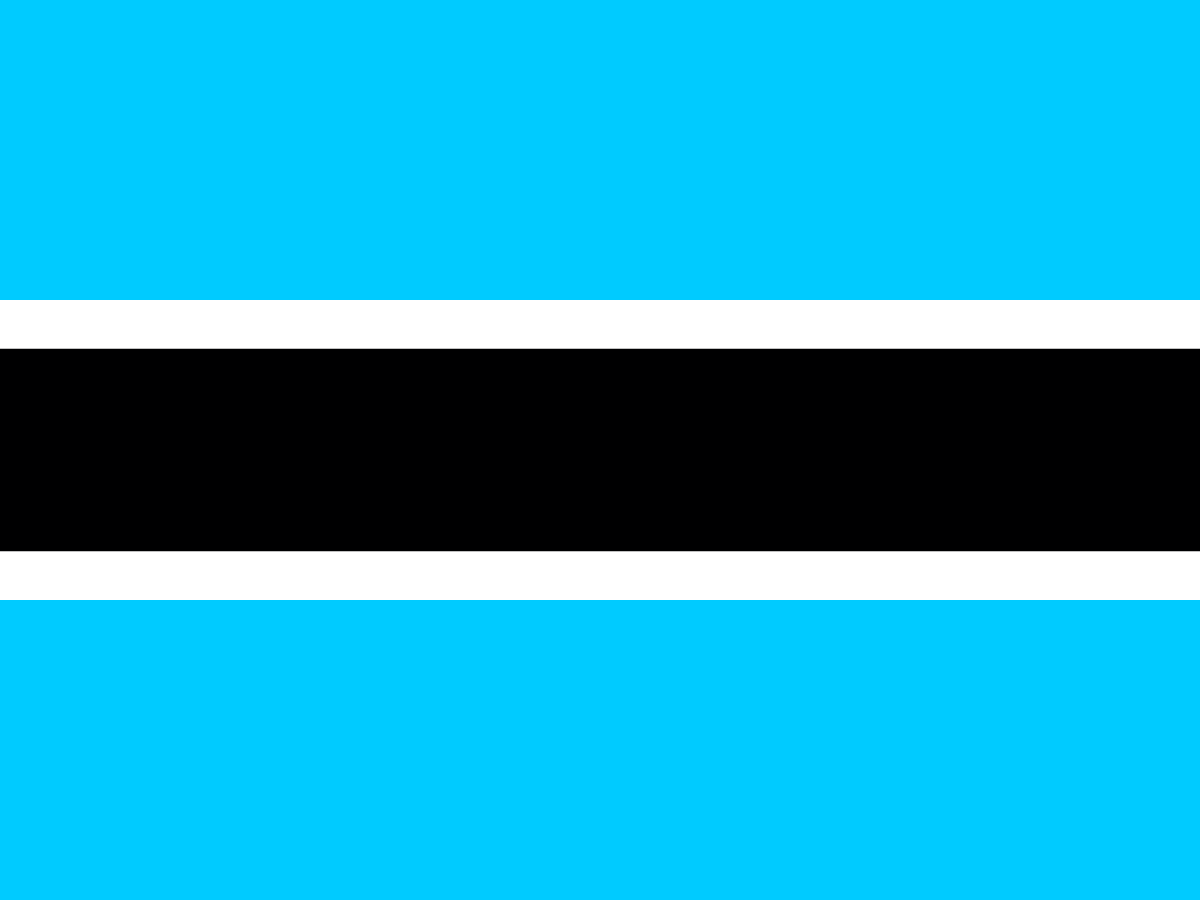
Blue represents water, a particularly important symbol in a country where much of the landscape is dry. The black and white bands are associated with racial harmony and with the contrasting colours of the zebra, one of Botswana's best-known animals.
simple
Did you know?
Botswana transformed from one of the world's poorest countries at independence to an upper-middle income economy, largely through diamond mining.
Test your knowledge
Think you know your world flags? Try the FlagAtlas daily challenge, speed quiz, or explore all Africa flags.
📚 Revising for GCSE Geography? Visit our free revision page →
About Botswana
Botswana is a landlocked country in southern Africa bordered by Namibia, South Africa, Zimbabwe and Zambia. Much of the country is covered by the Kalahari, while the north contains the remarkable Okavango Delta.
Gaborone is the capital and largest city. Botswana gained independence from Britain in 1966 and has since become known for political stability, conservation and diamond mining.
CapitalGaborone
RegionSouthern Africa
PopulationAbout 2.6 million
Area581,730 km²
CurrencyBotswana pula
Official languageEnglish
The flag of Botswana
Botswana's flag has a light blue field crossed horizontally by a black stripe edged in white. It was adopted on 30 September 1966, the day Botswana became independent.
The blue is especially important.
Botswana is a dry country where water is precious. The blue field therefore carries a particularly practical and meaningful national symbol.
The design is deliberately simple and does not use a coat of arms, shield or political emblem.
What do the colours on Botswana's flag mean?
Blue represents water and is also connected with the idea of rain, which is highly valued in Botswana's dry climate.
The black and white bands are associated with the country's people and the idea of racial harmony. They are also often linked visually with the contrasting black-and-white colouring of the zebra.
The simplicity of the design helped create a national symbol that could represent Botswana as an independent country without favouring a particular ethnic group.
Why is Botswana's flag unusual?
Botswana's flag stands out because its main field is a pale blue rather than one of the more common strong colours found on African flags. It also uses a black central stripe edged in white without a coat of arms.
The flag is therefore visually simple while still carrying several layers of meaning connected with water, unity and Botswana's environment.
A short history of Botswana
Before European colonial rule, the area was home to many Tswana-speaking communities and other peoples. Several Tswana kingdoms became important political powers in the region.
During the nineteenth century, European expansion and conflict in southern Africa increased pressure on local states. In 1885, Britain established the Bechuanaland Protectorate.
Bechuanaland remained a British protectorate for decades and became independent as Botswana on 30 September 1966. Seretse Khama became the country's first president.
Since independence, Botswana has maintained regular elections and relatively strong political institutions. The discovery and development of diamond deposits transformed the country's economy after independence.
Botswana's flag history
Botswana's modern flag was created for independence and has remained largely unchanged since 1966.
Pre-colonial periodTswana-speaking kingdoms and other communities developed across the region.
1885 — Bechuanaland ProtectorateBritain established a protectorate over the territory that became modern Botswana.
1966 — independenceBotswana became independent and adopted the blue, black and white flag.
1967 onwards — diamond developmentMajor diamond discoveries helped transform Botswana's economy.
TodayThe original independence-era flag remains the national flag.
Seretse Khama and independence
Seretse Khama was a key figure in Botswana's transition to independence and became the country's first president. He was a member of the Bangwato royal family but supported democratic government rather than hereditary rule.
His leadership helped establish many of the political traditions that have contributed to Botswana's reputation for stability.
Diamonds and Botswana's economy
Botswana is one of the world's best-known diamond-producing countries. Major discoveries after independence provided revenue that was invested in infrastructure, education, healthcare and other public services.
Diamonds remain important to the economy, although Botswana has also sought to diversify through tourism, services and other industries.
The Okavango Delta
The Okavango Delta is one of Botswana's most famous natural features. Unlike most major rivers, the Okavango does not reach the sea. Instead, it spreads into the Kalahari sands, creating a huge inland wetland.
The seasonal floodwaters support elephants, hippos, crocodiles, lions, leopards and many bird species. The delta is a major destination for wildlife tourism.
The Kalahari Desert
Much of Botswana lies within the Kalahari region. Although often called a desert, parts of the Kalahari receive enough seasonal rainfall to support grasslands, shrubs and substantial wildlife.
The Kalahari has also been home to San communities for thousands of years. Their knowledge of the environment is an important part of the region's cultural heritage.
Wildlife and conservation
Botswana has developed a strong international reputation for wildlife conservation. Protected areas cover large parts of the country and support some of Africa's most important populations of elephants and other large mammals.
National parks and reserves include Chobe National Park, Moremi Game Reserve and the Central Kalahari Game Reserve.
Chobe National Park
Chobe National Park is famous for its large elephant population. The Chobe River attracts wildlife during the dry season and provides opportunities to see elephants, buffalo, hippos and many bird species close to the water.
Botswana's people and languages
Botswana is home to a number of ethnic and cultural communities. Tswana culture has a particularly strong influence on national identity, while San communities preserve distinctive languages and traditions.
English is the official language and Setswana is widely spoken. The national identity emphasises unity across the country's different communities.
Traditional Botswana culture
The kgotla is an important traditional institution where community matters can be discussed. Traditional leaders have historically played an important role in local governance and dispute resolution.
Music, dance, craftwork and traditional ceremonies remain important elements of cultural life, alongside modern urban culture.
Gaborone — the capital
Gaborone is Botswana's capital and main administrative and economic centre. It has grown considerably since independence and is now home to a large share of the country's population and businesses.
The city is located in the south-east of the country near the border with South Africa, making it an important regional centre.
Botswana today
Botswana is a multi-party democracy and constitutional republic. It has held regular national elections since independence and has experienced peaceful transfers of power between political leaders.
The country continues to face challenges including dependence on diamond revenues, unemployment, inequality and the need to diversify the economy while protecting its exceptional natural environment.
Why is Botswana's flag important?
Botswana's flag is a good example of how a very simple design can communicate a country's identity. The blue field reflects the importance of water and rain, while the black and white stripe expresses unity and harmony.
Its history is also unusual because the flag adopted at independence in 1966 is still in use today, without major redesigns.
Explore Botswana on FlagAtlas
Continue exploring Botswana and the world's flags with these FlagAtlas resources.