Africa
Burkina Faso Flag
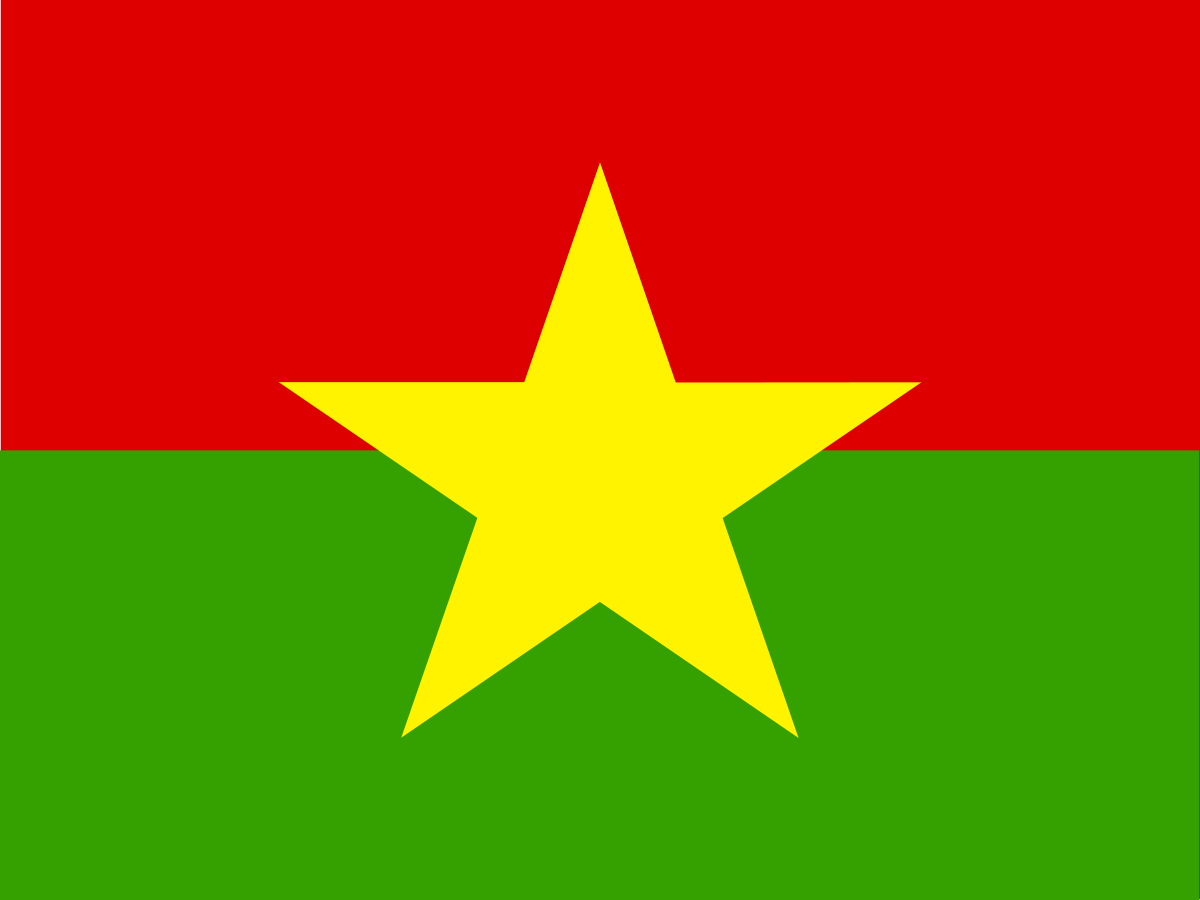
Burkina Faso is a landlocked country in West Africa, known for its strong sense of national identity, rich cultural traditions and distinctive red-and-green flag. The yellow star at its centre represents the guiding light of the revolution that transformed the country in the 1980s.
Capital
Ouagadougou
Continent
Africa
Population
22.0 million
Development indicators
GDP per capita
$870
USD per year (approx. 2023)
Human Development Index
0.449
Low development
World Bank income classification
Low Income (LIC)
LIC
🌡️ Climate: Tropical / Savanna
Flag symbolism
Red represents the revolution and the sacrifices made in the struggle for national renewal. Green represents hope and the country's agricultural wealth, while the yellow star represents the guiding light of the revolution.
starpan-african
Did you know?
Burkina Faso means 'Land of Honest People' — it changed its name from Upper Volta in 1984.
Test your knowledge
Think you know your world flags? Try the FlagAtlas daily challenge, speed quiz, or explore all Africa flags.
📚 Revising for GCSE Geography? Visit our free revision page →
About Burkina Faso
Burkina Faso is a landlocked country in West Africa bordered by Mali, Niger, Benin, Togo, Ghana and Côte d'Ivoire. Its capital is Ouagadougou, a major cultural and administrative centre.
The country is part of the Sahel region and has a strong agricultural tradition. Its modern identity is closely connected with the revolutionary period of the 1980s and the decision to adopt the name Burkina Faso.
CapitalOuagadougou
RegionWest Africa / Sahel
PopulationAbout 24 million
Area274,200 km²
CurrencyWest African CFA franc
Official languageFrench
The flag of Burkina Faso
Burkina Faso's flag consists of two horizontal bands: red above green, with a yellow five-pointed star in the centre. It was introduced during the revolutionary period under Thomas Sankara.
The flag is strongly linked to the country's revolution.
The red and green colours and central star were chosen to represent a new national identity based on revolution, hope and African solidarity.
The design replaced the earlier flag of Upper Volta after the country's name was changed in 1984.
What do the colours on Burkina Faso's flag mean?
Red represents the revolution and the sacrifices associated with it. Green represents hope and the country's agricultural wealth.
The yellow star is the guiding light of the revolution. The red, green and yellow combination also reflects the wider tradition of Pan-African colours used by many African countries.
Why is there a star on the flag?
The yellow five-pointed star is placed at the centre of the flag and represents the guiding light of the revolution. Its central position makes it the main visual focus of the design.
The star also gives the flag a clear connection with the revolutionary symbolism that shaped Burkina Faso's identity in the 1980s.
Where did the name Burkina Faso come from?
The name Burkina Faso was adopted in 1984, replacing the colonial-era name Upper Volta. It combines words from two major languages of the country.
“Burkina” from Mooré is commonly translated as “upright” or “honest”, while “Faso” from Dioula means “fatherland” or “land”. The name is therefore commonly rendered in English as “Land of Upright People” or “Land of Honest People”.
A short history of Burkina Faso
The territory of modern Burkina Faso has been home to numerous West African communities and kingdoms for centuries. The Mossi kingdoms became particularly important and established powerful political traditions.
France incorporated the territory into French West Africa in the late nineteenth and early twentieth centuries. It later became the Republic of Upper Volta after independence in 1960.
A series of military governments followed independence. In 1983, Thomas Sankara came to power after a coup and launched a radical programme of political, social and economic change.
In 1984, the country was renamed Burkina Faso and adopted its present flag. Sankara was overthrown and killed in 1987, after which Blaise Compaoré took power.
Burkina Faso's flag history
The current flag was created during the revolutionary period and represented a deliberate break with the symbols of Upper Volta.
1890s–1910s — French controlThe territory became part of the French colonial system in West Africa.
1960 — independenceUpper Volta became an independent republic.
1983 — revolutionThomas Sankara came to power and began a programme of radical political and social reform.
1984 — new name and flagUpper Volta became Burkina Faso and the red, green and yellow-star flag was adopted.
1987 — Sankara killedA coup brought Blaise Compaoré to power.
2014 — Compaoré leaves officeLarge protests led to the end of Compaoré's long presidency.
TodayThe revolutionary-era flag remains the national flag.
Thomas Sankara
Thomas Sankara was a military officer and revolutionary leader who became president in 1983. He promoted self-reliance, women's rights, vaccination, literacy and environmental protection.
He also opposed corruption and foreign dependence and encouraged citizens to adopt a new national identity. His government changed the country's name to Burkina Faso in 1984.
Sankara was assassinated in 1987. He remains an influential and often admired figure across Africa, particularly among people interested in anti-colonialism and African self-determination.
The Mossi kingdoms
The Mossi kingdoms were among the most important pre-colonial states in the region. They developed organised political structures and controlled important areas of what is now Burkina Faso.
The legacy of the Mossi kingdoms remains important to Burkina Faso's history and culture, although the country today is home to many different ethnic communities.
Burkina Faso and the Sahel
Burkina Faso lies within the Sahel, the broad transition zone between the Sahara Desert to the north and wetter tropical regions farther south.
The region experiences strong seasonal differences, with a rainy season followed by a long dry season. Rainfall is especially important because much of the population depends on agriculture and livestock.
Agriculture and rural life
A large part of Burkina Faso's population depends directly or indirectly on agriculture. Important crops include millet, sorghum, maize, cotton and other food crops.
Cotton has historically been one of the country's most important cash crops. Farming is closely linked to seasonal rainfall, making drought and changing weather patterns significant challenges.
Ouagadougou — the capital
Ouagadougou is the capital and largest city of Burkina Faso. It is the centre of national government, education, commerce and cultural life.
The city hosts major cultural events, markets and institutions and is also home to the country's principal political and administrative organisations.
Culture and languages
Burkina Faso is culturally diverse, with many ethnic communities and languages. Mooré, spoken widely by Mossi communities, and Dioula are particularly important languages in everyday life and trade.
French has traditionally been the official language of government and education, although local languages remain central to daily life and cultural identity.
Music, masks and festivals
Burkina Faso has a rich tradition of music, dance, storytelling and mask-making. Traditional performances vary between communities and often have ceremonial or spiritual significance.
Ouagadougou is also known for major cultural festivals, including FESPACO, one of Africa's most important film festivals.
FESPACO — African cinema
The Panafrican Film and Television Festival of Ouagadougou, commonly known as FESPACO, is held in Burkina Faso's capital. It has become one of the most important events for African cinema.
The festival provides a major platform for filmmakers from Africa and the African diaspora and has helped establish Ouagadougou as an important cultural centre.
Burkina Faso today
Burkina Faso has experienced significant political and security challenges in recent years, including armed conflict and instability linked to militant groups operating across parts of the Sahel.
These pressures have affected communities, agriculture, education and economic activity. Despite the challenges, Burkina Faso retains strong cultural traditions and a distinctive national identity.
Why is Burkina Faso's flag interesting?
Burkina Faso's flag is much more than a simple red-and-green tricolour. It records a major turning point in the country's history: the revolutionary transformation led by Thomas Sankara in the 1980s.
The name change, colours and central star were all part of a deliberate attempt to create a new national identity based on independence, African solidarity and social change.
Explore Burkina Faso on FlagAtlas
Continue exploring Burkina Faso and the world's flags with these FlagAtlas resources.