Africa
Burundi Flag
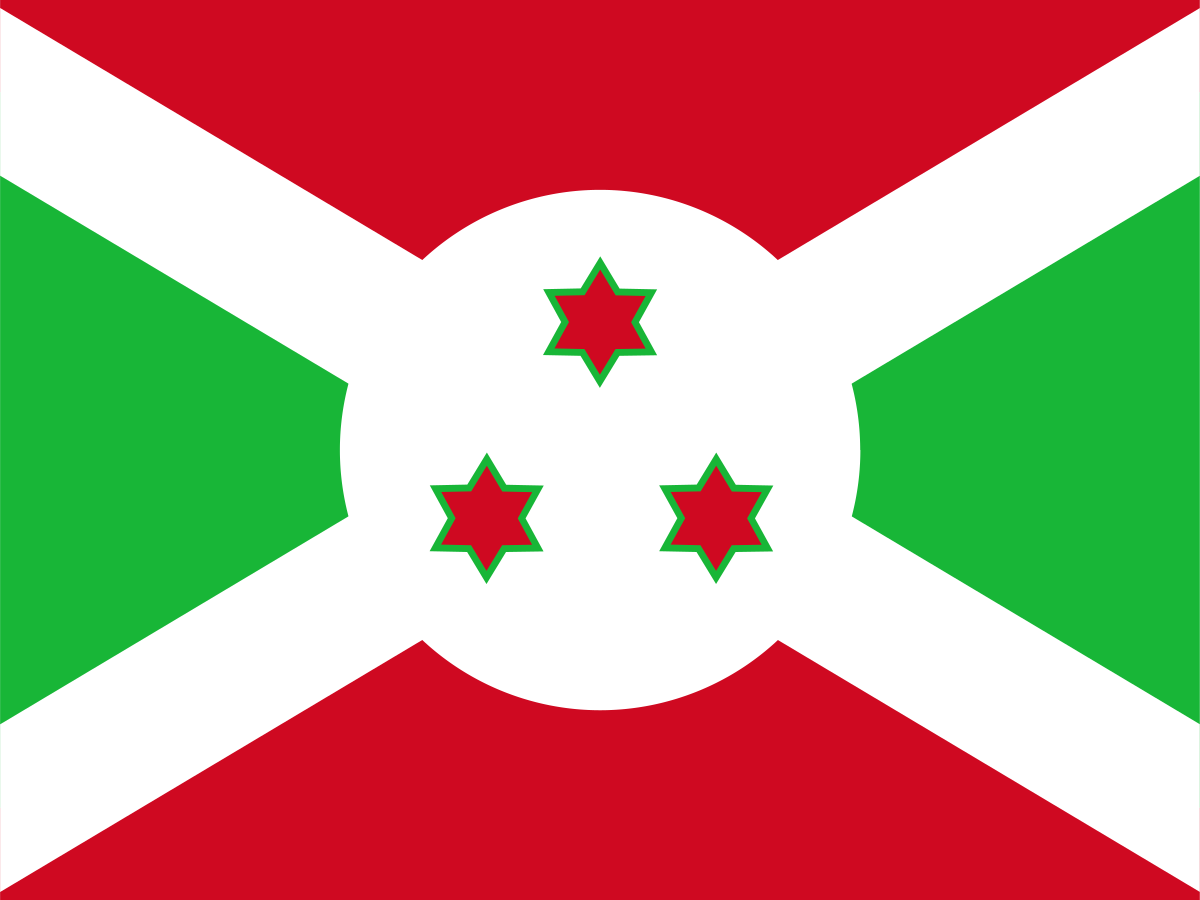
Burundi is a small, landlocked country in East Africa, famous for its highland landscape, Lake Tanganyika and distinctive flag. Its red, white and green design contains three red six-pointed stars, making it one of Africa's most recognisable national symbols.
Capital
Gitega
Continent
Africa
Population
12.0 million
Development indicators
GDP per capita
$230
USD per year (approx. 2023)
Human Development Index
0.426
Low development
World Bank income classification
Low Income (LIC)
LIC
🌡️ Climate: Tropical / Highland
Flag symbolism
Red represents the struggle for independence, white represents peace and green represents hope and the country's future. The three stars form a central symbol of national identity and unity.
stars
Did you know?
Burundi is one of the smallest and most densely populated countries in Africa.
Test your knowledge
Think you know your world flags? Try the FlagAtlas daily challenge, speed quiz, or explore all Africa flags.
📚 Revising for GCSE Geography? Visit our free revision page →
About Burundi
Burundi is a small, landlocked country in East Africa bordered by Rwanda, Tanzania and the Democratic Republic of the Congo. Its western edge reaches Lake Tanganyika, one of Africa's Great Lakes.
Gitega is the political capital, while Bujumbura remains the country's largest city and an important commercial centre on Lake Tanganyika. Burundi is one of Africa's most densely populated countries.
Political capitalGitega
Largest cityBujumbura
RegionEast Africa
PopulationAbout 13 million
Area27,834 km²
CurrencyBurundian franc
The flag of Burundi
Burundi's flag uses a white saltire to divide the design into red and green areas. At the centre is a white circular panel containing three red six-pointed stars arranged in a triangle.
The three stars are the most distinctive part of the flag.
They form a triangle and are commonly connected with Burundi's national motto and the country's people.
The current design was adopted after independence and has remained an important symbol of Burundi's national identity.
What do the colours on Burundi's flag mean?
Red is traditionally associated with the struggle for independence and the sacrifices made in achieving it. White represents peace, while green represents hope and the future.
The combination creates a flag that balances the country's difficult history with an emphasis on peace and hope.
What do the three stars mean?
Burundi's three red six-pointed stars are often explained through the national motto “Unity, Work, Progress”. The three words are represented by the three stars.
The stars are also commonly associated with the country's three main ethnic communities: Hutu, Tutsi and Twa. This interpretation is especially important because Burundi's modern history has been deeply affected by ethnic conflict.
Why are Burundi's stars six-pointed?
The stars on Burundi's flag are six-pointed rather than the more common five-pointed stars seen on many national flags. Their unusual shape helps make the flag immediately recognisable.
The stars sit inside a white circle at the centre of the saltire, creating a strong geometric design that is quite different from most other African flags.
A short history of Burundi
The region of modern Burundi was home to organised kingdoms before European colonial rule. The Kingdom of Burundi became an important political state in the Great Lakes region.
Germany established colonial control in the area in the late nineteenth century. After the First World War, Burundi became part of the Belgian-administered territory of Ruanda-Urundi.
Burundi gained independence from Belgium on 1 July 1962. The country subsequently experienced periods of military rule, political instability and severe ethnic violence.
The civil war that began in 1993 eventually ended through a lengthy peace process. Burundi remains a young democracy dealing with the legacy of decades of conflict.
Burundi's flag history
The national flag has changed as Burundi moved from monarchy and colonial rule to an independent republic.
Pre-colonial periodThe Kingdom of Burundi developed as an important Great Lakes state.
1890s — German ruleBurundi became part of German East Africa.
1916 onwards — Belgian administrationBelgian forces took control during the First World War and Burundi became part of Ruanda-Urundi.
1962 — independenceBurundi became independent from Belgium.
1966 — republicThe monarchy was abolished and Burundi became a republic.
1993 — civil warPolitical violence developed into a long and devastating civil conflict.
TodayThe three-star flag remains a central symbol of Burundi.
The Kingdom of Burundi
Before colonial rule, Burundi was organised around a monarchy with a long political tradition. The king, known as the mwami, stood at the centre of the kingdom's political system.
The kingdom's institutions, agricultural economy and social structures developed over many generations and continue to form an important part of Burundi's historical identity.
Lake Tanganyika
Lake Tanganyika forms part of Burundi's western border and is one of the world's deepest freshwater lakes. It is shared by Burundi, Tanzania, the Democratic Republic of the Congo and Zambia.
The lake is important for fishing, transport and tourism. Bujumbura sits on its northeastern shore and has long been Burundi's main commercial gateway.
Burundi's highlands
Much of Burundi is mountainous and elevated, earning it a reputation as a highland country. The higher elevations are cooler and can be very fertile.
Agriculture is central to the economy, with crops such as coffee, tea, bananas and beans grown in different parts of the country.
Coffee and tea
Coffee is one of Burundi's most important export crops. Arabica coffee is grown in the country's highland areas, where the climate and elevation can provide good growing conditions.
Tea is also cultivated in the highlands. Both crops provide income for rural communities and are important sources of foreign exchange.
Burundi's wildlife
Despite its small size and high population density, Burundi has important natural habitats. Protected areas include Kibira National Park, Ruvubu National Park and the Rusizi Nature Reserve.
Wildlife includes chimpanzees, hippos, crocodiles and many bird species. Conservation is challenging because pressure on land and natural resources is high.
Kibira National Park
Kibira National Park protects montane rainforest in northern Burundi. It forms part of a larger forest ecosystem extending towards Rwanda's Nyungwe landscape.
The forest provides habitat for primates and many bird species and is also important for protecting water sources and local ecosystems.
Gitega — Burundi's political capital
Gitega became Burundi's political capital in 2019, replacing Bujumbura as the seat of government. It lies in the central highlands and has long been associated with Burundi's traditional and cultural heritage.
Bujumbura remains the largest city and the country's main commercial centre, particularly because of its location beside Lake Tanganyika.
Burundian culture and languages
Kirundi is the national language and is spoken widely across Burundi. French is also used in government and education, while English has become increasingly important in regional and international relations.
Music, drumming, dance and storytelling are important parts of Burundian culture. Traditional drumming is particularly famous and is closely connected with the country's royal heritage.
The Royal Drummers of Burundi
Burundi's traditional drumming is one of its best-known cultural exports. The drummers perform complex rhythms using large traditional drums and have performed internationally for decades.
Historically, royal drummers performed at ceremonies connected with the mwami. Today, the tradition is an important symbol of Burundian culture and national identity.
Burundi's history of conflict
Burundi's post-independence history has been marked by repeated political violence between groups identified broadly as Hutu and Tutsi. These identities are complex and have been shaped by history, politics and colonial rule.
The assassination of President Melchior Ndadaye in 1993 triggered a devastating civil war. A long peace process eventually produced power-sharing arrangements and helped end the conflict.
Burundi today
Burundi is a presidential republic. The country faces major development challenges, including poverty, pressure on farmland, limited infrastructure and the long-term effects of political instability.
At the same time, Burundi has important agricultural resources, a distinctive cultural heritage and a strategic position within the Great Lakes region of Africa.
Why is Burundi's flag interesting?
Burundi's flag is a particularly good example of how a national flag can combine geometry and symbolism. The white saltire, central circle and three unusual six-pointed stars create a design that is instantly recognisable.
The three stars also connect the flag with ideas of unity, work and progress and with Burundi's complex social history, making the design much more meaningful than a simple colour pattern.
Explore Burundi on FlagAtlas
Continue exploring Burundi and the world's flags with these FlagAtlas resources.