Asia
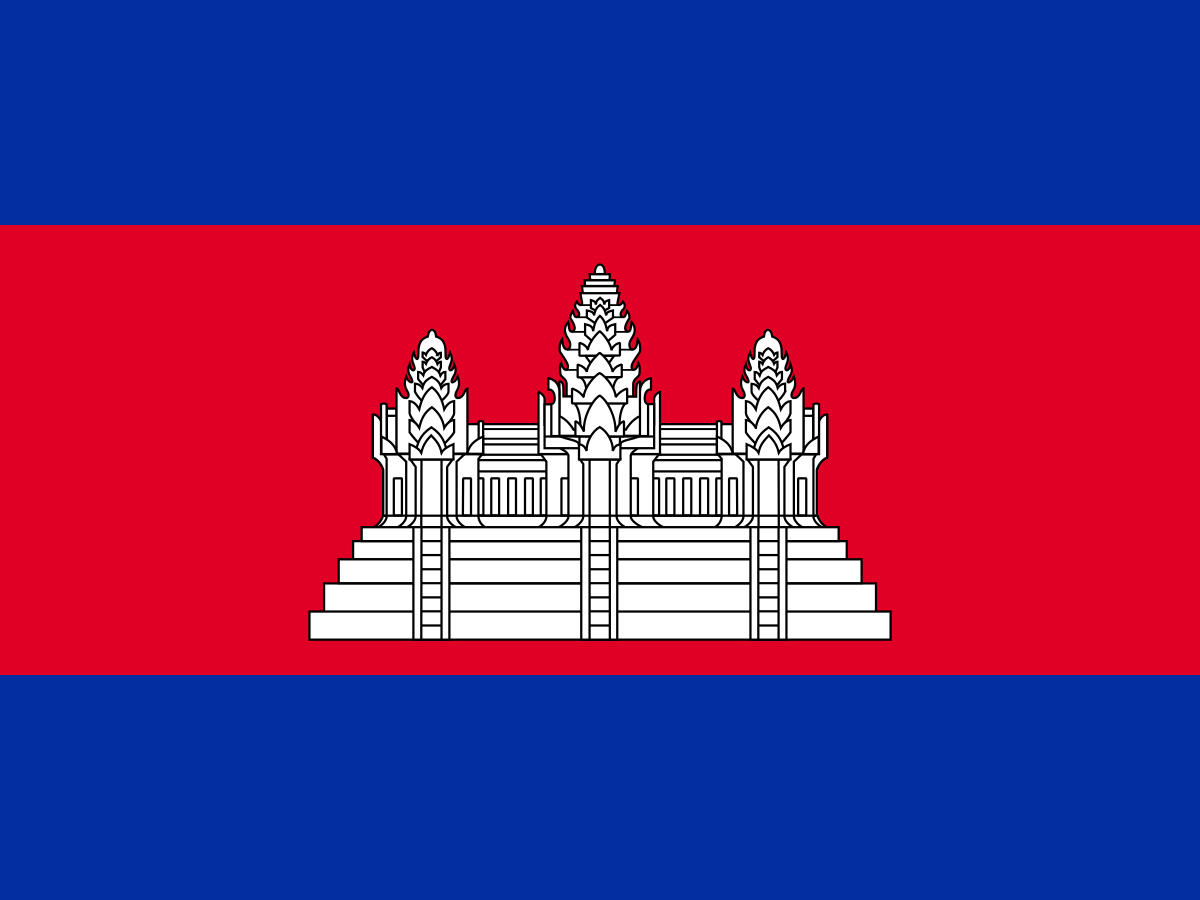
Cambodia Flag
Cambodia is a Southeast Asian country with a remarkable history shaped by the ancient Khmer Empire, French colonial rule and the devastating conflicts of the twentieth century. Its red, blue and white flag is instantly recognisable because it places Angkor Wat, one of the world’s most famous temples, at its centre.
Capital
Phnom Penh
Continent
Asia
Population
17.0 million
Development indicators
GDP per capita
$1,750
USD per year (approx. 2023)
Human Development Index
0.600
Medium development
World Bank income classification
Lower-Middle Income (LMIC)
LMIC
🌡️ Climate: Tropical
Flag symbolism
Blue is associated with the monarchy, red with the nation and its people, and white with religion. At the centre is Angkor Wat, representing Cambodia’s ancient Khmer civilisation and cultural heritage.
building
Did you know?
The Angkor Wat temple complex in Cambodia is the largest religious monument in the world.
Test your knowledge
Think you know your world flags? Try the FlagAtlas daily challenge, speed quiz, or explore all Asia flags.
📚 Revising for GCSE Geography? Visit our free revision page →
About Cambodia
Cambodia is a country in mainland Southeast Asia bordered by Thailand, Laos and Vietnam, with a coastline on the Gulf of Thailand. Phnom Penh is the capital and largest city.
The country is famous for the temples of Angkor, the Mekong River, Tonlé Sap lake and a rich Khmer cultural tradition. Modern Cambodia is a constitutional monarchy and a member of ASEAN.
CapitalPhnom Penh
RegionSoutheast Asia
PopulationAbout 17 million
Area181,035 km²
CurrencyCambodian riel
Official languageKhmer
The flag of Cambodia
Cambodia's flag has three horizontal bands: a blue band at the top, a wide red band in the centre and another blue band at the bottom. A white representation of Angkor Wat sits in the centre of the red band.
Cambodia's flag is unusual because it features a building.
Angkor Wat is one of the very few buildings to appear on a national flag and makes the Cambodian design immediately recognisable.
The current flag was restored in 1993 following the return of constitutional monarchy.
What do the colours on Cambodia's flag mean?
Blue is traditionally associated with the monarchy. Red represents the nation and its people, while white is associated with religion.
The colours are also strongly connected with Khmer national identity. Together with Angkor Wat, they create a design that links Cambodia's modern state with its ancient civilisation.
Why is Angkor Wat on the flag?
Angkor Wat is the most famous monument of the Khmer civilisation and one of the world's largest religious monuments. It was built during the height of the Khmer Empire and has become a powerful symbol of Cambodian culture.
The simplified temple shown on the flag represents the country's historical heritage and is so closely associated with Cambodia that it has become almost as recognisable as the flag itself.
Why does Cambodia have a building on its flag?
Most national flags use abstract shapes, stars, crosses, coats of arms or other symbols. Cambodia is unusual because its central image is an identifiable architectural monument.
The choice of Angkor Wat gives the flag a direct visual link to Cambodian history. It also reflects the importance of Khmer architecture and the country's Buddhist and Hindu heritage.
A short history of Cambodia
The Khmer civilisation developed into one of Southeast Asia's great empires. The Khmer Empire reached its height between roughly the ninth and fifteenth centuries and controlled large areas of mainland Southeast Asia.
Angkor became the centre of the empire and produced extraordinary temples and reservoirs. After the decline of Angkor, Cambodia remained an important kingdom but faced pressure from neighbouring powers.
France established a protectorate over Cambodia in 1863. Cambodia gained independence in 1953 under King Norodom Sihanouk.
The second half of the twentieth century was marked by war, the Khmer Rouge regime, genocide, Vietnamese intervention and civil conflict. Cambodia gradually returned to peace and constitutional monarchy in the 1990s.
Cambodia's flag history
The Cambodian flag has changed several times as the country moved through monarchy, colonial rule, republic, Khmer Rouge rule and modern constitutional government.
Khmer Empire — Angkor periodAngkor became the centre of a powerful Khmer civilisation whose temples still define Cambodia's national identity.
1863 — French protectorateFrance established a protectorate over Cambodia.
1953 — independenceCambodia regained full independence from France.
1975 — Khmer RougeThe Khmer Rouge took control and introduced a radically different national system and flag.
1979 — new governmentThe Khmer Rouge regime was overthrown and another flag was adopted.
1993 — constitutional monarchyThe monarchy was restored and the familiar Angkor Wat flag returned.
TodayThe blue, red and white Angkor Wat design remains Cambodia's national flag.
The Khmer Empire
The Khmer Empire was one of the most powerful states in medieval Southeast Asia. At its height, it controlled territory across much of modern Cambodia, Thailand, Laos and Vietnam.
Khmer rulers built enormous temples, roads, reservoirs and urban settlements. The architectural achievements of Angkor are among the most important surviving remains of the civilisation.
Angkor Wat
Angkor Wat was built in the early twelfth century under King Suryavarman II. It was originally dedicated to the Hindu god Vishnu and later became an important Buddhist temple.
The temple complex is a UNESCO World Heritage Site and is Cambodia's most famous tourist attraction. Its towers, galleries and bas-reliefs are represented in simplified form on the national flag.
Angkor and the temples of Cambodia
Angkor is much larger than Angkor Wat alone. The archaeological area contains numerous temples and other remains, including Bayon and Ta Prohm.
Bayon is famous for its large carved stone faces, while Ta Prohm is known for trees growing around and through parts of the temple ruins.
Phnom Penh — the capital
Phnom Penh sits where the Mekong, Tonlé Sap and Bassac rivers meet. It became Cambodia's capital in the nineteenth century and developed into the country's main political and economic centre.
Important landmarks include the Royal Palace, Silver Pagoda and National Museum. The city also contains memorial sites connected with Cambodia's twentieth-century history.
Tonlé Sap Lake
Tonlé Sap is the largest freshwater lake in Southeast Asia and one of Cambodia's most important natural resources. Its size changes dramatically with the seasons because of the annual reversal of the Tonlé Sap River.
The lake supports large fishing communities and provides food and livelihoods for millions of people directly or indirectly.
The Mekong River
The Mekong flows through Cambodia and is central to the country's agriculture, fisheries, transport and economy. Its seasonal flooding helps replenish farmland and wetlands.
The Mekong also supports an extraordinary range of aquatic wildlife. Cambodia is particularly important for conservation of the endangered Irrawaddy dolphin.
Khmer culture and language
The official language is Khmer, spoken by the great majority of the population. Khmer has its own distinctive script and is part of the Mon-Khmer language family.
Theravada Buddhism is the dominant religion. Traditional dance, music, sculpture, silk weaving and temple architecture remain important parts of Cambodian culture.
Apsara dance
Apsara dance is a traditional Cambodian classical dance form inspired by figures depicted in the temples of Angkor. Dancers wear elaborate costumes and use highly controlled hand and finger movements.
The tradition became an important symbol of Cambodian cultural revival after the devastation of the twentieth century.
The Khmer Rouge period
From 1975 to 1979, the Khmer Rouge led by Pol Pot controlled Cambodia. Their regime attempted to transform society through forced labour, mass displacement and radical political policies.
Approximately 1.5 to 2 million people died through execution, starvation, disease and overwork. The period remains one of the darkest chapters in Cambodia's history.
Cambodia's recovery
Following the fall of the Khmer Rouge, Cambodia experienced years of conflict before a wider peace settlement was reached. The Paris Peace Agreements of 1991 helped establish a framework for peace and political reconstruction.
UN-sponsored elections were held in 1993 and the constitutional monarchy was restored. Cambodia has since undergone rapid economic and urban development.
Cambodia today
Cambodia is a constitutional monarchy with a parliamentary system. Tourism, manufacturing, agriculture and construction are important parts of the economy.
The country continues to develop its infrastructure and education system while facing challenges including poverty, inequality, environmental pressure and the preservation of historic sites.
Why is Cambodia's flag interesting?
Cambodia's flag is one of the clearest examples of a national flag being used to tell a country's historical story. The colours represent national and cultural ideas, while Angkor Wat connects the modern country directly to the Khmer Empire.
It is also one of the world's rare national flags to feature a recognisable building, making it particularly useful for learning about flag symbolism.
Explore Cambodia on FlagAtlas
Continue exploring Cambodia and the world's flags with these FlagAtlas resources.