Africa
Cameroon Flag
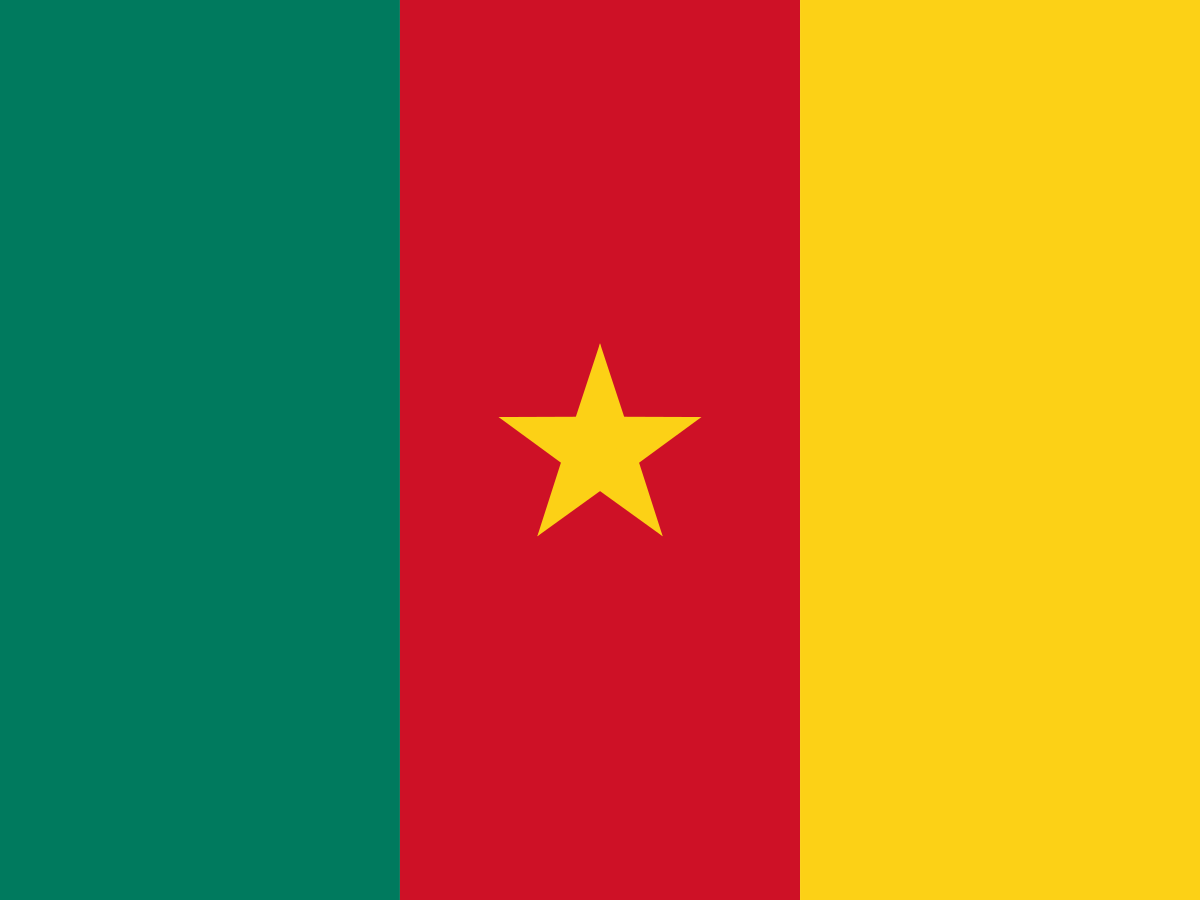
Cameroon is a diverse country in Central Africa, stretching from the Gulf of Guinea to the mountains and savannahs around Lake Chad. Its green, red and yellow flag uses Pan-African colours and a central golden star to represent national unity.
Capital
Yaoundé
Continent
Africa
Population
27.0 million
Development indicators
GDP per capita
$1,680
USD per year (approx. 2023)
Human Development Index
0.587
Medium development
World Bank income classification
Lower-Middle Income (LMIC)
LMIC
🌡️ Climate: Tropical / Savanna
Flag symbolism
Green represents the southern forests and hope, red represents unity and sovereignty, and yellow represents the northern savannahs and the sun. The central star is a symbol of national unity.
starpan-african
Did you know?
Cameroon is called 'Africa in miniature' because it has every climate and geographical zone found across the continent.
Test your knowledge
Think you know your world flags? Try the FlagAtlas daily challenge, speed quiz, or explore all Africa flags.
📚 Revising for GCSE Geography? Visit our free revision page →
About Cameroon
Cameroon is a country in Central Africa with a coastline on the Gulf of Guinea. It borders Nigeria, Chad, the Central African Republic, the Republic of the Congo, Gabon and Equatorial Guinea.
Yaoundé is the political capital, while Douala is the largest city and a major commercial port. Cameroon's landscape ranges from tropical rainforest and coastlines to mountains, grasslands and the dry Sahel in the far north.
CapitalYaoundé
Largest cityDouala
RegionCentral Africa
PopulationAbout 27 million
Area475,442 km²
CurrencyCFA franc
The flag of Cameroon
Cameroon's flag has three equal vertical bands of green, red and yellow. A large five-pointed yellow star sits in the centre of the red band.
Cameroon was one of the first countries to use the modern Pan-African colour combination.
The green, red and yellow design connects the country with a wider tradition of African national flags.
The current flag was adopted around independence and has remained the national flag of the modern republic.
What do the colours on Cameroon's flag mean?
Green is associated with the southern forests and hope. Red represents unity and sovereignty, while yellow is associated with the northern savannahs and the sun.
The three colours also form the familiar Pan-African palette used by many African countries, linking Cameroon with the wider history of African independence.
What does the star mean?
The central five-pointed yellow star represents unity. Its position in the middle of the red band makes it the main focal point of the flag.
The star is particularly significant in a country with many ethnic groups, languages and regional identities. The symbolism of unity reflects the idea of Cameroon as one national state.
Why is Cameroon called “Africa in miniature”?
Cameroon is sometimes called “Africa in miniature” because an unusually wide range of the continent's landscapes and climates can be found within its borders.
There are tropical forests in the south, volcanic mountains around the west, high plateaus, grasslands and increasingly dry savannah and Sahel landscapes towards the north.
A short history of Cameroon
The region has been home to many different peoples and kingdoms for centuries. European contact increased from the fifteenth century, followed by German colonial rule in the late nineteenth century.
After the First World War, the territory was divided between French and British administration. This history helps explain why Cameroon today has both French- and English-speaking regions.
French Cameroun became independent in 1960. Southern British Cameroons later joined the new federation, creating the Federal Republic of Cameroon in 1961.
The country became a unitary state in 1972 and later adopted a multi-party political system. Cameroon remains a republic with a complex colonial and linguistic heritage.
Cameroon's flag history
The modern flag developed during the period of independence and national unification.
1884 — German KamerunGermany established colonial control over the territory.
1919 — divisionAfter Germany's defeat in the First World War, the territory was divided into French and British-administered areas.
1960 — independenceFrench-administered Cameroon became independent and adopted a green, red and yellow flag.
1961 — reunificationSouthern British Cameroons joined the Republic of Cameroon in a federation.
1972 — unitary stateThe federation was replaced by a unitary republic.
TodayThe Pan-African tricolour with its central star remains the national flag.
German Cameroon
Germany established the colony of Kamerun in 1884. German rule introduced new administrative structures and expanded trade, plantations and infrastructure.
German colonial rule ended during the First World War. The territory was subsequently administered under League of Nations mandates by France and Britain.
French and British Cameroon
One of the most important features of Cameroon's modern history is its division between French and British administration after the First World War.
The French-administered territory was much larger, while Britain controlled smaller areas in the west. The two systems used different legal and educational traditions, helping create the bilingual character of modern Cameroon.
Yaoundé and Douala
Yaoundé is Cameroon's political capital and sits in the country's southern highlands. It is home to government institutions, universities and cultural organisations.
Douala is the country's largest city and principal commercial port. Its position on the Wouri estuary makes it a major centre for trade and industry.
Mount Cameroon
Mount Cameroon is one of Africa's highest mountains and an active volcano. It rises dramatically near the Gulf of Guinea close to the city of Buea.
The mountain's fertile volcanic soils support agriculture, while its forests contain important biodiversity. It is also a popular destination for hiking and outdoor activities.
Rainforests and wildlife
Southern and eastern Cameroon contain extensive tropical forests that form part of the Congo Basin ecosystem. These forests are home to gorillas, chimpanzees, forest elephants and many other species.
Protected areas such as Korup National Park and Dja Faunal Reserve play an important role in conservation. The Dja Reserve is recognised as a UNESCO World Heritage Site.
Cameroon's northern landscapes
The north of Cameroon is very different from the humid south. The landscape becomes progressively drier, with grasslands, savannah and Sahel conditions around Lake Chad.
This contrast is one reason the country is often described as a miniature version of the wider African continent.
Languages and culture
Cameroon is one of Africa's most linguistically diverse countries, with hundreds of local languages. French and English are the country's two official languages.
Cameroonian culture includes many musical, artistic and culinary traditions. Makossa and bikutsi are two internationally recognised musical styles associated with the country.
Football in Cameroon
Football is hugely popular in Cameroon. The men's national team, known as the Indomitable Lions, has won the Africa Cup of Nations multiple times.
Cameroon also made history at the 1990 FIFA World Cup by reaching the quarter-finals, becoming the first African team to reach that stage of the competition.
Agriculture and natural resources
Agriculture employs a large part of the population. Important products include cocoa, coffee, bananas, cotton, palm products and other food crops.
Cameroon also has petroleum, natural gas and other mineral resources. Balancing economic development with environmental protection remains an important challenge.
Cameroon today
Cameroon is a presidential republic and an important regional economy in Central Africa. Its location gives it connections to both the Gulf of Guinea and the countries of the interior.
The country continues to face challenges including regional inequality, infrastructure needs and political tensions. Its cultural and geographical diversity remains one of its defining characteristics.
Why is Cameroon's flag interesting?
Cameroon's flag looks simple, but its design connects several important themes: African independence, national unity, geography and the country's French and British colonial history.
The central star is especially useful for understanding the flag because it turns an otherwise simple Pan-African tricolour into a distinctive national symbol.
Explore Cameroon on FlagAtlas
Continue exploring Cameroon and the world's flags with these FlagAtlas resources.