Americas
Canada Flag
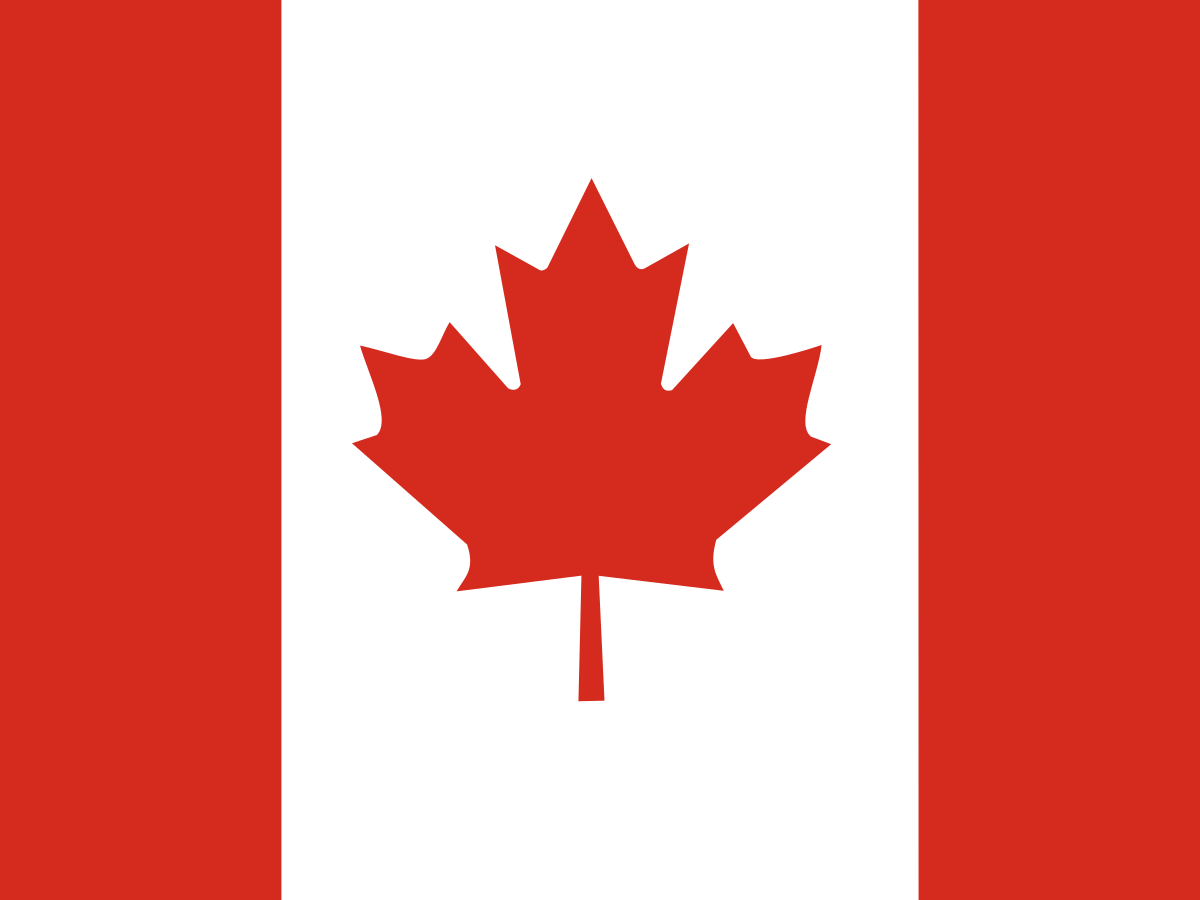
Canada is the second-largest country in the world by area, stretching from the Atlantic to the Pacific and north to the Arctic Ocean. Its distinctive red and white flag, adopted in 1965, features the eleven-pointed maple leaf that has become one of the world's best-known national symbols.
Capital
Ottawa
Continent
Americas
Population
38.0 million
Development indicators
GDP per capita
$53,800
USD per year (approx. 2023)
Human Development Index
0.935
Very High development
World Bank income classification
High Income (HIC)
HIC
🌡️ Climate: Subarctic / Temperate
Flag symbolism
Red and white are Canada's official colours. The central maple leaf is a long-standing Canadian symbol associated with the country's natural environment and national identity.
leaf
Did you know?
Canada has the world's longest coastline — over 202,000 km.
Test your knowledge
Think you know your world flags? Try the FlagAtlas daily challenge, speed quiz, or explore all Americas flags.
📚 Revising for GCSE Geography? Visit our free revision page →
About Canada
Canada occupies most of the northern part of North America and has coastlines on the Atlantic, Pacific and Arctic oceans. It shares the world's longest international land border with the United States.
Ottawa is the capital. Canada is a federal parliamentary democracy and constitutional monarchy, with ten provinces and three territories. English and French are the country's two official languages.
CapitalOttawa
RegionNorth America
PopulationAbout 40 million
Area9.98 million km²
CurrencyCanadian dollar
Official languagesEnglish & French
The flag of Canada
Canada's national flag is often called the Maple Leaf. It consists of two vertical red panels separated by a white square containing a stylised red maple leaf with eleven points.
The Maple Leaf flag was adopted on 15 February 1965.
Before 1965, Canada used the Canadian Red Ensign and other designs. The new flag created a distinctive national symbol that did not closely copy the flags of Britain or France.
15 February is now celebrated each year as National Flag of Canada Day.
What do the colours on Canada's flag mean?
Red and white are Canada's official colours. The two colours were formally recognised as Canada's national colours in 1921.
The maple leaf is not assigned a separate official colour symbolism in the flag specification, but the leaf has become a powerful symbol of Canada's natural environment, history and national identity.
Why is there a maple leaf on the Canadian flag?
The maple leaf has been associated with Canada for centuries. Maple trees are widespread across the country, and maple products became an important part of Canadian life and trade.
The maple leaf was used by French Canadians in the nineteenth century and later became a broader symbol of Canadian identity. It was already appearing on military badges and emblems before it became the centrepiece of the national flag.
Why does Canada's flag have 11 points on the leaf?
The maple leaf on the flag has eleven points. The number does not represent Canada's provinces and territories.
The leaf was carefully simplified during the flag design process so that it would remain clear when flying in strong wind. The eleven-point design is therefore primarily a graphic solution rather than a coded list of Canadian regions.
A short history of Canada
Indigenous peoples have lived across the lands of present-day Canada for thousands of years, developing many distinct nations, languages and cultures.
French and British colonisation followed European exploration. New France developed around the St. Lawrence River and Great Lakes, while Britain gradually expanded its influence.
The Confederation of Canada took place in 1867, when Ontario, Quebec, Nova Scotia and New Brunswick joined to create the Dominion of Canada. Other provinces and territories joined over time.
Canada gradually became more politically independent from Britain. The Constitution was patriated in 1982, including the Canadian Charter of Rights and Freedoms.
Canada's flag history
The current flag is the result of a long debate over how Canada should represent itself as an increasingly independent country.
1700s–1800s — maple leaf symbolThe maple leaf became increasingly associated with French Canadian and later Canadian identity.
1867 — ConfederationThe Dominion of Canada was created by Confederation.
1921 — national coloursRed and white were formally proclaimed Canada's national colours.
1964 — Great Flag DebateParliament debated competing designs for a distinct Canadian flag.
1965 — Maple Leaf adoptedThe new flag was inaugurated on 15 February 1965.
TodayThe Maple Leaf is one of Canada's most recognisable national symbols.
The Great Canadian Flag Debate
In the early 1960s, Prime Minister Lester B. Pearson wanted Canada to adopt a distinctive flag rather than relying on designs strongly connected with Britain's Union Flag.
A parliamentary committee considered many proposals. The final design, based on a red-and-white flag with a maple leaf, was approved by Parliament in December 1964 and proclaimed by Queen Elizabeth II in January 1965.
The flag was inaugurated on 15 February 1965 on Parliament Hill in Ottawa.
The Canadian Red Ensign
Before the Maple Leaf flag, the Canadian Red Ensign was widely used as an unofficial Canadian symbol. It combined a red field with the Union Flag in the canton and a Canadian shield or coat of arms.
Its history helps explain why the creation of a separate Maple Leaf design was significant: Canada wanted a flag that represented the country itself rather than its historical ties to Britain.
Indigenous peoples of Canada
Canada is home to many Indigenous peoples, including First Nations, Inuit and Métis communities. Their histories and cultures predate the arrival of European settlers by thousands of years.
Indigenous languages, art, traditions and relationships with the land are important parts of Canada's identity. Modern Canada continues to address the legacy of colonial policies and residential schools.
Ottawa — Canada's capital
Ottawa is located in Ontario on the Ottawa River, close to the border with Quebec. It became Canada's capital in the nineteenth century and is the centre of the federal government.
Parliament Hill is one of Canada's most recognisable landmarks. It was also the setting for the inauguration of the Maple Leaf flag in 1965.
The Canadian provinces and territories
Canada has 10 provinces and 3 territories. The provinces have constitutional powers of their own, while the territories exercise powers delegated by the federal government.
The three territories are Yukon, the Northwest Territories and Nunavut. Nunavut was created in 1999 and is Canada's newest territory.
The Rocky Mountains
The Canadian Rockies form part of the great mountain system of western North America. They contain some of Canada's most spectacular landscapes, including Banff and Jasper national parks.
Mountain environments support glaciers, forests and alpine wildlife. Tourism is a major part of the economy in the Rocky Mountain region.
Canada's forests and wildlife
Canada contains enormous areas of boreal forest, one of the world's largest terrestrial ecosystems. The country is home to species such as moose, beavers, black bears, grizzly bears, wolves and caribou.
Canada's northern regions also provide important habitat for polar bears. Protecting forests, wetlands and Arctic ecosystems is a major conservation priority.
Maple syrup and the maple tree
Maple syrup is strongly associated with Canadian culture, especially in Quebec and eastern Canada. In spring, sap is collected from sugar maple and other maple trees and concentrated into syrup.
The maple leaf on the flag should not be confused with a specific provincial emblem: it represents Canada as a whole and has become a national symbol.
English and French Canada
Canada's two official languages reflect the country's history. French remains especially prominent in Quebec, while English is the majority language in most other provinces and territories.
New Brunswick is officially bilingual at the provincial level. Canada's bilingual identity is also reflected in federal institutions and national public services.
Canada today
Canada has a highly developed economy based on services, manufacturing, natural resources, technology and international trade. It is a member of the G7, G20, NATO and the United Nations.
The country faces challenges including housing affordability, regional inequality, climate change, Indigenous reconciliation and the high cost of providing services across an enormous geographic area.
Why is Canada's flag interesting?
Canada's flag looks simple, but its story is tied to one of the country's biggest questions: how could Canada express a distinct national identity while remaining connected to its British and French heritage?
The result is a highly recognisable design with no coat of arms, no Union Flag and no provincial symbols — just red, white and the maple leaf.
Explore Canada on FlagAtlas
Continue exploring Canada and the world's flags with these FlagAtlas resources.