About the Central African Republic
The Central African Republic (CAR) is a landlocked country in Central Africa bordered by Chad, Sudan, South Sudan, the Democratic Republic of the Congo, the Republic of the Congo and Cameroon.
Bangui is the capital and largest city. Much of the country is covered by savannah, woodland and tropical forest, while the Ubangi River forms part of its southern geography.
CapitalBangui
RegionCentral Africa
PopulationAbout 5.0 million
Area622,984 km²
CurrencyCFA franc
Official languagesFrench & Sango
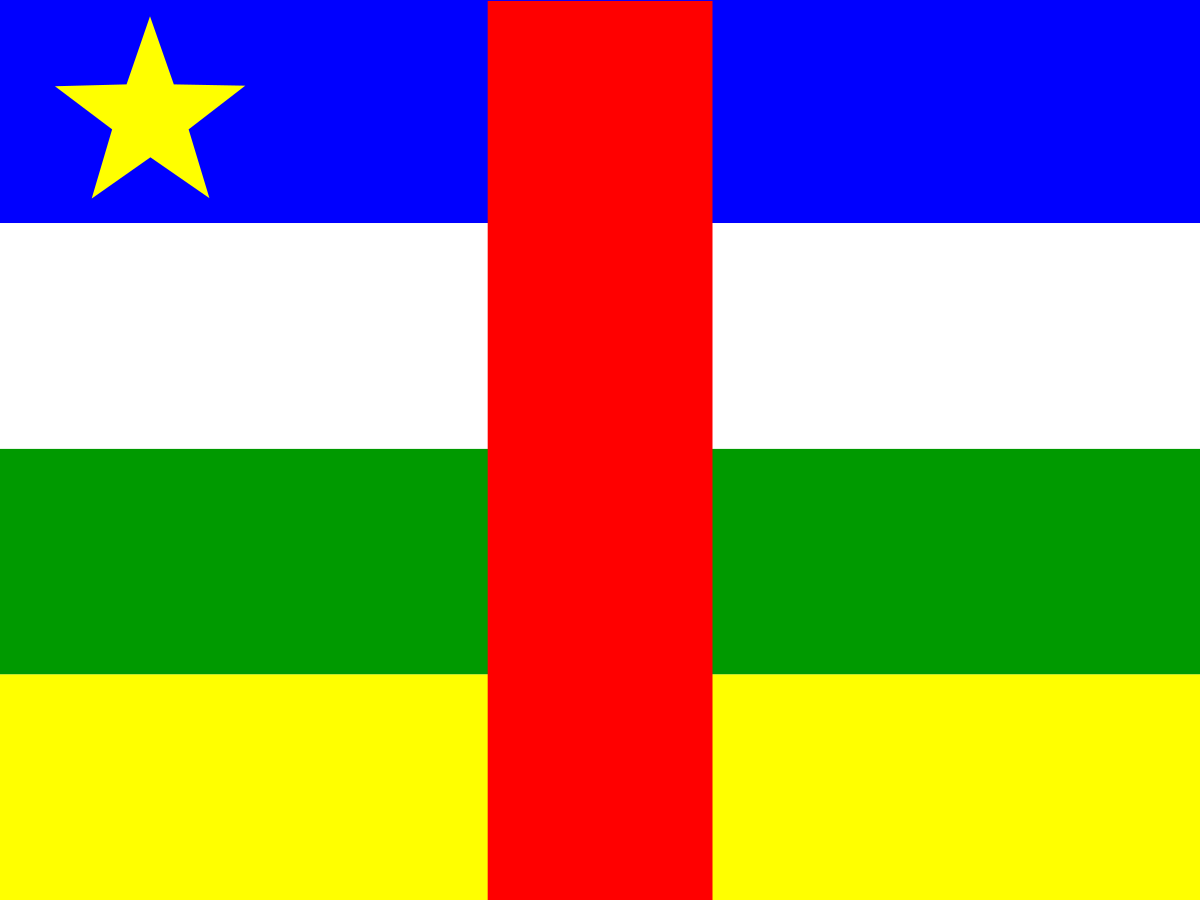
The flag of the Central African Republic
The flag has four horizontal bands of blue, white, green and yellow. A vertical red stripe runs through the centre, crossing all four bands. A yellow five-pointed star appears in the upper hoist corner.
The design was intended to unite African and European influences.
The colours combine the Pan-African colours of green, yellow and red with blue and white, traditionally associated with France and the country's colonial history.
The flag was adopted in 1958, before the country became fully independent in 1960.
What do the colours on the flag mean?
Blue represents the sky, freedom and the southern rivers. White represents peace and dignity. Green represents the country's forests and hope, while yellow represents the savannah, sunlight and the country's future.
The red vertical stripe represents the blood of humanity and the sacrifices and unity shared by the country's people. Because it crosses all the other colours, it is also a powerful visual symbol of unity.
What does the star mean?
The yellow star represents the country's future, national dignity and the hope of a united Central African Republic.
Its position at the upper hoist makes it the flag's main individual symbol, while the central red stripe creates a visual connection between the star and the rest of the design.
Why does the flag have a red stripe through the middle?
The vertical red stripe is one of the most unusual features of the CAR flag. Rather than dividing the flag into separate regions, it crosses every horizontal colour.
This design reflects the idea of unity and shared sacrifice. It also gives the flag a distinctive appearance compared with many other African national flags.
A short history of the Central African Republic
The territory has long been home to diverse peoples and trading communities. European colonial expansion increased during the late nineteenth century, and France established control over the territory that became Ubangi-Shari.
Under French rule, the territory was part of French Equatorial Africa. The road to independence gathered pace after the Second World War.
Ubangi-Shari became an autonomous republic in the French Community in 1958 and became fully independent on 13 August 1960. David Dacko became the country's first president.
Independence was followed by periods of military rule, political instability, rebellions and conflict. The CAR has continued to face serious political and security challenges in the twenty-first century.
Flag history timeline
Late 1800s — French expansionFrance established colonial control over the territory that became Ubangi-Shari.
1958 — flag adoptedThe present four-colour design with its central red stripe and yellow star was adopted.
1960 — independenceThe Central African Republic became independent from France.
1976–1979 — Central African EmpireThe country was transformed into an empire under Jean-Bédel Bokassa. The imperial period used a modified version of the national symbolism.
1979 — republic restoredThe empire ended and the republic and its national flag were restored.
TodayThe distinctive four-colour flag remains the national symbol of the CAR.
The Central African Empire
Between 1976 and 1979, President Jean-Bédel Bokassa declared himself emperor and renamed the country the Central African Empire.
The imperial regime was authoritarian and highly controversial. It ended after French-backed intervention in 1979, when the country returned to being a republic.
This brief imperial period makes the CAR unusual among modern African states and is an important part of understanding its twentieth-century history.
Bangui — the capital
Bangui sits on the Ubangi River in the south-west of the country, close to the border with the Democratic Republic of the Congo. It is the political, commercial and cultural centre of the CAR.
The city developed during the French colonial period and remains home to the country's government, universities, markets and major institutions.
The Ubangi River
The Ubangi River is one of the most important waterways in the southern CAR. It forms part of the international boundary with the Democratic Republic of the Congo.
The river connects the capital with the wider Congo River system and has historically been important for transport, trade and fishing.
Forests, savannah and wildlife
The CAR contains a mixture of tropical forest, woodland and savannah. Its southern forests form part of the wider Congo Basin ecosystem, one of the most important tropical forest regions on Earth.
Wildlife includes forest elephants, gorillas, chimpanzees, buffalo and numerous bird species. Protected areas such as Dzanga-Sangha are internationally important for conservation.
Dzanga-Sangha
The Dzanga-Sangha protected area in south-western CAR is part of a wider forest conservation landscape shared with Cameroon and the Republic of the Congo.
It is particularly famous for forest elephants and western lowland gorillas and forms part of a UNESCO World Heritage Site known as the Sangha Trinational.
Diamonds and natural resources
The Central African Republic has deposits of diamonds, gold, uranium and other natural resources. Diamonds have historically been one of its best-known exports.
Resource wealth has not translated into widespread prosperity, however. Informal mining, limited infrastructure and conflict have made it difficult for the country to fully benefit from its natural resources.
Languages and culture
Sango is the national language and is widely used as a lingua franca across the country. French is also an official language and is important in government, education and administration.
The CAR is culturally diverse, with many ethnic communities, languages, musical traditions and forms of craft. Community life and oral traditions remain important parts of the country's cultural heritage.
Music and traditional culture
Music, dance and storytelling are important throughout the Central African Republic. Traditional instruments include drums and stringed instruments, while songs often accompany ceremonies and community events.
The country's cultural diversity means there is no single tradition that represents every community. Instead, Central African culture is made up of many regional and ethnic traditions.
Climate and geography
The CAR has a generally tropical climate, becoming wetter in the south and more seasonal towards the north. A large part of the country consists of savannah and woodland.
Rainfall is particularly important for farming. Climate variability can affect food production and water availability, especially in areas already facing infrastructure and security challenges.
Agriculture and rural life
Agriculture is the main livelihood for much of the population. Important crops include cassava, maize, millet, sorghum, bananas and groundnuts, while cotton and coffee have been important cash crops.
Most farming is small-scale and depends heavily on rainfall. Improving roads, markets and agricultural infrastructure is an important part of the country's development.
The Central African Republic today
The CAR is a presidential republic and one of the world's least-developed economies. The country has experienced repeated conflict and displacement, particularly since renewed fighting in the early 2000s.
International peacekeeping and humanitarian organisations have played major roles in supporting communities and maintaining security. Despite these challenges, the country has significant natural resources, biodiversity and cultural heritage.
Why is the Central African Republic's flag interesting?
The CAR flag is a particularly good example of a flag designed to communicate several ideas at once. Its colours represent different aspects of the country, while the central red stripe physically connects them.
It also reflects the country's position between African and European historical influences. The result is a flag with a distinctive design and a strong connection to the country's history of independence.
Explore the Central African Republic on FlagAtlas
Continue exploring the CAR and the world's flags with these FlagAtlas resources.