About Chad
Chad is a large landlocked country in north-central Africa. It stretches from the Sahara Desert in the north through the Sahel to more fertile savannah regions in the south. The country's name comes from Lake Chad, one of the most important bodies of water in the region.
N'Djamena is the capital and largest city. Chad shares borders with Libya, Sudan, the Central African Republic, Cameroon, Nigeria and Niger, placing it at an important crossroads between North and Central Africa.
CapitalN'Djamena
RegionCentral / North Africa
PopulationAbout 17 million
Area1,284,000 km²
CurrencyCFA franc
Official languagesFrench & Arabic
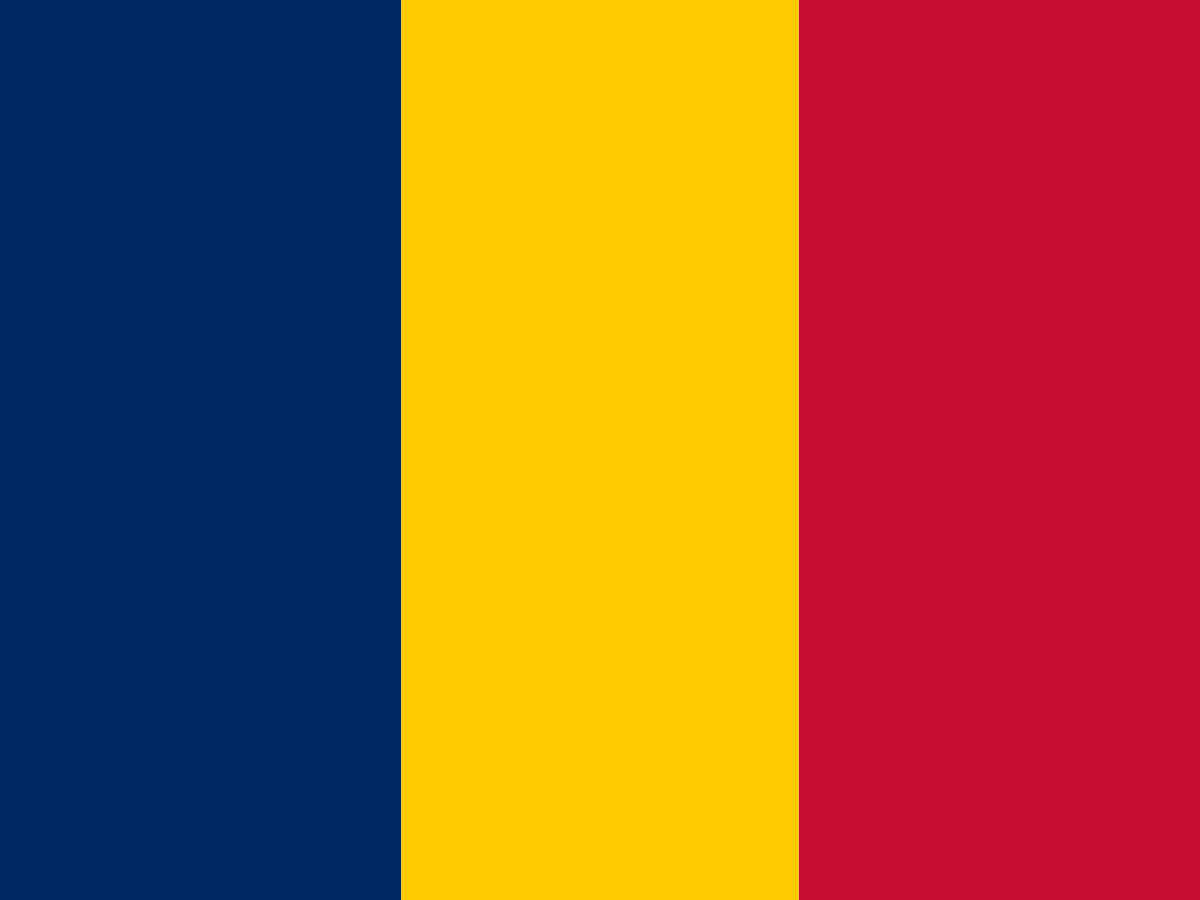
The flag of Chad
Chad's flag has three equal vertical bands of blue, yellow and red. It is one of the simplest national flag designs, but the colours have strong geographical and historical associations.
Chad's flag is famously similar to Romania's.
The two flags use the same basic blue-yellow-red vertical tricolour. The main practical distinction is the shade of blue used in each design.
The current flag dates from the period when Chad became independent from France in 1960.
What do the colours on Chad's flag mean?
Blue represents the sky, hope and the waters of the south. Yellow represents the sun and the dry northern landscapes, including the Sahara. Red represents the blood shed in the struggle for independence and the determination of the people.
Together the colours also reflect the country's contrasting landscapes, from the dry north to the greener south.
Why is Chad's flag almost identical to Romania's?
Chad and Romania both use a vertical blue-yellow-red tricolour. The similarity is striking because the two countries developed their modern flags through very different histories.
The colours have different historical meanings in each country, and the shades of blue are not officially identical. In practice, however, flags made for display can look extremely similar, especially from a distance.
Chad adopted its flag around independence in 1960. Romania's modern tricolour has a much longer European history, with its blue-yellow-red design associated with the Romanian national movement during the nineteenth century.
Chad and Romania: a quick comparison
ChadBlue · Yellow · Red
RomaniaBlue · Yellow · Red
LayoutBoth vertical
Chad blueDarker / deeper
Romania blueLighter / cobalt
MeaningDifferent histories
A short history of Chad
The region has a long history of powerful kingdoms and trading states. The Kanem-Bornu Empire developed around the Lake Chad basin and became one of the major political powers of the central Sahel.
Other important states and communities developed across the area, including the Bagirmi and Wadai kingdoms. Trans-Saharan trade connected the region with North Africa and the wider Islamic world.
France established colonial control over the territory in the late nineteenth and early twentieth centuries. Chad became an overseas territory within French Equatorial Africa before gaining autonomy and then independence.
Chad became independent on 11 August 1960. François Tombalbaye became the country's first president.
Chad's flag history
The modern flag emerged during the transition from French colonial rule to independence.
Pre-colonial eraPowerful kingdoms developed around Lake Chad and across the Sahel.
Late 1800s–early 1900sFrance expanded control over the territory and incorporated it into French Equatorial Africa.
1958 — autonomyChad became an autonomous republic within the French Community.
1960 — independenceChad became independent and adopted the blue, yellow and red tricolour.
1970s–1980sCivil war and regional conflict brought major political and military upheaval.
TodayThe tricolour remains the national flag of Chad.
The Kanem-Bornu Empire
The Kanem-Bornu Empire was one of the longest-lasting political states in African history. It developed around Lake Chad and existed in different forms for many centuries.
Its rulers controlled important trade routes across the central Sahara and Sahel. Islam became influential among the ruling elite and helped connect the empire with North African and wider Islamic networks.
Lake Chad
Lake Chad is a shallow freshwater lake at the meeting point of Chad, Cameroon, Nigeria and Niger. Its size changes considerably depending on rainfall and river flows.
The lake is vital for fishing, farming, livestock and local communities. It is also an important wetland habitat for birds and other wildlife.
Declining water availability and climate variability have made the Lake Chad basin an important environmental and humanitarian concern.
The Sahara Desert
Northern Chad lies largely within the Sahara, the world's largest hot desert. The landscape includes vast areas of sand, rock, mountains and dry valleys.
The Tibesti Mountains rise dramatically in the far north. Emi Koussi, a volcanic massif in the Tibesti, is the highest point in Chad and one of the highest mountains in the Sahara.
The Sahel
Between the Sahara and the wetter regions of southern Chad lies the Sahel, a broad semi-arid belt that crosses Africa from west to east.
Rainfall is seasonal and unpredictable. Communities often depend on a mixture of farming and livestock, making drought and changing rainfall patterns especially important.
N'Djamena — the capital
N'Djamena lies in the south-west of Chad near the Chari River, close to the border with Cameroon. It is the country's political, economic and administrative centre.
The city grew during the colonial period and was originally known as Fort-Lamy. It was renamed N'Djamena after independence.
The Chari and Logone rivers
The Chari and Logone rivers are among Chad's most important waterways. They flow northwards towards Lake Chad and provide water for communities, agriculture and ecosystems.
The rivers are particularly important because much of Chad is extremely dry. Southern river systems therefore support a much higher concentration of population and farming.
Languages and culture
Chad is extremely diverse, with more than a hundred languages spoken across the country. French and Arabic are official languages, while Chadian Arabic and many African languages are widely used in daily life.
The country contains Muslim, Christian and traditional religious communities. Music, dance, storytelling, crafts and colourful clothing vary considerably between regions and ethnic groups.
Wildlife and Zakouma
Chad's southern and central regions support important wildlife populations. Zakouma National Park is particularly famous for its elephants, buffalo, lions and other large mammals.
Conservation efforts have helped some wildlife populations recover after years of severe poaching. Chad's protected areas are important for both biodiversity and tourism.
Oil and natural resources
Oil became an important part of Chad's economy after major production began in the early twenty-first century. The country also has deposits of gold, uranium and other minerals.
Oil revenues have provided government income but have not removed the country's wider development challenges. Infrastructure, education, healthcare and poverty remain major issues.
Agriculture and rural life
A large proportion of Chad's population depends on agriculture and livestock. Important crops include millet, sorghum, maize, groundnuts and cotton.
The north is mainly pastoral because of its arid climate, while farming becomes more important towards the wetter south. Rainfall and access to water have a major influence on rural livelihoods.
Chad today
Chad is a presidential republic with a population spread unevenly across a very large territory. Most people live in the wetter southern regions, while the Sahara occupies much of the north.
The country faces significant challenges including poverty, food insecurity, displacement, climate pressure and political instability. Its location also means that developments in neighbouring countries can have a major impact on Chad.
Why is Chad's flag interesting?
Chad's flag demonstrates how a very simple design can become a surprisingly interesting historical subject. The three colours connect to geography and independence, while the almost identical Romanian flag creates one of the world's best-known flag comparisons.
It is also a useful starting point for learning about the Sahara, the Sahel, Lake Chad and the long history of kingdoms and trade across Central Africa.
Explore Chad on FlagAtlas
Continue exploring Chad and the world's flags with these FlagAtlas resources.