About Chile
Chile is a long, narrow country on the western edge of South America, stretching between the Andes Mountains and the Pacific Ocean. It is famous for its extraordinary range of landscapes, from the Atacama Desert in the north to Patagonia and the sub-Antarctic south.
Santiago is the capital and largest city. Chile shares borders with Peru, Bolivia and Argentina, while the Pacific Ocean forms its western coastline.
CapitalSantiago
RegionSouth America
PopulationAbout 19.5 million
Area756,102 km²
CurrencyChilean peso
Official languageSpanish
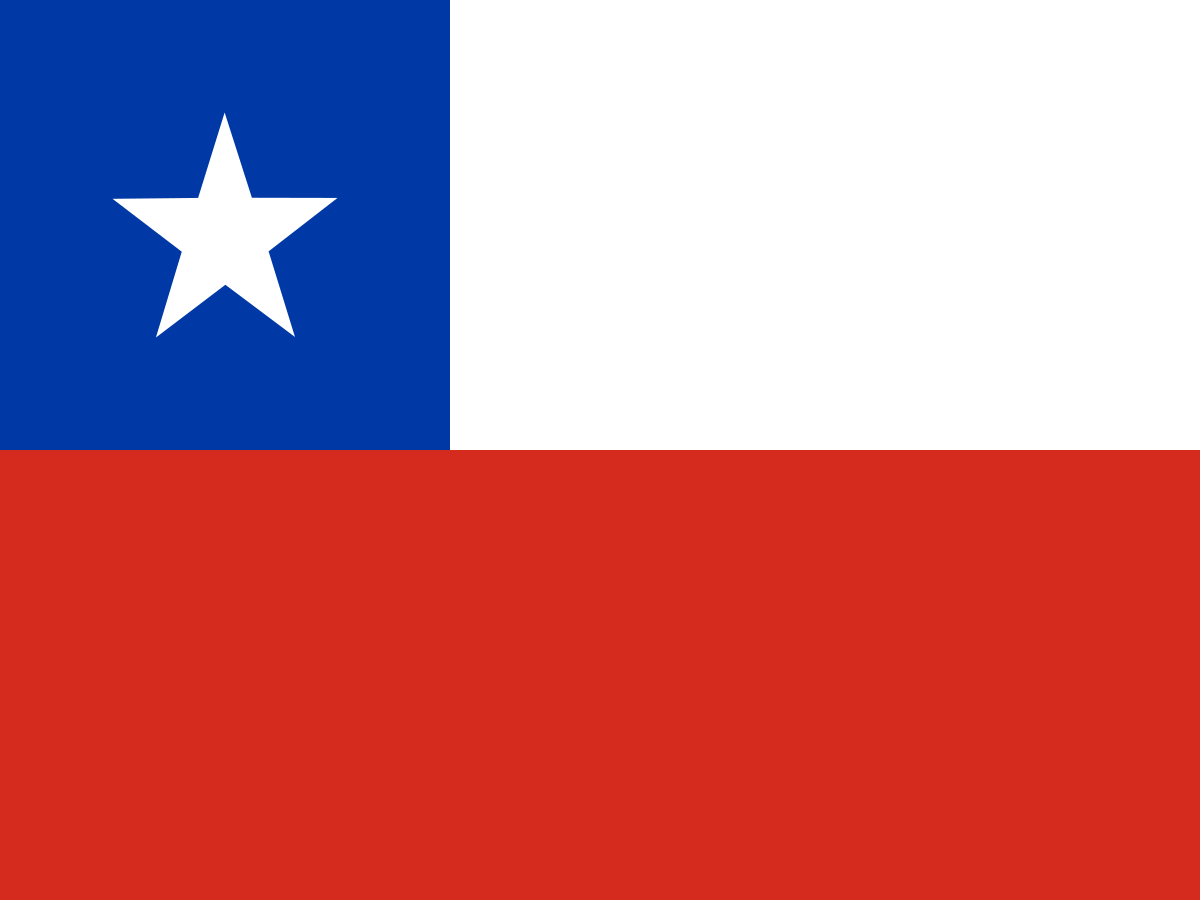
The flag of Chile
Chile's national flag has two horizontal sections. The lower half is red, while the upper half is white with a blue square at the hoist containing a single white five-pointed star.
The Chilean flag is often called "La Estrella Solitaria" — the Lone Star.
The star is one of the flag's most recognisable features and has become an important symbol of Chilean national identity.
The current flag was officially adopted on 18 October 1817, during the period when Chile was establishing itself as an independent republic.
What do the colours on Chile's flag mean?
Blue represents the sky and the Pacific Ocean. White is traditionally associated with the snow-covered Andes Mountains. Red represents the blood shed during the struggle for independence.
These meanings connect the flag directly to Chile's geography and the country's fight to establish independence from Spanish rule.
What does the star on Chile's flag mean?
The white star is often described as representing honour, progress and the guiding light of the nation. It is sometimes associated with the idea of a single united republic.
The star also has a strong geographical association: Chile is a Pacific-facing country, and the flag's blue canton places the star against a representation of the sky and ocean.
Why does Chile have only one star?
Unlike countries whose flags use multiple stars to represent states, provinces or islands, Chile's flag has a single prominent star.
The lone star fits the idea of a single national republic. It is therefore not a count of Chile's regions or administrative divisions.
Chile's independence
Chile's independence developed through a long period of conflict beginning in the early nineteenth century. The process is generally associated with the Chile War of Independence, fought between forces supporting independence and those loyal to the Spanish monarchy.
Chile declared independence in 1818, although fighting continued for several years. Bernardo O'Higgins became one of the most important leaders of the independence movement.
Chile celebrates its national independence during the September national holidays, especially 18 September, known as Fiestas Patrias.
Flag history timeline
1810 — independence movement beginsThe Chilean independence process began after political upheaval in Spain and the wider Spanish Empire.
1812 — early Chilean flagChile used an earlier blue, white and yellow design during the first period of independence.
1817 — current design establishedThe present blue, white and red design was introduced during the independence period.
1818 — independence declaredChile formally declared independence from Spain.
Late 1800s — national symbolThe flag became firmly established as a symbol of the Chilean republic.
TodayThe Lone Star flag is one of South America's best-known national flags.
The Atacama Desert
Northern Chile contains the Atacama Desert, one of the driest places on Earth. Some parts receive extremely little rainfall because of the region's geography and atmospheric conditions.
The desert contains salt flats, volcanoes, high-altitude lagoons and striking rock formations. It is also an important location for astronomy because of its dry, clear skies.
The Andes Mountains
The Andes form Chile's eastern border with Argentina and Bolivia and dominate much of the country's landscape. The range contains numerous volcanoes, glaciers and high mountain peaks.
Ojos del Salado, on the Chile-Argentina border, is the world's highest active volcano and one of the highest mountains in the Americas.
Chile's extraordinary geography
Chile stretches for roughly 4,300 kilometres from north to south while being relatively narrow from east to west. This gives the country an unusually wide variety of climates and ecosystems.
Visitors can travel from one of the world's driest deserts through Mediterranean valleys and temperate forests to the glaciers and fjords of Patagonia.
Santiago — the capital
Santiago lies in central Chile in a valley surrounded by mountains. It is the country's political, financial and cultural centre and contains a large proportion of the national population.
The city is home to government buildings, universities, museums and historic districts. The Andes can be seen from many parts of Santiago on clear days.
Patagonia and the far south
Southern Chile contains some of the country's most dramatic landscapes, including glaciers, mountains, forests, fjords and windswept plains.
Torres del Paine National Park is one of Chile's best-known protected areas, famous for its granite towers, lakes and mountain scenery.
Easter Island and Rapa Nui
Chile also includes Rapa Nui (Easter Island), a remote Polynesian island in the Pacific Ocean. It is famous for its monumental stone statues, known as moai.
Rapa Nui has a distinctive Polynesian culture and history. The island and its archaeological sites are protected as a UNESCO World Heritage Site.
Chile's wine industry
Chile has become one of the world's important wine-producing countries. Mediterranean-style climates in central Chile are particularly suitable for growing grapes.
Well-known wine regions include the Maipo, Colchagua and Casablanca valleys. Chile's geography, including its natural barriers of mountains and ocean, has helped protect vineyards from some pests and diseases.
Mining and copper
Mining is extremely important to Chile's economy. The country is the world's leading producer of copper, a metal used extensively in electrical equipment, construction and renewable-energy technologies.
Chile also has significant lithium resources, making the country increasingly important to global supply chains for batteries and electric vehicles.
Climate and natural hazards
Chile experiences many different climates because of its enormous north-south length. The north is extremely dry, central Chile has a Mediterranean climate, and the south is cooler and much wetter.
Chile lies on the Pacific Ring of Fire and is highly exposed to earthquakes and volcanic activity. The country's long coastline also means some areas are vulnerable to tsunamis following major undersea earthquakes.
Chilean culture and Fiestas Patrias
Chile's national celebrations take place every September. Fiestas Patrias features traditional music, dancing, food, rodeo events and gatherings with family and friends.
The cueca is Chile's national dance and is especially prominent during the September celebrations. The national flag is widely displayed throughout the country during this period.
Football in Chile
Football is one of Chile's most popular sports. The men's national team is known as La Roja and has won the Copa América twice, in 2015 and 2016.
Chile's football culture is another reason the national colours and flag are highly visible during major international tournaments.
Chile today
Chile is one of Latin America's more developed economies and has relatively strong institutions compared with many countries in the region. Its economy includes mining, agriculture, manufacturing, services and tourism.
The country also faces challenges including inequality, housing costs, water stress, environmental pressures and the effects of earthquakes and climate change.
Why is Chile's flag interesting?
Chile's flag looks simple, but almost every part of it can be connected to the country's story. The blue reflects the Pacific and sky, white evokes the Andes, red recalls the struggle for independence and the lone star represents national identity and aspiration.
Its design also fits Chile's unusual geography: a narrow Pacific country backed by one of the world's great mountain ranges.
Explore Chile on FlagAtlas
Continue exploring Chile and the world's flags with these FlagAtlas resources.