About China
China is one of the world's largest countries and one of its oldest continuous civilisations. It stretches from the Pacific coast across mountains, deserts, grasslands and river valleys to the borders of Central and South Asia.
Beijing is the capital. China has a population of more than a billion people and contains enormous regional differences in climate, landscape, language, food and culture.
CapitalBeijing
RegionEast Asia
PopulationAbout 1.4 billion
Area9.6 million km²
CurrencyRenminbi (yuan)
Official languageMandarin Chinese
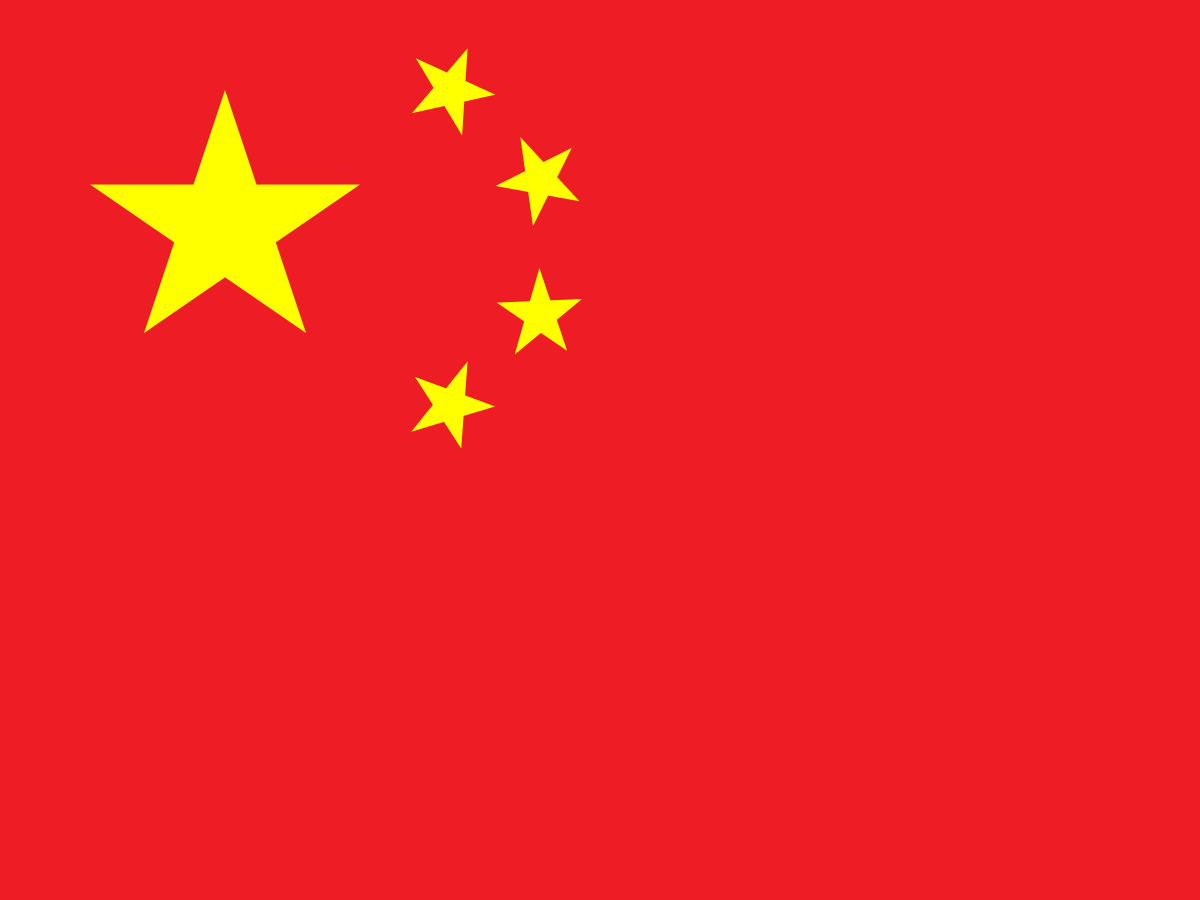
The flag of China
China's national flag is a bright red field with one large yellow five-pointed star near the upper hoist and four smaller yellow stars arranged around it.
The flag is officially known as the Five-starred Red Flag.
The design was selected in 1949 as the People's Republic of China was established.
The red field makes the flag particularly distinctive and strongly connects it with the revolutionary history of modern China.
What does the red colour mean?
Red is strongly associated with the Chinese Revolution and the Communist movement that established the People's Republic of China in 1949.
The colour had already been used by revolutionary movements before the present flag was adopted. It therefore carries a political and historical meaning rather than simply representing a geographical feature.
What does the large star mean?
The large yellow star represents the Chinese Communist Party. It is positioned separately from the four smaller stars and acts as the dominant symbol on the flag.
The five stars together form the central visual idea of the design, with the smaller stars oriented towards the larger one.
What do the four smaller stars mean?
The four smaller stars are traditionally interpreted as representing four social groups united around the leadership of the Communist Party.
Their curved arrangement around the large star is intended to show a relationship of unity and common purpose. The design was created during a period when China was undergoing enormous political change.
Why are the stars arranged at an angle?
The four smaller stars are not simply placed in a straight line. Each is oriented so that one point faces towards the large star.
This arrangement creates the impression that the four smaller groups are gathered around the central symbol. It also gives the otherwise simple red field a strong sense of movement.
Who designed China's flag?
The present flag was designed by Zeng Liansong, who submitted a design during a national competition in 1949.
His original proposal was modified before adoption. The final design removed a large yellow stripe representing the Yellow River and retained the five-star arrangement on a red field.
Flag history timeline
Late 1800s–early 1900sChina experienced political upheaval, foreign intervention and the decline of the Qing dynasty.
1912 — Republic of ChinaThe Qing dynasty ended and the Republic of China was established.
1949 — People's Republic establishedThe Communist Party established the People's Republic of China and a competition was held for a new national flag.
September 1949 — design selectedThe five-star red flag was chosen as the national flag.
1 October 1949 — first raisedThe new flag was raised in Beijing during the proclamation of the People's Republic.
TodayThe Five-starred Red Flag remains the national flag of the People's Republic of China.
China before the modern flag
China has used many different flags and imperial symbols throughout its history. The Qing dynasty, which ruled until 1912, used a yellow flag featuring a blue dragon and a red pearl.
After the revolution that ended the Qing dynasty, the Republic of China used several different designs. The People's Republic adopted the present red-and-yellow flag after the Communist victory in 1949.
Beijing — the capital
Beijing has been one of China's most important political centres for centuries. It is home to the Forbidden City, the Temple of Heaven and Tiananmen Square, as well as the country's central government institutions.
The city has hosted major international events, including the 2008 Summer Olympics and the 2022 Winter Olympics.
The Great Wall of China
The Great Wall is one of the world's most famous historic structures. It is not a single wall built at one time, but a vast system of walls, fortifications and barriers constructed and rebuilt over many centuries.
Some of the best-known sections were built or strengthened during the Ming dynasty. The wall was intended to help defend China's northern frontier and control movement and trade.
The Forbidden City
The Forbidden City in Beijing was the imperial palace of China's Ming and Qing dynasties. It became the centre of government and court life for almost five centuries.
Today it is a major museum and one of China's most important cultural landmarks. Its buildings, courtyards and ceremonial spaces illustrate traditional Chinese imperial architecture.
The Silk Road
The Silk Road was a network of trade routes connecting China with Central Asia, the Middle East and Europe. Chinese silk was one of the best-known products traded along these routes.
The routes also carried ideas, religions, technologies, foods and artistic influences. They helped connect China with societies across a huge part of Eurasia.
Ancient inventions
China is famous for several inventions and technologies that had a major influence on world history. These include paper, printing, gunpowder and the compass.
These developments did not always appear suddenly or in a single form, but Chinese inventors and craftsmen played major roles in their early development and spread.
The Yangtze and Yellow Rivers
The Yangtze is China's longest river and one of the world's great rivers. It flows from the Tibetan Plateau to the East China Sea and supports agriculture, transport and major cities.
The Yellow River has been central to Chinese civilisation for thousands of years. Its fertile basin supported some of the earliest large settlements in China.
Mount Everest and the Himalayas
China shares the northern side of the Himalayas with Nepal and other countries. The Chinese side of Mount Everest lies in the Tibet Autonomous Region.
The Tibetan Plateau is sometimes called the "Roof of the World" because of its enormous elevation. It is the source region for several major Asian rivers.
Pandas and Chinese wildlife
The giant panda has become one of China's best-known national symbols. Wild pandas survive mainly in mountain forests in central China, particularly in Sichuan and neighbouring regions.
China's enormous size also supports many other species, including snow leopards, golden monkeys, red pandas and the endangered Yangtze finless porpoise.
Chinese culture and festivals
Chinese culture includes thousands of years of literature, philosophy, art, music, cuisine and traditional crafts. Major philosophical traditions include Confucianism, Daoism and Buddhism.
Chinese New Year, also known as the Spring Festival, is the most important traditional festival for many Chinese communities. Lantern festivals, dragon dances and family gatherings are associated with celebrations in many places.
Chinese writing
Chinese writing uses characters rather than an alphabet in the European sense. Some characters have extremely long histories, with evidence of early forms dating back more than three thousand years.
Modern Chinese is written using simplified characters in mainland China, while traditional characters remain widely used in places including Taiwan and Hong Kong.
China's economy
China has one of the world's largest economies and is a major centre of manufacturing, technology, trade and infrastructure. Its economic transformation since the late twentieth century has been one of the most significant developments in the modern global economy.
Major industries include electronics, machinery, vehicles, chemicals, textiles, telecommunications and renewable-energy manufacturing.
China and renewable energy
China has become a major producer of solar panels, batteries and electric vehicles. It has also built very large amounts of solar, wind and hydroelectric generating capacity.
The country's energy transition is significant globally because of China's enormous industrial base and its continuing importance as both an energy consumer and manufacturer.
China today
The People's Republic of China is a one-party socialist state led by the Chinese Communist Party. It is a permanent member of the United Nations Security Council and a major participant in international trade and diplomacy.
China's enormous population, economic influence, technological development and geographic size make it one of the world's most important countries.
Why is China's flag interesting?
China's flag is visually simple but carries a large amount of political history. The red field connects it with the Chinese Revolution, while the five stars express the political structure and unity that the designers wanted the flag to represent.
The story of the flag also gives a useful route into China's much longer history, from imperial dynasties and the Silk Road to the 1912 revolution and the establishment of the People's Republic in 1949.
Explore China on FlagAtlas
Continue exploring China and the world's flags with these FlagAtlas resources.