About Colombia
Colombia is a country in the north-west of South America, where the Andes meet the Caribbean Sea and Pacific Ocean. It is the only South American country with coastlines on both oceans.
Bogotá is the capital and largest city. Colombia has extraordinary geographical variety, from Caribbean beaches and tropical rainforest to high Andean mountains and the vast Llanos grasslands.
CapitalBogotá
RegionSouth America
PopulationAbout 52 million
Area1,141,748 km²
CurrencyColombian peso
Official languageSpanish
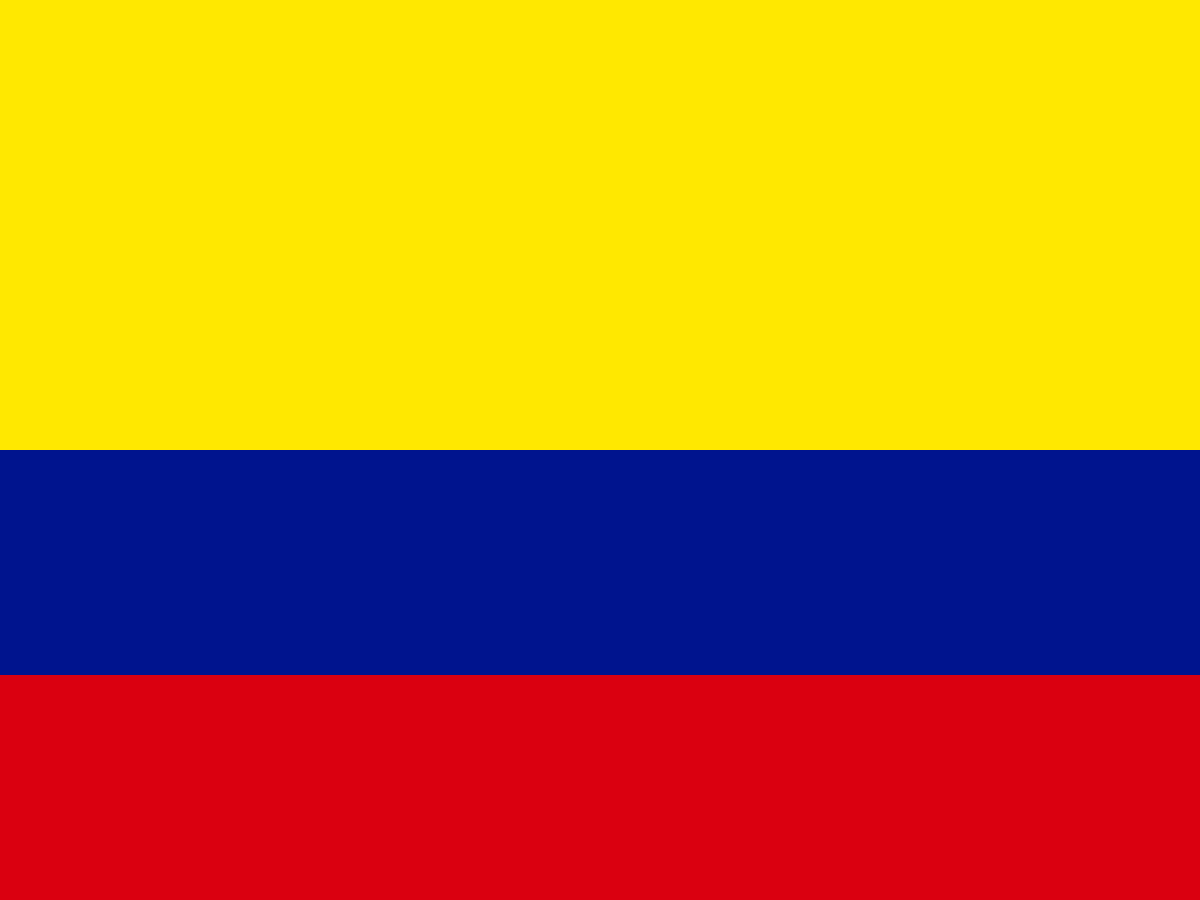
The flag of Colombia
Colombia's flag has three horizontal bands of yellow, blue and red. The yellow band is twice the height of each of the blue and red bands, making it the dominant feature.
Yellow takes up half of the flag.
This unusual proportion makes Colombia's tricolour easy to distinguish from the flags of Ecuador and Venezuela, which share related colours.
The current design developed from the colours used by independence leader Francisco de Miranda and was adopted during Colombia's struggle for independence from Spain.
What do the colours on Colombia's flag mean?
Yellow is traditionally associated with the gold and other riches of the New World. Blue represents the seas and the connection between Colombia and the wider world. Red represents the blood shed by those who fought for independence.
These interpretations connect the flag with both Colombia's natural wealth and its history of independence.
Why is Colombia's yellow stripe so large?
The yellow band occupies the top half of the flag, while blue and red each occupy one quarter. This gives yellow considerably more visual weight than the other colours.
The proportions are part of the design that distinguishes Colombia's flag from the related tricolours of Ecuador and Venezuela.
Colombia, Ecuador and Venezuela
Colombia, Ecuador and Venezuela all use yellow, blue and red in their national flags. The similarity is not accidental: the colours are connected with the independence movements associated with Francisco de Miranda and the former territories of Gran Colombia.
Colombia's flag has no coat of arms, while Ecuador's flag normally displays a coat of arms on government and diplomatic versions. Venezuela's design uses stars and has different proportions.
Francisco de Miranda and the tricolour
Venezuelan revolutionary Francisco de Miranda is closely associated with the yellow, blue and red tricolour used by several South American countries.
The colours were later adopted by independence movements in northern South America and became associated with the struggle to break away from Spanish colonial rule.
A short history of Colombia
Before European colonisation, the region was home to many Indigenous peoples, including the Muisca, Tairona and Quimbaya. The Muisca are especially famous for their goldworking traditions and the legend that helped inspire the story of El Dorado.
Spain established colonial control in the sixteenth century. The territory became part of the Viceroyalty of New Granada, with Bogotá developing as an important administrative centre.
Independence movements grew during the early nineteenth century. Colombia declared independence from Spain in 1810, although the conflict continued for years before Spanish control was finally defeated in the region.
Simón Bolívar became one of the most important leaders of the independence struggle and helped create Gran Colombia, a short-lived republic that included much of modern Colombia, Venezuela, Ecuador and Panama.
Flag history timeline
Pre-1500s — Indigenous ColombiaNumerous Indigenous societies developed across the region, with distinctive cultures, languages and trading networks.
1500s — Spanish colonisationSpain established control over much of the territory and created the colonial administration of New Granada.
1810 — independence movementPolitical events in Bogotá helped launch the independence process.
1819 — decisive independenceSimón Bolívar's forces won the Battle of Boyacá, a major turning point in the struggle.
1819–1830 — Gran ColombiaColombia was part of the larger Republic of Gran Colombia.
TodayThe yellow, blue and red flag remains the national symbol of Colombia.
Gran Colombia
Gran Colombia was a republic created in 1819 that brought together territories corresponding broadly to modern Colombia, Venezuela, Ecuador and Panama.
The state was politically difficult to maintain because of its huge size, regional differences and competing political interests. It broke apart during the early 1830s, leaving separate countries.
Simón Bolívar
Simón Bolívar was one of the most influential leaders of South American independence. He played a major role in the liberation of Venezuela, Colombia, Ecuador, Peru and Bolivia.
In Colombia he is particularly associated with the victory at Boyacá in 1819 and the creation of Gran Colombia. Bogotá's main square is named Plaza de Bolívar in his honour.
Bogotá — the capital
Bogotá sits on a high plateau in the Andes at more than 2,500 metres above sea level. It is Colombia's political, economic and cultural centre.
The historic district of La Candelaria contains colonial buildings, museums, churches and universities. The city is also known for its extensive network of cycle routes and cultural institutions.
The Andes in Colombia
The Andes split into three major ranges within Colombia: the Western, Central and Eastern Cordilleras. These mountains shape the country's climate, transport and settlement patterns.
High-altitude valleys and plateaus support major cities and farming regions, while volcanoes, glaciers and páramo ecosystems occur at higher elevations.
Colombia's two oceans
Colombia has coastlines on both the Caribbean Sea and the Pacific Ocean. This gives the country important maritime links and a huge variety of coastal ecosystems.
The Pacific coast is particularly wet and contains some of the country's richest rainforest. The Caribbean coast includes beaches, coral reefs and the historic city of Cartagena.
The Amazon rainforest
Southern Colombia includes part of the Amazon Basin, one of the world's most important tropical ecosystems. Large areas of forest are difficult to access and contain exceptional biodiversity.
Rivers are essential for transport and local communities in many Amazonian areas. Conservation is increasingly important as pressures from land clearance, mining and infrastructure development grow.
Caño Cristales — the River of Five Colours
Caño Cristales is famous for its vivid colours, produced by aquatic plants known as Macarenia clavigera. Depending on conditions, the river can appear red, yellow, green, blue and black.
It is located in the Sierra de la Macarena and has become one of Colombia's best-known natural attractions.
El Dorado and Indigenous Colombia
The legend of El Dorado was linked to stories about the Muisca people and their goldworking traditions. European explorers transformed these stories into the idea of a fabulously wealthy lost kingdom.
The famous Muisca raft in Bogotá's Gold Museum provides evidence of the sophisticated goldworking traditions that helped inspire the legend, although the mythical golden city was never found.
Coffee and Colombia
Colombia is one of the world's best-known coffee-producing countries. Coffee is grown mainly in mountainous regions where altitude, rainfall and climate create favourable conditions.
The Coffee Cultural Landscape of Colombia is recognised by UNESCO for its cultural importance and traditional coffee-growing landscapes.
Colombian wildlife
Colombia is one of the world's most biodiverse countries. Its range of ecosystems supports thousands of species, including jaguars, spectacled bears, monkeys, toucans and enormous numbers of bird species.
Colombia is particularly famous for its birds and is often regarded as the country with the greatest number of recorded bird species in the world.
Music and culture
Colombian culture combines Indigenous, African and European influences. Music and dance are central to national identity, with styles including cumbia, vallenato and salsa.
Colombia is also famous for its literature. Gabriel García Márquez, winner of the Nobel Prize in Literature, helped bring Colombian writing and Caribbean culture to an international audience.
Football in Colombia
Football is one of Colombia's most popular sports. The national team is known for its yellow shirts, reflecting the dominant colour of the national flag.
Colombia's men's team reached the quarter-finals of the 2014 FIFA World Cup, its best World Cup performance at the time, while the women's game has also grown rapidly.
Colombia today
Colombia is a constitutional republic and one of South America's largest economies. Important sectors include services, manufacturing, agriculture, energy and mining.
The country has made major progress in reducing poverty and expanding infrastructure, while continuing to face challenges involving inequality, rural development, environmental protection and the legacy of armed conflict.
Why is Colombia's flag interesting?
Colombia's flag is a simple tricolour with an unusually large yellow band, but its story reaches into the history of South American independence.
The same yellow, blue and red colours appear on the flags of Ecuador and Venezuela, providing a fascinating example of how national flags can share a common historical origin while developing into distinct designs.
Explore Colombia on FlagAtlas
Continue exploring Colombia and the world's flags with these FlagAtlas resources.