About Côte d'Ivoire
Côte d'Ivoire, commonly known in English as Ivory Coast, is a country on the southern coast of West Africa. It borders Liberia and Guinea to the west, Mali and Burkina Faso to the north, and Ghana to the east, with the Gulf of Guinea to the south.
Yamoussoukro is the political capital, while Abidjan is the country's largest city and its main economic and commercial centre. Côte d'Ivoire is one of West Africa's most important economies and is particularly famous for cocoa, coffee and other agricultural products.
CapitalYamoussoukro
Largest cityAbidjan
RegionWest Africa
PopulationAbout 30 million
CurrencyWest African CFA franc
Official languageFrench
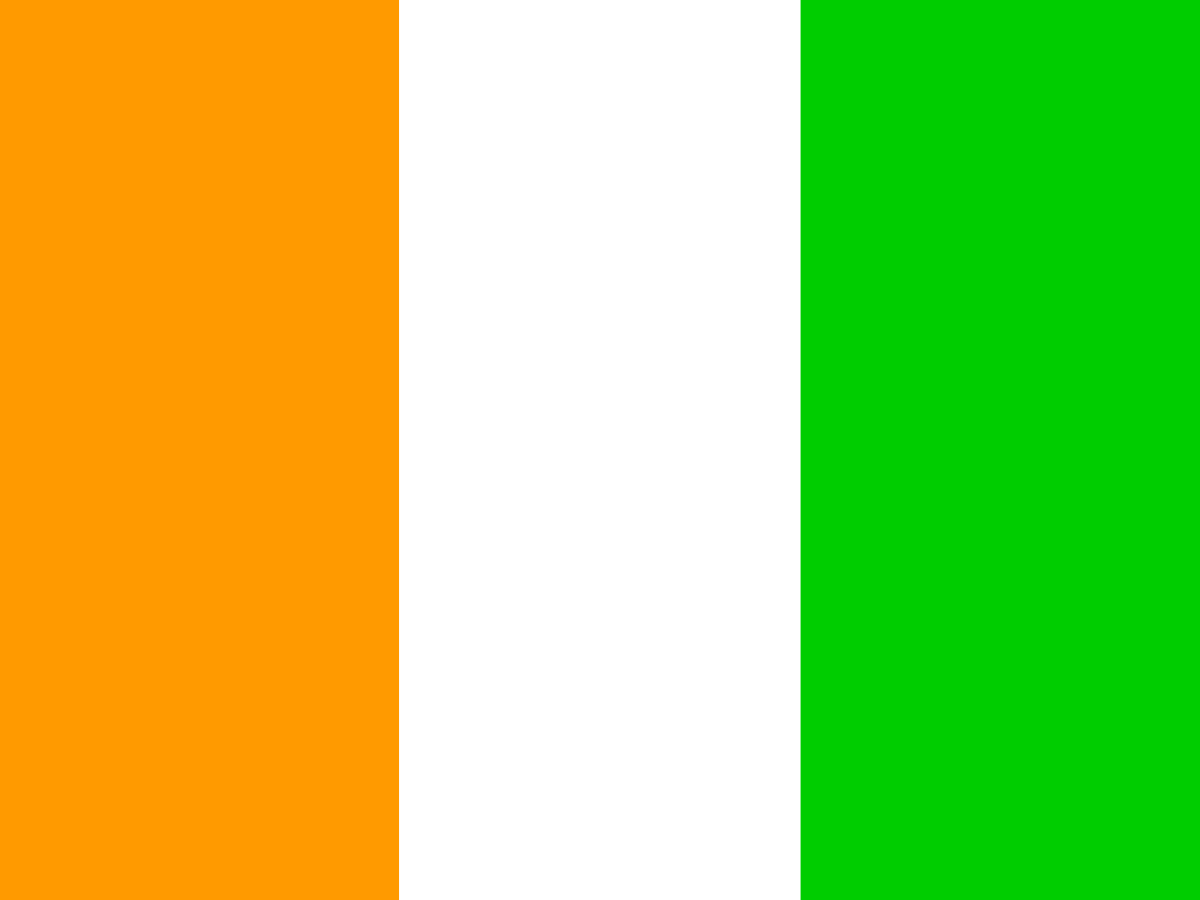
The flag of Côte d'Ivoire
Côte d'Ivoire's flag has three equal vertical stripes: orange, white and green. It was adopted shortly before independence in 1960 and has remained the national flag ever since.
It is easy to confuse the Côte d'Ivoire flag with Ireland's flag.
Both use orange, white and green, but Côte d'Ivoire has orange nearest the flagpole, while Ireland has green nearest the flagpole.
The vertical tricolour is simple, but its colours were chosen to represent different aspects of the country's landscape, hopes and national identity.
What do the colours mean?
Orange is associated with the northern savannah and the country's fertile land. White represents peace and unity. Green represents the forests and the hope associated with the country's future.
The colours can therefore be read as a geographical journey across Côte d'Ivoire, from the northern savannah through the central region to the greener southern landscape.
Côte d'Ivoire and Ireland — why are the flags similar?
Côte d'Ivoire and Ireland both use orange, white and green, but the order is reversed. Côte d'Ivoire's flag is orange-white-green, while Ireland's is green-white-orange.
The similarity is an excellent example of how two countries can use the same basic colours while giving them different historical and geographical meanings. It is also why the two flags can be easy to mix up when seen quickly.
Why is the flag vertical?
Côte d'Ivoire chose a vertical tricolour when establishing its national identity around independence. Vertical stripes give the flag a clear, simple appearance and distinguish it from many of the horizontal tricolours used elsewhere in Africa.
The design also reflects the influence of European flag traditions while using colours and symbolism connected specifically with Côte d'Ivoire.
A short history of Côte d'Ivoire
Before European colonisation, the region contained numerous kingdoms, states and communities, including the Akan, Baoulé, Sénoufo, Malinké and Dan peoples. Trade routes connected the interior with the West African coast.
France established colonial control during the nineteenth century and Côte d'Ivoire became part of French West Africa. The colony developed major agricultural exports, including coffee and cocoa.
Côte d'Ivoire became independent on 7 August 1960. Félix Houphouët-Boigny became the country's first president and remained a dominant figure in Ivorian politics for decades.
Yamoussoukro — the capital
Yamoussoukro is the official political capital of Côte d'Ivoire, although Abidjan is considerably larger and remains the country's main economic centre.
The city became especially important under Félix Houphouët-Boigny, who was born nearby. Yamoussoukro is famous for the enormous Basilica of Our Lady of Peace, one of the most recognisable buildings in the country.
Abidjan — the economic capital
Abidjan is the largest city in Côte d'Ivoire and a major commercial centre for West Africa. It sits around the Ébrié Lagoon and contains the country's main port, business districts and international connections.
The city is known for areas such as Plateau, Cocody and Treichville, and has become an important centre for finance, manufacturing, culture and entertainment.
The Basilica of Our Lady of Peace
The Basilica of Our Lady of Peace in Yamoussoukro is one of the world's largest Christian churches. It was commissioned by Félix Houphouët-Boigny and consecrated in the early 1990s.
Its architecture was inspired partly by St Peter's Basilica in Rome. The enormous dome and surrounding grounds make it one of Côte d'Ivoire's most distinctive landmarks.
Cocoa and Côte d'Ivoire
Côte d'Ivoire is the world's leading cocoa-producing country and plays a major role in the global chocolate supply chain. Cocoa is grown mainly in the humid southern and central parts of the country.
The crop is hugely important to the economy and provides livelihoods for many farming communities. However, the industry also faces challenges involving farmer incomes, child labour, deforestation and the long-term sustainability of cocoa production.
Coffee, cashews and agriculture
Agriculture is central to Côte d'Ivoire's economy. Alongside cocoa, important products include coffee, cashew nuts, rubber, palm oil, bananas and cotton.
Different crops suit different parts of the country. The wetter south supports tree crops such as cocoa and rubber, while northern areas are better suited to crops such as cotton and cashews.
The geography of Côte d'Ivoire
Côte d'Ivoire stretches from the humid coastal zone in the south to drier savannah landscapes in the north. The transition between these environments is reflected in the colours of the national flag.
The country has a mixture of lagoons, coastal plains, forests, rolling hills and northern savannah. Mount Nimba on the western border is part of a mountainous region with exceptional biodiversity.
Forests and biodiversity
Côte d'Ivoire once contained extensive tropical forests, particularly in the south and west. These forests support chimpanzees, forest elephants, monkeys, antelopes and thousands of plant species.
Forest loss caused by farming, logging and other development has become a major environmental issue. Protected areas such as Taï National Park are important for conserving remaining rainforest ecosystems.
Taï National Park
Taï National Park in western Côte d'Ivoire is one of the largest remaining areas of primary tropical rainforest in West Africa. It is recognised by UNESCO as a World Heritage Site.
The park provides habitat for rare species including forest elephants, pygmy hippopotamuses and chimpanzees. It is also important for scientific research into tropical forest ecosystems.
Mount Nimba
The Mount Nimba region lies on the borders of Côte d'Ivoire, Guinea and Liberia. Its mountains, forests and grasslands contain exceptional biodiversity.
The wider Mount Nimba Strict Nature Reserve is recognised by UNESCO and protects rare plants and animals. The landscape is also important for understanding the transition between West African forest and savannah environments.
Languages and culture
French is the official language of Côte d'Ivoire, reflecting the country's colonial history, but many local languages are spoken across the country. Major language groups include Akan, Mande and Kru languages.
Ivorian culture is extremely diverse. Music, dance, textiles, food and festivals vary between communities, while modern cities have developed a vibrant national popular culture.
Music and dance
Côte d'Ivoire has produced internationally influential music styles and artists. Coupé-décalé developed in the early 2000s and became one of the country's most recognisable modern genres.
Traditional music and dance remain important too, with different communities maintaining their own rhythms, instruments, masks and ceremonies.
Football in Côte d'Ivoire
Football is the country's most popular sport. The national team is known as Les Éléphants, a name inspired by the elephant's importance in Ivorian identity.
Côte d'Ivoire won the Africa Cup of Nations in 1992 and 2015, and again in 2024. The country has also produced internationally famous players who have played for major European clubs.
Côte d'Ivoire today
Côte d'Ivoire is one of West Africa's largest and fastest-growing economies. Important sectors include agriculture, manufacturing, mining, construction, services and telecommunications.
Abidjan has become a major regional business centre, while infrastructure investment has expanded roads, ports and energy capacity. The country nevertheless continues to face challenges involving inequality, rural development, environmental protection and access to services.
Why is Côte d'Ivoire's flag interesting?
Côte d'Ivoire's flag looks simple, but it tells a story about geography, independence and national identity. The orange, white and green colours connect the country's northern savannah, ideals of peace and southern forests.
Its reversed similarity to Ireland's flag also makes it one of the world's easiest flags to confuse with another country's flag — giving it a natural connection to FlagAtlas's guides about similar flags.
Flag history timeline
Before European ruleMany West African peoples and kingdoms developed across the region, linked by trade, farming and cultural exchange.
1800s — French expansionFrance expanded its influence along the West African coast and established colonial control over Côte d'Ivoire.
1893 — French colonyCôte d'Ivoire was formally established as a French colony.
1944 — political reformFélix Houphouët-Boigny founded the African Agricultural Union, an important step in the development of the country's independence movement.
1960 — independenceCôte d'Ivoire became independent from France on 7 August.
TodayThe orange, white and green tricolour remains the national symbol of Côte d'Ivoire.
Explore Côte d'Ivoire on FlagAtlas
Continue exploring Côte d'Ivoire and the world's flags with these FlagAtlas resources.