About Cuba
Cuba is the largest island in the Caribbean and lies between the Caribbean Sea, Gulf of Mexico and Atlantic Ocean. The country also includes many smaller islands and cays.
Havana is the capital and largest city. Cuba is famous for its long history, distinctive music, classic cars, tobacco, baseball, beaches and Spanish colonial architecture.
CapitalHavana
RegionCaribbean
PopulationAbout 11 million
Area109,884 km²
CurrencyCuban peso
Official languageSpanish
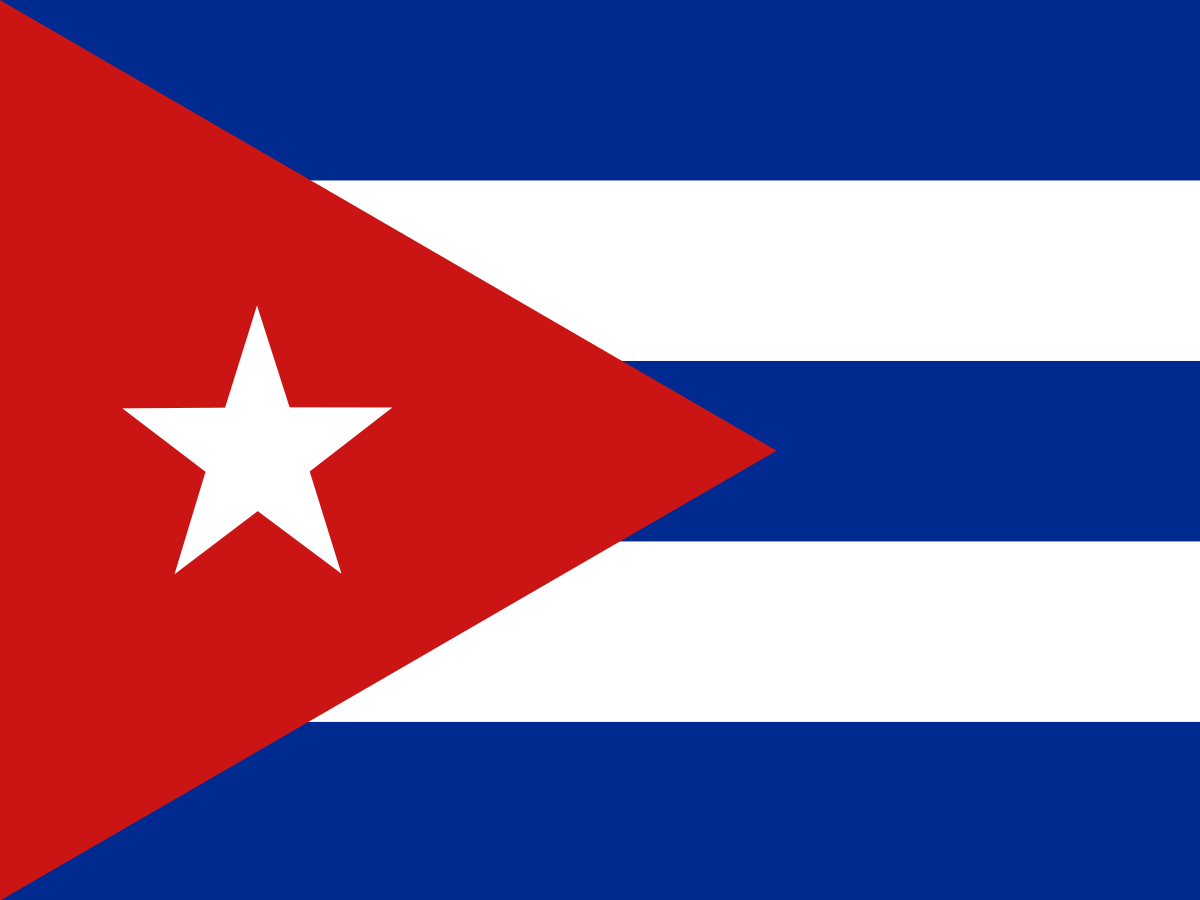
The flag of Cuba
The Cuban flag has five horizontal stripes of blue and white. A red triangle sits at the hoist, containing a single white five-pointed star.
The design is closely connected with Cuba's nineteenth-century independence movement.
The three blue stripes traditionally represent the three military districts of the colonial period, while the two white stripes represent the purity of the independence cause.
The red triangle represents the struggle for independence, while the white star is associated with independence and freedom.
What do the colours and symbols mean?
The three blue stripes traditionally represent the three military departments into which Cuba was divided during Spanish colonial rule. The two white stripes represent the purity of the independence ideal.
The red triangle represents the blood and struggle associated with the fight for independence. The white star, known as the Estrella Solitaria or Lone Star, represents independence and freedom.
The Lone Star
The white star on Cuba's flag is often called the Lone Star. It became a powerful symbol of the independence movement and of Cuba's aspiration to become a free and sovereign nation.
The use of a single prominent star also connects Cuba with the wider tradition of revolutionary and independence symbolism found across the Americas.
Who designed the Cuban flag?
The Cuban flag was created in the nineteenth century by Narciso López, a Venezuelan-born military leader who became involved in Cuban independence efforts.
The design first appeared in 1849 and was inspired partly by ideas associated with the United States and other independence movements. It later became the recognised symbol of the Cuban independence cause.
A short history of Cuba
Before European arrival, Cuba was home to Indigenous peoples including the Taíno and Ciboney. Christopher Columbus reached the island in 1492, after which Spain gradually established colonial control.
Cuba remained a Spanish colony for centuries. Independence movements developed during the nineteenth century, culminating in the Spanish-American War and the end of Spanish rule in 1898.
Cuba became a formally independent republic in 1902, although the United States retained significant influence over the island for many years.
Flag history timeline
1849 — flag designNarciso López introduced the design that would become the Cuban national flag.
1868 — Ten Years' WarCuban revolutionaries launched a major uprising against Spanish rule.
1895 — War of IndependenceJosé Martí and other independence leaders helped launch the final major struggle against Spanish rule.
1898 — Spanish rule endsSpain lost control of Cuba after the Spanish-American War.
1902 — Republic of CubaCuba became an independent republic and adopted the flag as a national symbol.
1959 — Cuban RevolutionFidel Castro's revolutionary movement took power, beginning a new period in Cuban history.
TodayThe blue, white and red flag remains the national flag of Cuba.
José Martí and Cuban independence
José Martí was one of the most important figures in the Cuban independence movement. He was a writer, poet, journalist and political organiser who argued for Cuban independence from Spain.
Martí died in 1895, shortly after the final war for independence began, but his ideas became central to Cuban national identity. He is remembered as a national hero.
Havana — the capital
Havana is Cuba's capital and largest city. Its historic centre contains plazas, churches, fortifications and colourful buildings dating from the Spanish colonial period.
Old Havana is a UNESCO World Heritage Site. The city's waterfront, known as the Malecón, is one of Cuba's best-known public spaces.
Old Havana
Old Havana developed around the city's historic harbour and became an important Spanish trading centre. Its architecture includes Baroque churches, colonial houses, defensive walls and grand public buildings.
Major landmarks include the Cathedral of Havana, Plaza de Armas and Castillo de la Real Fuerza. Restoration projects have helped preserve the historic district.
Cuba's geography
Cuba is long and relatively narrow, stretching roughly east to west across the northern Caribbean. Much of the country consists of rolling plains, with mountain ranges concentrated in the east and southeast.
The island's coastline includes beaches, mangroves, coral reefs, wetlands and rocky shores. The combination of tropical climate and varied terrain supports a wide range of ecosystems.
The Sierra Maestra
The Sierra Maestra is a mountain range in southeastern Cuba. It played an important role during the Cuban Revolution because revolutionary forces used the remote mountains as a base.
The region includes Pico Turquino, the highest point in Cuba. Its forests and steep terrain also make it one of the country's most important natural areas.
Cuba's wildlife
Cuba has many species found nowhere else in the world. Its isolation has encouraged distinctive evolution among reptiles, amphibians, birds and other wildlife.
The country is home to the Cuban crocodile, Cuban hutia, colourful birds and the tiny bee hummingbird, one of the world's smallest birds.
Beaches and coral reefs
Cuba is surrounded by warm tropical seas containing coral reefs, seagrass beds and mangrove ecosystems. Areas such as Varadero, Cayo Coco and the Jardines de la Reina are famous for beaches and marine environments.
These ecosystems support fish, sea turtles and other marine species and are important to both conservation and tourism.
Cuban music
Music is one of Cuba's most influential cultural exports. Cuban traditions helped shape genres including son, salsa, mambo, rumba and cha-cha-cha.
African and Spanish musical traditions combined over centuries to create distinctive Cuban rhythms. Music remains central to celebrations, dancing and everyday cultural life.
Cuban dance
Cuban dance traditions are closely linked with the country's music. Salsa, son, rumba and other forms combine complex rhythms with influences from African and European traditions.
Dance is an important part of Cuban cultural identity and has influenced popular music and dance around the world.
Baseball in Cuba
Baseball is Cuba's most popular sport and has been an important part of national culture since the nineteenth century. Cuba has produced many highly regarded players and has a long history of success in international amateur baseball.
Baseball is so closely associated with Cuban identity that it often competes with music and dance as one of the country's most recognisable cultural exports.
Cuban cigars and tobacco
Cuba is famous for its tobacco, particularly the tobacco grown in the western region of Pinar del Río. Cuban cigars have become an internationally recognised luxury product.
The quality of the tobacco is influenced by the region's soils, climate and traditional cultivation methods. Tobacco farming has been part of Cuban agriculture for centuries.
Classic cars in Cuba
Havana is famous for its collection of American cars from the 1940s and 1950s. Many survived because restrictions on importing new vehicles and spare parts meant that owners kept older cars running for decades.
Today these brightly maintained classic cars have become one of the most recognisable images of Havana and an important part of the tourist economy.
Cuba and the United States
Cuba's relationship with the United States has had a major influence on modern Cuban history. After the Cuban Revolution of 1959, relations deteriorated rapidly and the two countries entered a long period of political and economic hostility.
The Bay of Pigs invasion in 1961 and the Cuban Missile Crisis in 1962 became major Cold War events. Diplomatic relations were restored in 2015, although relations have remained complicated.
The Cuban Revolution
The Cuban Revolution culminated in 1959 when Fidel Castro's revolutionary forces overthrew the government of Fulgencio Batista.
The revolution transformed Cuba's political and economic system. The country became closely aligned with the Soviet Union during the Cold War and developed a socialist state.
Cuba today
Cuba is a socialist republic whose economy includes state-owned enterprises alongside private and cooperative activity. Important sectors include tourism, services, agriculture, biotechnology and manufacturing.
The country has a highly distinctive political and economic system and continues to face significant economic challenges, including shortages, infrastructure pressures and restrictions on international trade.
Why is Cuba's flag interesting?
Cuba's flag is a strong example of how national flags can emerge from independence movements. The design was created decades before the modern Cuban state existed and became a symbol of resistance to Spanish rule.
Its simple combination of stripes, triangle and lone star is instantly recognisable and has remained unchanged through enormous political changes on the island.
Explore Cuba on FlagAtlas
Continue exploring Cuba and the world's flags with these FlagAtlas resources.