About Cyprus
Cyprus is an island country in the eastern Mediterranean Sea, south of Turkey and close to the coasts of Syria and Lebanon. It is the third-largest island in the Mediterranean after Sicily and Sardinia.
Nicosia is the capital. Cyprus is a member of the European Union and is famous for its ancient history, Mediterranean beaches, mountains, archaeological sites and distinctive position at the crossroads of Europe, Asia and Africa.
CapitalNicosia
RegionEastern Mediterranean
PopulationAbout 1.2 million
CurrencyEuro (€)
Official languagesGreek & Turkish
Highest mountainMount Olympus
The flag of Cyprus
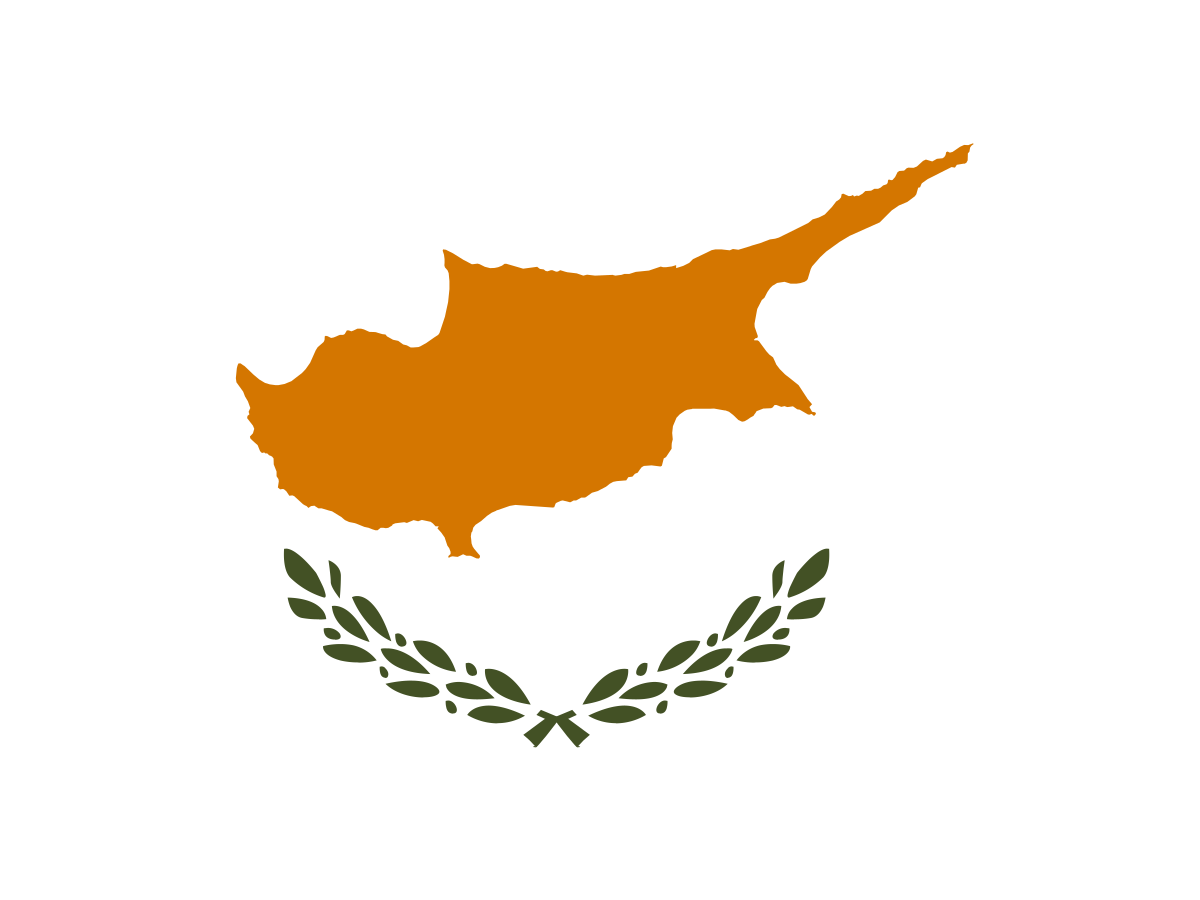
Cyprus has one of the world's most unusual national flags. A copper-coloured silhouette of the entire island is placed above two green olive branches on a plain white background.
Cyprus is one of only a small number of countries whose flag shows the country's territory as a map.
The map is deliberately shown in a copper colour, linking the design to Cyprus's ancient copper-mining heritage.
The olive branches are a traditional symbol of peace. The plain white background reinforces the peaceful character of the design.
Why does the flag show a map?
The map was included to make the island itself the central symbol of the flag. Cyprus's name has long been associated with copper, and the island was an important source of copper in antiquity.
Using the outline of Cyprus also gives the flag a distinctive identity. Unlike most national flags, you can immediately recognise the country from the shape displayed on it.
The olive branches
Two green olive branches appear beneath the map. They represent peace and reconciliation.
Olive branches have been used as symbols of peace since antiquity, making them particularly appropriate for a country whose modern history has included political and communal division.
Why is the background white?
The white field gives the flag a deliberately simple appearance and provides a strong contrast with the copper-coloured island and green olive branches.
The overall design avoids the traditional red, blue or striped patterns common on many national flags. This makes the Cyprus flag unusually restrained and instantly recognisable.
A short history of Cyprus
Cyprus has been inhabited for thousands of years and has been influenced by many civilisations, including the Greeks, Romans, Byzantines, Venetians and Ottomans.
Britain took control of the island in the nineteenth century, and Cyprus became an independent republic in 1960. The new state adopted its distinctive map-and-olive-branch flag.
Modern Cyprus has a complicated political history, including tensions between Greek Cypriot and Turkish Cypriot communities and the division of the island that developed after conflict in the 1970s.
Flag history timeline
Ancient CyprusThe island became an important centre for copper production and Mediterranean trade.
1571 — Ottoman ruleCyprus came under Ottoman control after centuries of Venetian rule.
1878 — British administrationBritain took administrative control of Cyprus, which later became a British colony.
1960 — independenceCyprus became an independent republic and adopted the present flag.
1974 — divisionConflict and military intervention led to the island becoming divided, with a UN buffer zone separating the two sides.
2004 — European UnionThe Republic of Cyprus joined the European Union.
TodayThe map and olive branches remain the official symbols on the national flag of the Republic of Cyprus.
Nicosia — the capital
Nicosia is the capital and largest city of Cyprus. It lies roughly in the centre of the island and has been an important settlement for centuries.
The old city is surrounded by distinctive Venetian walls built in the sixteenth century. Nicosia is also unusual because the city is divided by the UN buffer zone, making it one of the world's few divided capitals.
A divided island
Cyprus has been divided since the events of 1974. The Republic of Cyprus exercises control over the southern part of the island, while the northern part is administered by the self-declared Turkish Republic of Northern Cyprus, which is recognised internationally only by Turkey.
A United Nations buffer zone separates the two sides in many places. The political division remains unresolved, although negotiations and confidence-building efforts have continued at various times.
Cyprus and the European Union
The Republic of Cyprus joined the European Union on 1 May 2004. The whole island is considered EU territory in legal terms, although EU law is suspended in areas where the Republic of Cyprus does not exercise effective control.
Cyprus adopted the euro in 2008, replacing the Cyprus pound in the areas controlled by the Republic of Cyprus.
Ancient Cyprus and copper
Cyprus has been associated with copper for thousands of years. Ancient mining and metalworking helped make the island an important trading centre in the Mediterranean.
The word copper is connected historically with the Latin name for Cyprus, cuprum. This is why copper became such an appropriate colour for the island on the national flag.
The Troodos Mountains
The Troodos Mountains dominate the centre and southwest of Cyprus. They contain forests, villages, monasteries and some of the island's most important natural landscapes.
Mount Olympus, also called Chionistra, is the highest point at about 1,952 metres. During winter, the upper slopes can receive snow and support Cyprus's ski facilities.
The Mediterranean coast
Cyprus has a long coastline with sandy beaches, rocky headlands, sea caves and sheltered bays. The warm Mediterranean climate makes coastal areas popular with visitors.
Important coastal cities include Limassol, Larnaca and Paphos. The eastern coast is particularly known for beaches and clear water.
Paphos and ancient history
Paphos on the southwest coast is famous for its archaeological remains and its connection with the ancient worship of Aphrodite. The Archaeological Park of Paphos contains impressive Roman mosaics.
Paphos is recognised as a UNESCO World Heritage Site because of its exceptional archaeological and historical importance.
Kyrenia and the north
Kyrenia, known as Girne in Turkish, is a historic coastal city in the northern part of Cyprus. Its harbour and castle are among the best-known landmarks in the region.
The city lies below the Kyrenia mountain range, which runs along the northern side of the island and creates a striking landscape.
Cyprus wildlife
Cyprus has several species and habitats adapted to its Mediterranean environment. The island is particularly important for migratory birds because it lies on major routes between Europe, Africa and Asia.
The Cyprus mouflon, a wild sheep found in the Troodos region, is the island's largest native land mammal and a national wildlife symbol.
Climate
Cyprus has a Mediterranean climate with hot, dry summers and mild, wetter winters. The mountains are cooler than the coastal plains and can receive snow in winter.
The long summer season has helped make Cyprus a popular destination for beach holidays, while the mountains provide a different climate and landscape.
Cypriot food
Cypriot cuisine combines Mediterranean ingredients with influences from Greek, Turkish and Middle Eastern traditions. Common foods include halloumi, olives, fresh vegetables, grilled meats and seafood.
Halloumi cheese is particularly associated with Cyprus and has become an internationally popular food.
Languages and culture
Greek and Turkish are the official languages of the Republic of Cyprus, while English is also widely understood because of the island's history and tourism industry.
Cypriot culture combines ancient Mediterranean traditions with Greek, Turkish, Middle Eastern and European influences. Religious festivals, music, food and village traditions remain important parts of life.
Why is Cyprus important geographically?
Cyprus sits at a crossroads between Europe, Asia and the Middle East. Its position has made it strategically important throughout history and has brought many different cultures and empires to the island.
The island is closer to the coast of the Middle East than to mainland Greece, despite its strong cultural connections with the Greek world.
Cyprus today
The Republic of Cyprus is a parliamentary republic and an EU member state. Its economy includes tourism, shipping, financial services, professional services, manufacturing and agriculture.
Tourism remains particularly important, with visitors attracted by beaches, archaeology, historic towns, mountains and the island's warm climate.
Why is the Cyprus flag interesting?
Cyprus's flag is unusual because it puts a map of the country itself at the centre of the design. The copper colour links the modern state to the island's ancient mining history, while the olive branches provide a clear message of peace.
It is also a flag with an important political story: the design was created for an independent Cyprus and its symbolism continues to be viewed in the context of the island's division and the search for reconciliation.
Explore Cyprus on FlagAtlas
Continue exploring Cyprus and the world's flags with these FlagAtlas resources.