About Czechia
Czechia, officially the Czech Republic, is a landlocked country in Central Europe. It borders Germany, Poland, Slovakia and Austria and sits at an important crossroads between western and eastern Europe.
Prague is the capital and largest city. Czechia is known for its medieval towns, castles, historic architecture, forests, mountains, beer tradition and industrial heritage.
CapitalPrague
RegionCentral Europe
PopulationAbout 10.9 million
CurrencyCzech koruna
Official languageCzech
Highest pointSněžka
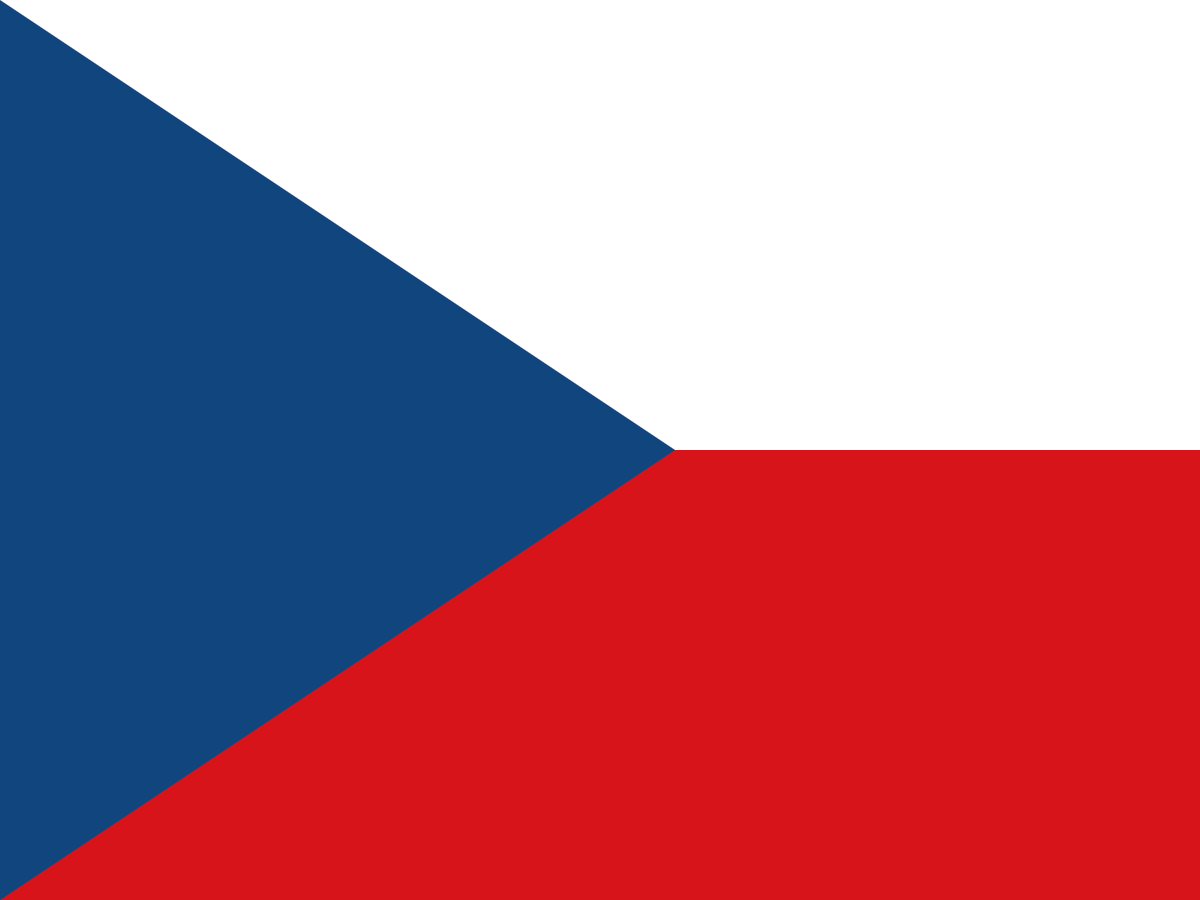
The flag of Czechia
The Czech flag has two horizontal fields, white above red, with a distinctive blue triangle extending from the hoist.
The blue triangle is what makes the Czech flag different from Poland's flag.
Poland uses the same white-over-red arrangement without the blue triangle.
The design was adopted in its modern form in 1920 and later retained by the independent Czech Republic after the peaceful dissolution of Czechoslovakia.
What do the colours mean?
The Czech flag uses the traditional colours white, red and blue. White and red have deep historical connections with Bohemia, while blue was added to create a distinctive national design and later became associated with Moravia and Slovakia in the Czechoslovak context.
Unlike some modern flags, the Czech colours do not have one universally agreed simple list of symbolic meanings. Their importance comes largely from heraldry and national history.
Why does the flag have a blue triangle?
The blue triangle was introduced because the original white-and-red design was too similar to Poland's flag. The triangle gives the flag a strong visual identity.
The blue shape also became a useful symbol of the country's broader national and regional identity. In the period of Czechoslovakia, blue was particularly important in representing Slovakia alongside the traditional Bohemian colours.
Bohemia, Moravia and Czech Silesia
The Czech lands are traditionally divided into Bohemia, Moravia and Czech Silesia. These historic regions have played an important role in the country's identity.
Bohemia occupies the western part of the country and contains Prague. Moravia lies mainly in the east, while Czech Silesia occupies areas in the northeast. The historic Czech lion is particularly associated with Bohemia, while the Moravian eagle appears in the country's full coat of arms.
The Czech coat of arms
The Czech Republic has a large coat of arms containing symbols for the country's historic lands. The Bohemian lion appears twice, while the Moravian and Silesian emblems appear in the other quarters.
The lion is a particularly important national symbol and appears on official buildings, coins, sporting imagery and other Czech institutions.
A short history of Czechia
The Czech lands have a long history reaching from prehistoric settlements through the medieval Kingdom of Bohemia, the Habsburg period and the creation of Czechoslovakia.
In 1918, Czechoslovakia became an independent state after the First World War. The country later experienced Nazi occupation during the Second World War and became a communist state after 1948.
The Velvet Revolution of 1989 brought an end to communist rule. Czechoslovakia then separated peacefully into the Czech Republic and Slovakia on 1 January 1993.
Flag history timeline
Medieval periodHeraldic symbols including the Czech lion developed alongside the Kingdom of Bohemia.
1918 — CzechoslovakiaThe new Czechoslovak state initially used a white-and-red flag based on Bohemian colours.
1920 — blue triangle addedThe distinctive blue hoist triangle was introduced to distinguish the flag from Poland's.
1939–1945 — occupationNazi Germany occupied the Czech lands during the Second World War.
1948 — communist eraCzechoslovakia became a communist state and remained so until the Velvet Revolution.
1993 — Czech RepublicThe Czech Republic became independent and retained the former Czechoslovak flag.
TodayThe same red, white and blue flag is the national flag of Czechia.
Prague — the capital
Prague is one of Europe's best-known historic cities. The Vltava River runs through the city and its skyline includes Prague Castle, church towers and historic bridges.
The Charles Bridge, Old Town Square and Prague Castle are among the city's most recognisable landmarks. Prague's historic centre is a UNESCO World Heritage Site.
Prague Castle
Prague Castle is one of the largest historic castle complexes in the world and has been a centre of Czech political life for centuries.
The complex includes St Vitus Cathedral, the Old Royal Palace and Golden Lane. Czech kings, Holy Roman Emperors and modern presidents have all been associated with the site.
Czech castles and towns
Czechia has hundreds of castles, châteaux and historic estates. They reflect the country's medieval kingdoms, aristocratic families and centuries within the Habsburg lands.
Famous sites include Český Krumlov, Karlštejn Castle and Hluboká Castle. Historic towns are a major part of Czech cultural heritage and tourism.
The landscape of Czechia
Czechia is mostly made up of rolling hills, uplands and river basins, with mountain ranges along parts of its borders. The country has no coastline, but major rivers including the Vltava, Elbe and Morava have shaped settlement and trade.
The landscape contains forests, farmland, meadows and protected mountain areas. Sněžka, on the border with Poland, is the country's highest point at about 1,603 metres.
Bohemian Paradise and national parks
Czechia contains several protected landscapes and national parks. Bohemian Switzerland and the Šumava region are known for forests, sandstone formations and hiking.
The country's protected areas help conserve forests, wetlands, mountain habitats and distinctive rock landscapes.
Czech beer tradition
Beer is one of the most famous parts of Czech culture. The country has a long brewing history and is associated with styles such as pilsner.
The city of Plzeň gave its name to Pilsner beer, while České Budějovice is associated with another internationally famous brewing tradition. Beer has been produced in the Czech lands for centuries.
Food in Czechia
Traditional Czech cuisine includes hearty soups, dumplings, roast meats, sauces and pastries. Vepřo knedlo zelo combines roast pork with bread or potato dumplings and sauerkraut.
Other familiar foods include svíčková, goulash, koláče pastries and a wide range of breads and cakes.
Czech language and culture
Czech is a West Slavic language written using the Latin alphabet. It is closely related to Slovak and shares many similarities with other Slavic languages.
Czech culture has made important contributions to literature, music, theatre, architecture and science. Writers such as Franz Kafka and Milan Kundera are strongly associated with Czech cultural history, while composers such as Antonín Dvořák and Bedřich Smetana are internationally famous.
The Velvet Revolution
The Velvet Revolution of 1989 was a peaceful mass movement that helped end communist rule in Czechoslovakia.
Students, intellectuals and ordinary citizens participated in demonstrations and strikes. Václav Havel, a playwright and dissident, became a leading figure and later president of Czechoslovakia.
The Velvet Divorce
Czechoslovakia separated peacefully into two independent states on 1 January 1993. The Czech Republic and Slovakia became sovereign countries without a war between them.
This event is commonly called the Velvet Divorce, echoing the peaceful nature of the earlier Velvet Revolution.
Czechia and the European Union
Czechia joined the European Union on 1 May 2004. It is also a member of NATO and other major European and international organisations.
The country remains outside the euro area and continues to use the Czech koruna.
Czech inventions and industry
The Czech lands have a long industrial tradition, particularly in engineering, machinery, vehicles and manufacturing. The country is also associated with inventions and innovations in fields ranging from chemistry to modern technology.
The industrial city of Brno is an important centre for engineering, research and education, while Prague has developed into a major services and technology hub.
Football and ice hockey
Football and ice hockey are two of the country's most popular sports. Czechia has a strong ice hockey tradition and has won multiple world championship titles.
Czech football has also produced internationally successful players and clubs. The national football team reached the European Championship final in 1996.
Czechia today
Czechia is a parliamentary democracy with a diversified economy based on manufacturing, engineering, services, technology, transport and tourism. It has close economic links with Germany and other European countries.
Prague remains the country's main political, cultural and economic centre, while cities such as Brno, Ostrava and Plzeň have important regional roles.
Why is Czechia's flag interesting?
The Czech flag is a good example of a design created to solve a practical problem. The original white-and-red Bohemian colours were too similar to Poland's flag, so the blue triangle was introduced to make the national flag distinctive.
Its survival is also historically unusual: after Czechoslovakia peacefully split in 1993, the Czech Republic retained the former Czechoslovak flag rather than creating an entirely new design.
Explore Czechia on FlagAtlas
Continue exploring Czechia and the world's flags with these FlagAtlas resources.