About the Democratic Republic of the Congo
The Democratic Republic of the Congo, commonly called DR Congo or the DRC, is one of Africa's largest countries. It occupies much of the centre of the continent and has access to the Atlantic Ocean through a narrow western corridor.
Kinshasa is the capital and largest city. The country is famous for its enormous tropical rainforest, major rivers, exceptional mineral resources and extraordinary biodiversity.
CapitalKinshasa
RegionCentral Africa
PopulationAbout 100 million
CurrencyCongolese franc
Official languageFrench
Highest pointMount Stanley
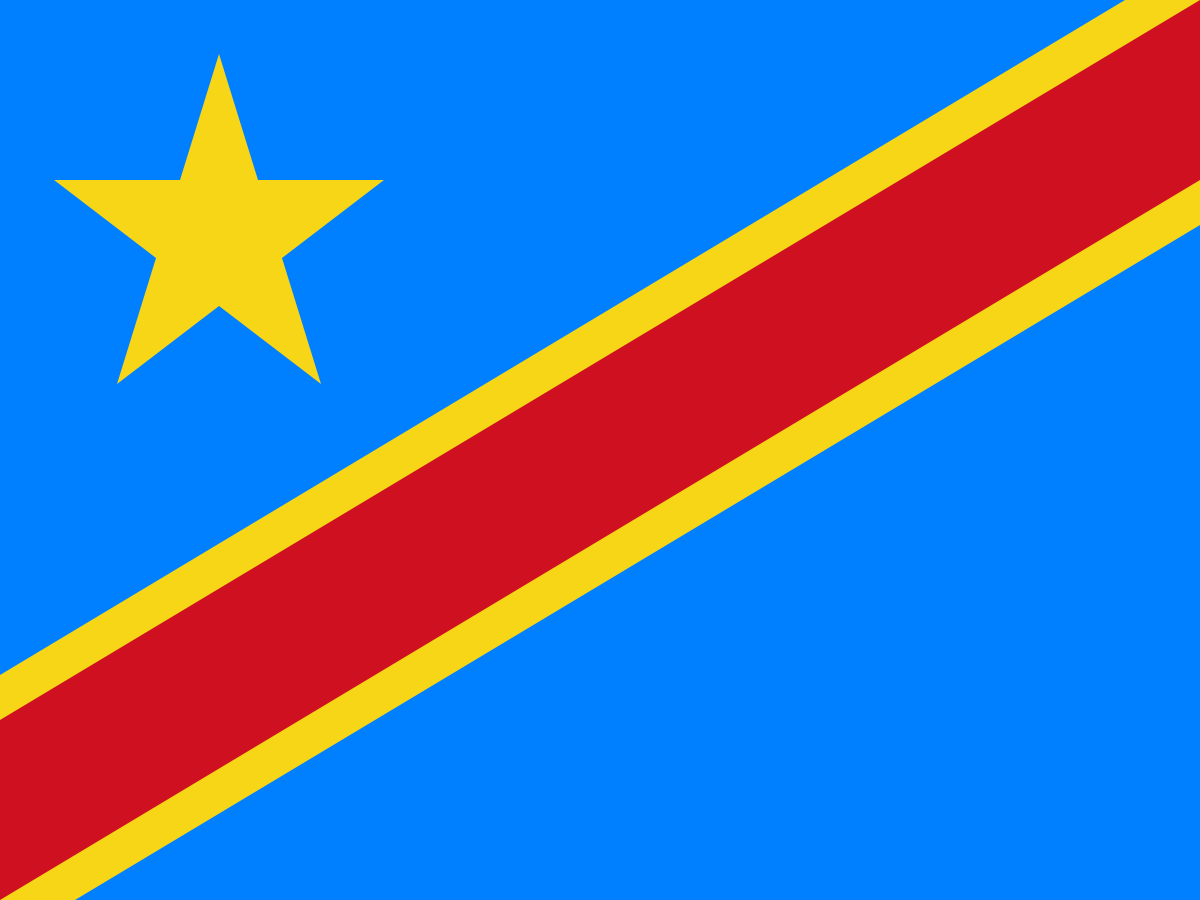
The flag of DR Congo
The current DR Congo flag has a sky-blue field crossed diagonally by a red stripe edged in yellow. A large yellow five-pointed star sits in the upper hoist corner.
The design combines peace, sacrifice, mineral wealth and national unity.
Blue is associated with peace, the red stripe with the blood of those who suffered for the country, yellow with mineral wealth, and the star with unity and hope.
The present flag was adopted in 2006, following the country's transition towards a new constitutional order.
What do the colours mean?
The blue background is traditionally associated with peace. The red diagonal stripe represents the blood shed by the country's martyrs and those who sacrificed for the nation.
The yellow edging is commonly associated with the country's rich mineral resources and wealth. The combination makes the diagonal stripe stand out strongly against the blue field.
The gold star
The large yellow star in the upper hoist is a central feature of the flag. It represents the country's unity and the hope of a better future.
The star is particularly prominent because it is the only major symbol placed on the blue field apart from the diagonal stripe.
The red diagonal stripe
The diagonal red band gives the DR Congo flag its distinctive appearance. It runs from the lower hoist towards the upper fly and is bordered by narrow yellow bands.
The red is linked to sacrifice and the blood of people who died during the country's difficult history. The yellow edging adds the mineral-wealth symbolism associated with the country's natural resources.
A short history of DR Congo
The territory of modern DR Congo has a long history of kingdoms, communities and trading networks. The Kongo Kingdom was one of the major states in the region before and during early European contact.
In the late nineteenth century the territory became the Congo Free State under the personal control of King Leopold II of Belgium. The period was marked by severe exploitation and atrocities.
Belgian colonial rule followed until independence in 1960. The country later became known as Zaire before returning to the name Democratic Republic of the Congo in 1997.
Flag history timeline
Before European ruleCentral Africa contained numerous kingdoms, chiefdoms and trading societies, including the powerful Kongo Kingdom.
1885 — Congo Free StateThe territory was internationally recognised as the Congo Free State under Leopold II.
1908 — Belgian CongoBelgium took over direct colonial administration after international criticism of conditions in the Congo Free State.
1960 — independenceThe Belgian Congo became independent on 30 June 1960 as the Republic of the Congo.
1971 — ZaireThe country was renamed Zaire under Mobutu Sese Seko.
1997 — Democratic Republic of the CongoThe country returned to the name Democratic Republic of the Congo after Mobutu's government fell.
2006 — current flagThe present blue, red, yellow and star design was adopted under the new constitution.
The Congo Free State
From 1885 to 1908, much of the territory was administered as the Congo Free State under King Leopold II of Belgium. The system relied heavily on forced labour, particularly in the extraction of rubber and other resources.
Reports of widespread abuses eventually caused international outrage. In 1908 Belgium took direct control and the territory became the Belgian Congo.
Independence in 1960
The Belgian Congo became independent on 30 June 1960. Independence was followed by political instability, including the Congo Crisis and the secession of Katanga.
The early years of independence had a major influence on the country's later political history and its changing national symbols.
From Congo to Zaire and back
In 1971 the country was renamed Zaire under President Mobutu Sese Seko. A green flag with a yellow hand holding a torch was used during this period.
After Mobutu's government fell in 1997, the country returned to the name Democratic Republic of the Congo. A new flag was eventually adopted in 2006.
Kinshasa
Kinshasa is the capital and largest city of DR Congo, located on the south bank of the Congo River. Across the river is Brazzaville, the capital of the Republic of the Congo.
The two capitals are among the world's closest national capitals, separated by the river. Kinshasa is a major cultural, political and economic centre in Central Africa.
The Congo River
The Congo River is one of the world's great rivers and the deepest known river. Its enormous drainage basin covers a large part of Central Africa.
The river and its tributaries are vital for transport, fishing, agriculture, hydropower and wildlife. The Congo basin is also central to the country's rainforest ecosystem.
The Congo Basin rainforest
DR Congo contains more than half of the remaining Congo Basin rainforest, the second-largest tropical rainforest ecosystem after the Amazon.
The forest stores huge amounts of carbon and supports an extraordinary range of plants and animals. It is also home to millions of people who depend on forest resources.
Gorillas and wildlife
DR Congo has exceptional biodiversity. Its forests are home to mountain gorillas, eastern lowland gorillas, bonobos, okapi, forest elephants and many other species.
Virunga National Park, Kahuzi-Biéga National Park and other protected areas are internationally important for wildlife conservation.
The bonobo
The bonobo is a great ape found naturally only in DR Congo, in forests south of the Congo River. Bonobos are closely related to humans and are one of the world's most distinctive primate species.
Protecting their habitat is a major conservation challenge because forests are affected by hunting, land use and other pressures.
The okapi
The okapi is an unusual forest mammal found only in DR Congo. Although its striped legs resemble a zebra, the okapi is actually more closely related to the giraffe.
It is strongly associated with the country's rainforest and is an important symbol of Congolese wildlife.
Virunga National Park
Virunga National Park in eastern DR Congo is one of Africa's most important protected areas. It contains forests, savannah, wetlands, volcanoes and habitats for mountain gorillas.
The park has also faced serious security and conservation challenges, making protection of its wildlife particularly difficult.
Mount Nyiragongo
Mount Nyiragongo is an active volcano near the city of Goma in eastern DR Congo. It is famous for its extremely fluid lava and has produced major eruptions.
The volcano is part of the Virunga volcanic chain and demonstrates the powerful geological forces shaping the Great Rift Valley region.
Mineral wealth
DR Congo is extraordinarily rich in natural resources. It has major deposits of copper, cobalt, diamonds, gold and other minerals.
Cobalt is particularly important because it is used in many rechargeable batteries. The country's mineral wealth creates major economic opportunities but has also been associated with environmental damage, illegal mining and conflict.
Climate
Much of DR Congo has a tropical climate, with warm temperatures and substantial rainfall. Conditions vary considerably because the country is enormous and includes mountains, forests, savannahs and highland areas.
The Congo Basin's climate and forests are closely connected: rainfall helps maintain the rainforest, while the forest itself influences regional water and carbon cycles.
Agriculture
Agriculture supports a large share of the population. Farmers grow crops including cassava, maize, bananas, plantains, rice and various vegetables.
The country's fertile land and huge river system provide considerable agricultural potential, although poor transport infrastructure and insecurity can make it difficult to develop that potential fully.
Languages of DR Congo
French is the official language and is widely used in government, education and administration. The country is also home to hundreds of local languages.
Four major national languages are commonly highlighted: Lingala, Swahili, Kikongo and Tshiluba. This linguistic diversity reflects the enormous size and cultural variety of the country.
Music and culture
DR Congo has had an enormous influence on African popular music. Congolese rumba developed in the region and became influential across Central Africa and beyond.
Modern Congolese music, dance, fashion and art remain important parts of the country's cultural identity and international reputation.
DR Congo today
DR Congo is a large and resource-rich country with enormous economic and environmental importance. Its forests are critical to global climate discussions, while its minerals are important to modern industries.
The country also faces major challenges, including poverty, infrastructure gaps, political tensions and armed conflict in parts of the east.
Why is the DR Congo flag interesting?
The DR Congo flag is a good example of a relatively simple design carrying several layers of meaning. The blue field represents peace, the red stripe sacrifice, the yellow edging mineral wealth and the star national unity.
Its history is also unusual because the country has used several very different flags during periods of colonial rule, independence, Zaire and the modern Democratic Republic of the Congo.
Explore DR Congo on FlagAtlas
Continue exploring DR Congo and the world's flags with these FlagAtlas resources.