About Timor-Leste
Timor-Leste, commonly called East Timor, is a small country in Southeast Asia occupying the eastern half of the island of Timor. It also includes the Oecusse exclave and the islands of Atauro and Jaco.
Dili is the capital. Timor-Leste became fully independent in 2002 after Portuguese colonial rule, Indonesian occupation and a long struggle for self-determination.
CapitalDili
RegionSoutheast Asia
PopulationAbout 1.3 million
CurrencyUS dollar
Official languagesTetum & Portuguese
Highest pointMount Ramelau
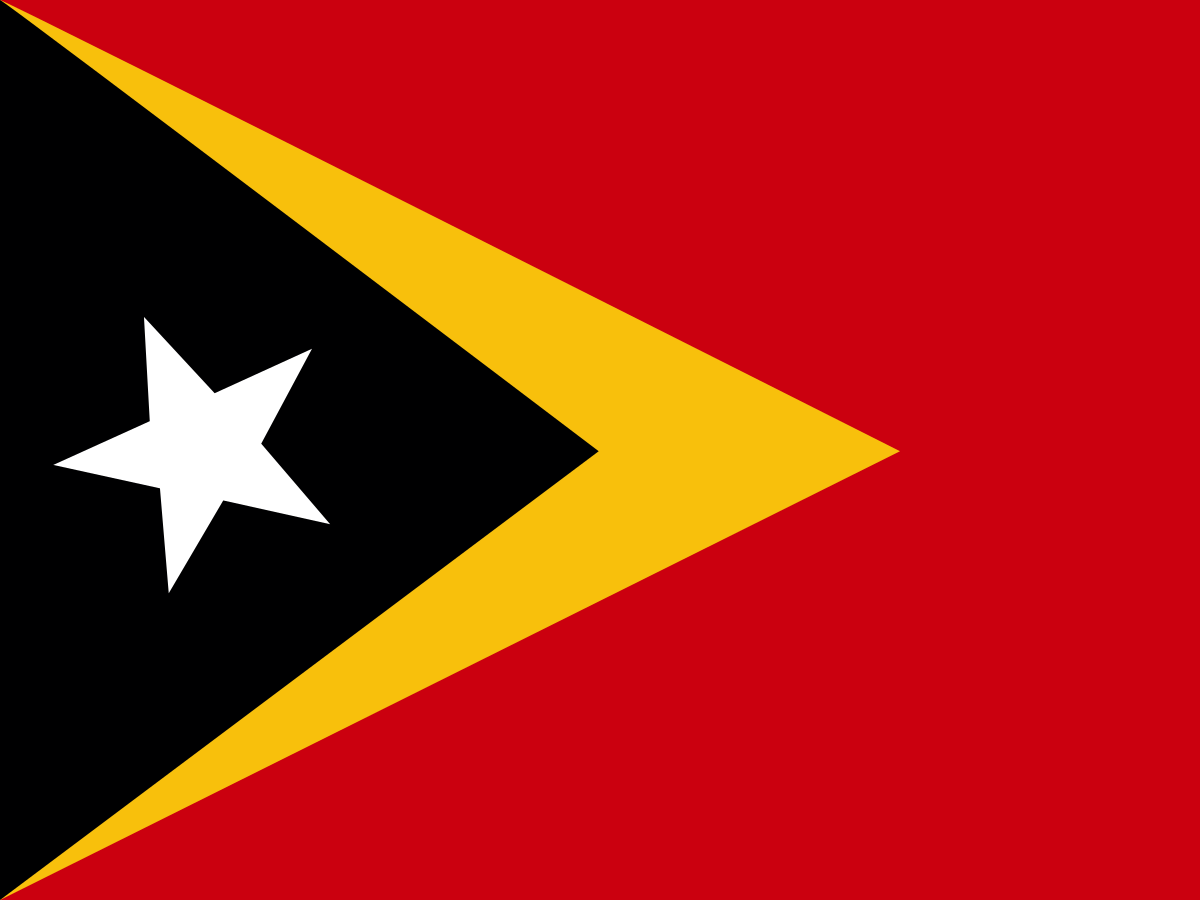
The flag of Timor-Leste
The flag has a red field with a large yellow triangle from the hoist, a smaller black triangle inside it and a white five-pointed star.
The flag is closely connected with the independence struggle.
Red represents liberation, black the colonial past, yellow the nation's wealth and white peace.
The design was first used when independence was declared in 1975 and was restored when full independence was achieved in 2002.
What do the colours mean?
Red represents the struggle for national liberation. Black symbolises the difficult colonial past. Yellow represents the wealth of the nation, while white represents peace.
Together the colours tell a compact story of struggle, history, national resources and hope for a peaceful future.
The white star and triangles
The white five-pointed star is the focal point of the flag and is associated with light, hope and peace. The large yellow triangle and smaller black triangle give the flag its distinctive layered design and were part of the symbolism used by the independence movement.
A short history of Timor-Leste
Timor has a long history of Indigenous communities and regional trade. Portuguese influence became established from the sixteenth century, while the western part of the island developed under Dutch control.
East Timor remained Portuguese until 1975. It declared independence that year, but Indonesia invaded soon afterwards.
Following a UN-backed transition, Timor-Leste became fully independent on 20 May 2002.
Flag history timeline
Portuguese eraPortugal established colonial control over eastern Timor.
1974Political change in Portugal opened the way for decolonisation.
28 November 1975East Timor declared independence and raised its national flag.
1975–1999Indonesia occupied East Timor.
1999A UN-backed referendum produced an overwhelming vote for independence.
20 May 2002Timor-Leste became fully independent and restored its national flag.
Portuguese Timor
Portugal maintained control over much of eastern Timor for centuries. Portuguese influence remains visible in Timor-Leste's official language, Catholic traditions, architecture and legal institutions.
Portuguese colonial rule ended after political change in Portugal in 1974 created an opportunity for self-government.
The 1975 declaration of independence
On 28 November 1975, FRETILIN declared East Timor independent from Portugal. The new republic used the flag that later became the national flag of Timor-Leste.
The declaration was short-lived because Indonesia invaded in December 1975.
The Indonesian occupation
Indonesia occupied East Timor from 1975 until 1999. The period involved armed resistance, political repression and severe humanitarian suffering.
The independence struggle became closely associated with the country's national symbols, including its flag.
The 1999 referendum
In 1999, East Timor held a United Nations-backed referendum. Voters overwhelmingly rejected autonomy within Indonesia and chose independence.
Violence followed, after which an international force was deployed and the territory was administered by the United Nations during the transition to independence.
Independence in 2002
Timor-Leste became fully independent on 20 May 2002. Xanana Gusmão became the country's first president.
The restoration of the flag marked the beginning of a new period as an internationally recognised sovereign state.
Dili — the capital
Dili sits on the northern coast and is the political, economic and cultural centre of Timor-Leste. The city lies between the sea and steep mountains.
Landmarks include the Government Palace, the Santa Cruz area and the Cristo Rei statue overlooking the coast.
Mount Ramelau
Mount Ramelau, also known as Tatamailau, is the highest mountain in Timor-Leste. It rises to almost 3,000 metres and has cultural and spiritual significance as well as being a popular hiking destination.
Geography
Timor-Leste has a rugged landscape of mountains, dry lowlands, valleys and a long coastline. Its territory also includes Oecusse, Atauro and Jaco.
The country's position between Southeast Asia and Australia gives it a distinctive geographical and cultural identity.
Atauro Island
Atauro lies north of Dili and is known for clear waters, coral reefs and marine biodiversity. It has become increasingly popular for diving and nature tourism and lies within the wider Coral Triangle region.
Oecusse
Oecusse is an exclave of Timor-Leste surrounded by Indonesian territory on Timor. It has historical importance because it was one of the earliest areas of Portuguese settlement on the island.
Climate
Timor-Leste has a tropical climate with distinct wet and dry seasons. Much of the country is relatively dry compared with some other parts of Southeast Asia.
Monsoon winds and mountainous terrain strongly influence rainfall. Droughts and extreme rainfall can both affect agriculture.
Agriculture and coffee
Agriculture remains important to many households. Farmers grow maize, rice, cassava, sweet potatoes and other crops.
Coffee is one of Timor-Leste's best-known exports and is grown in mountainous areas, providing income for rural communities.
Languages
Tetum and Portuguese are the two official languages. Indonesian and English are also used in some contexts, reflecting the country's recent history and regional connections.
Several local languages are spoken across different communities.
Religion and culture
Timor-Leste has a predominantly Roman Catholic population, unusual in Southeast Asia. Catholic traditions developed alongside older Indigenous beliefs and Portuguese influence.
Traditional dance, music, weaving and community ceremonies remain important parts of Timorese culture.
Tais weaving
Tais is a traditional handwoven textile produced in Timor-Leste. Patterns and colours can vary between communities and the textiles are used in clothing, ceremonies and cultural displays.
Wildlife and marine life
Timor-Leste's forests, mountains and surrounding seas support diverse wildlife. Its coral reefs and coastal waters are particularly important, while its location near the Coral Triangle gives the country major marine biodiversity value.
Economy
Timor-Leste's economy has historically depended heavily on petroleum resources, although the country is seeking to diversify. Agriculture, coffee, tourism and services are important areas of potential growth.
Creating sustainable employment and reducing dependence on limited natural resources remain major development challenges.
Timor-Leste today
Timor-Leste is a democratic republic and a member of the United Nations. It has built institutions and infrastructure since independence while strengthening its economy and public services.
The country remains closely connected to Indonesia and other Southeast Asian neighbours.
Why is the East Timor flag interesting?
The Timor-Leste flag is strongly tied to the country's independence story. Its four colours and central star create a simple design with a clear historical message: liberation, the colonial past, national wealth and peace.
Explore Timor-Leste on FlagAtlas
Continue exploring East Timor and the world's flags with these FlagAtlas resources.