About Egypt
Egypt is a country in north-eastern Africa, with the Sinai Peninsula extending into Asia. It sits at the crossroads of Africa, the Middle East and the Mediterranean and has one of the world's longest recorded histories.
Cairo is the capital and largest city. The Nile has shaped Egyptian settlement, farming and civilisation for thousands of years, while the Red Sea, Mediterranean coast and desert landscapes give the country a remarkable range of environments.
CapitalCairo
RegionNorth Africa
PopulationAbout 110 million
CurrencyEgyptian pound
Official languageArabic
Highest pointMount Catherine
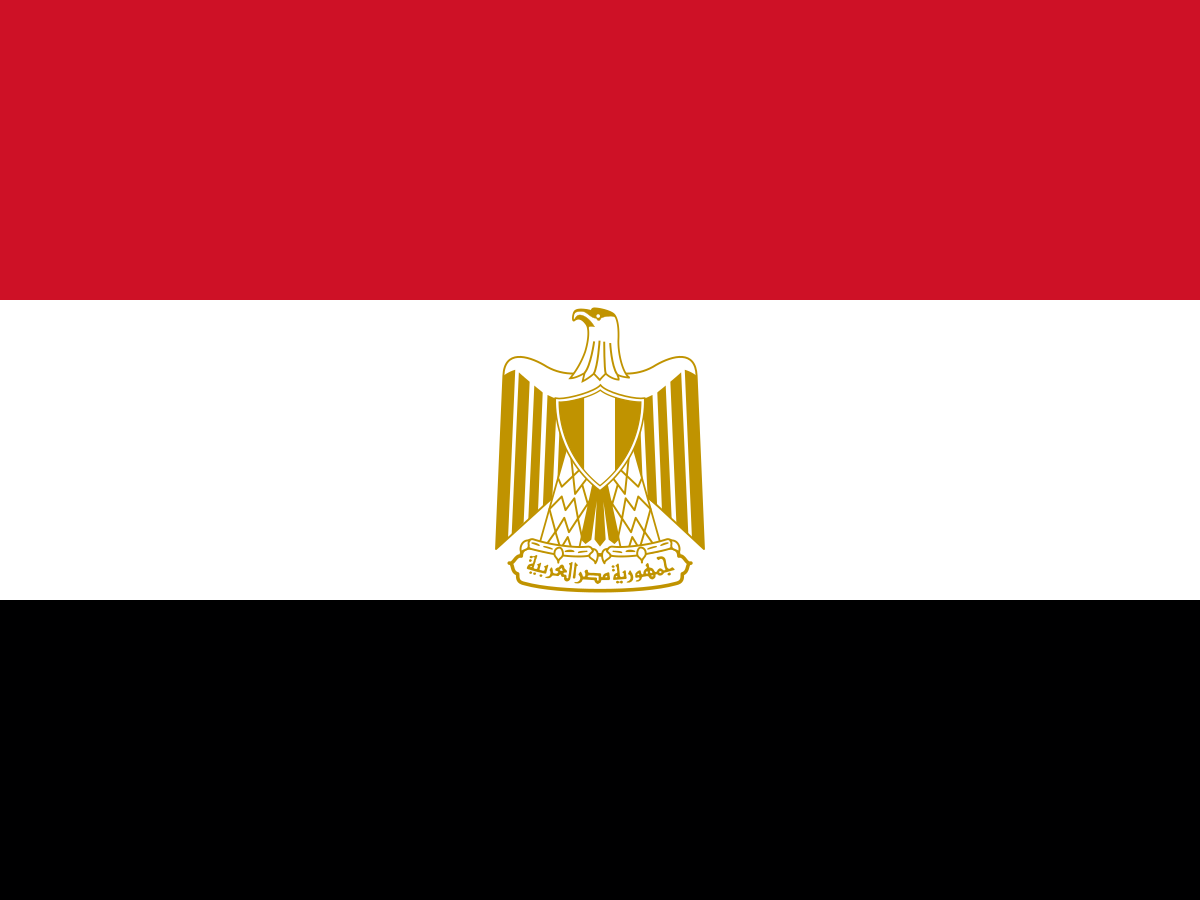
The flag of Egypt
The Egyptian flag has three equal horizontal bands of red, white and black, with the golden Eagle of Saladin in the centre of the white band.
The three colours are part of the wider Pan-Arab colour tradition.
They are associated with the history of Arab nationalism and the political changes that shaped modern Egypt.
The current design was adopted in 1984 and is based on the flag introduced during the period of the Egyptian revolution and the Arab Republic of Egypt.
What do the colours mean?
The red band is traditionally associated with the period before the 1952 revolution and the struggle surrounding Egypt's modern political transformation. White represents the peaceful nature of the revolution, while black represents the end of oppression.
Egypt's red, white and black colours are also closely connected to the wider Pan-Arab flag tradition and appear in several other national flags.
The Eagle of Saladin
The golden Eagle of Saladin is the central emblem on Egypt's flag. It is associated with Salah al-Din, known in the West as Saladin, although the exact historical link between the modern heraldic eagle and Saladin's personal emblem is debated.
The eagle faces the hoist and carries a shield decorated in the colours of the Egyptian flag. A scroll below it bears the Arabic name of the country, جمهورية مصر العربية — Arab Republic of Egypt.
Why is the eagle on the flag?
The eagle became a powerful symbol of Arab nationalism and Egyptian statehood during the twentieth century. Its use connects modern Egypt with a long tradition of regional history and Islamic heritage.
The modern emblem is also a useful example of how national flags can combine historical references with modern political symbolism.
The Pan-Arab colours
Egypt's red, white, black and gold design sits within the wider history of Pan-Arab colours. Red, white, black and green appear in various combinations on flags across the Arab world.
These colours have historical associations with major Arab dynasties and became particularly important during the rise of Arab nationalism in the twentieth century.
A short history of Egypt
Egypt has one of the world's oldest continuous civilisations. Ancient Egyptian civilisation developed along the Nile, producing monumental architecture, writing systems, organised government and major advances in science and engineering.
After the ancient period, Egypt came under Greek, Roman, Byzantine, Islamic, Ottoman and European influence. Modern Egypt became a republic in 1953 after the 1952 revolution ended the monarchy.
Flag history timeline
Ancient EgyptPharaonic civilisation developed around the Nile and produced some of history's most famous monuments.
1517 — Ottoman ruleEgypt became part of the Ottoman Empire.
1882 — British occupationBritain occupied Egypt, although the country formally remained linked to the Ottoman Empire for part of this period.
1922 — nominal independenceEgypt became an independent kingdom, although British influence remained substantial.
1952 — revolutionThe Free Officers Movement overthrew King Farouk.
1953 — republicEgypt became a republic.
1984 — current flagThe present red, white and black flag with the Eagle of Saladin was adopted.
Ancient Egypt
Ancient Egypt developed along the Nile more than 5,000 years ago. The civilisation is famous for the pyramids, temples, hieroglyphic writing, pharaohs and complex religious traditions.
The Nile provided water and fertile soil in an otherwise largely desert environment, making it the foundation of Egyptian civilisation.
The Nile River
The Nile is central to Egypt's geography and history. Most of the country's population and farmland are concentrated in the narrow Nile Valley and the broad Nile Delta.
The river flows north into the Mediterranean and remains essential for agriculture, drinking water, transport and industry.
The pyramids of Giza
The Great Pyramid of Giza and the other pyramids on the Giza plateau are among the world's most famous ancient monuments. The Great Pyramid was built for Pharaoh Khufu and was the tallest human-made structure in the world for thousands of years.
The pyramids demonstrate the organisational, engineering and architectural capabilities of ancient Egyptian civilisation.
The Sphinx
The Great Sphinx of Giza is a monumental limestone statue with the body of a lion and a human head. It stands near the pyramids and is one of Egypt's most recognisable symbols.
The Sphinx is generally associated with the reign of Pharaoh Khafre, although many details about its original purpose remain subjects of archaeological study.
Cairo — the capital
Cairo is Egypt's capital and largest metropolitan area. It sits along the Nile and has been a major political and cultural centre for centuries.
The wider Cairo area includes Giza and some of Egypt's most important ancient and Islamic monuments. The city is also a major centre for education, media and commerce.
The Suez Canal
The Suez Canal connects the Mediterranean Sea with the Red Sea, allowing ships to travel between Europe and Asia without sailing around the southern tip of Africa.
The canal is one of the world's most important shipping routes and is a major source of strategic and economic importance for Egypt.
The Red Sea
Egypt has a long coastline along the Red Sea, known for coral reefs, clear water and marine biodiversity. Resorts such as Hurghada and Sharm El-Sheikh are major tourism destinations.
The Red Sea coast is also important for shipping, fishing and offshore activities.
The Sinai Peninsula
The Sinai Peninsula is the part of Egypt located in Asia. It lies between the Mediterranean Sea and the Red Sea and includes mountains, desert and important coastal environments.
Mount Sinai is traditionally associated with the biblical story of Moses and is an important religious and cultural landmark.
The Sahara Desert
Most of Egypt is desert, forming part of the vast Sahara. The contrast between desert and the fertile Nile Valley is one of the defining features of the country's geography.
Egyptian settlement is heavily concentrated around the Nile because the surrounding desert receives very little rainfall.
Climate
Egypt has a predominantly hot desert climate. Summers can be extremely hot, while winters are generally milder, particularly in the north.
Rainfall is limited in most of the country, with the Mediterranean coast receiving more precipitation than the desert interior.
Egyptian wildlife
Despite its deserts, Egypt supports a variety of wildlife. The Nile and its wetlands provide habitats for birds, fish and other animals, while desert and mountain environments support reptiles, mammals and specialised plant life.
The Red Sea is particularly rich in marine species and coral reef ecosystems.
Languages
Arabic is the official language of Egypt, with Egyptian Arabic widely spoken in everyday life. English and French are also used in education, tourism and business.
Egyptian Arabic has had a major influence on Arabic-language cinema, television and popular culture across the wider Arab world.
Religion and culture
Egypt's population is predominantly Muslim, with a significant Coptic Christian community. Religion has played an important role in Egyptian history, architecture and cultural traditions.
Egypt also has a rich heritage of music, literature, film, crafts and cuisine that has influenced the wider Middle East and North Africa.
Egyptian food
Egyptian cuisine includes dishes such as koshari, ful medames, falafel and molokhia. Bread, beans, rice and vegetables are important staples.
Egypt's cuisine reflects influences from the Nile Valley, Mediterranean, Middle East and North Africa.
The economy
Egypt has one of the largest economies in Africa and the Middle East. Important sectors include tourism, manufacturing, agriculture, energy, construction, services and the Suez Canal.
Tourism is particularly important because of Egypt's ancient monuments, Red Sea resorts and cultural heritage.
Agriculture and the Nile
Agriculture is concentrated along the Nile Valley and Delta, where irrigation makes productive farming possible. Crops include cotton, wheat, rice, maize, sugar cane and vegetables.
Because Egypt receives very little rainfall, the country depends heavily on the Nile for freshwater and agriculture.
The Aswan High Dam
The Aswan High Dam was completed in the 1970s and created Lake Nasser, one of the world's largest artificial lakes. The dam helps control flooding, store water and generate hydroelectric power.
Its construction also led to major archaeological projects, including the relocation of the temples at Abu Simbel.
Egypt today
Egypt is a republic and one of the most influential countries in the Arab world. Its location gives it strategic importance between Africa, Asia and Europe.
The country combines an exceptionally long historical heritage with a modern economy, huge cities and a rapidly changing population.
Why is Egypt's flag interesting?
Egypt's flag is interesting because a relatively simple red, white and black tricolour is transformed by the detailed Eagle of Saladin. It connects modern Egyptian identity with Pan-Arab symbolism, the country's political history and a much older cultural heritage.
Explore Egypt on FlagAtlas
Continue exploring Egypt and the world's flags with these FlagAtlas resources.