About Estonia
Estonia is a small country in Northern Europe on the eastern shore of the Baltic Sea. It borders Latvia and Russia and has maritime links with Finland and Sweden.
Tallinn is the capital and largest city. Estonia is one of the three Baltic states, alongside Latvia and Lithuania, and is known for its forests, islands, digital services and medieval capital.
CapitalTallinn
RegionNorthern Europe
PopulationAbout 1.3 million
CurrencyEuro (€)
Official languageEstonian
Highest pointSuur Munamägi
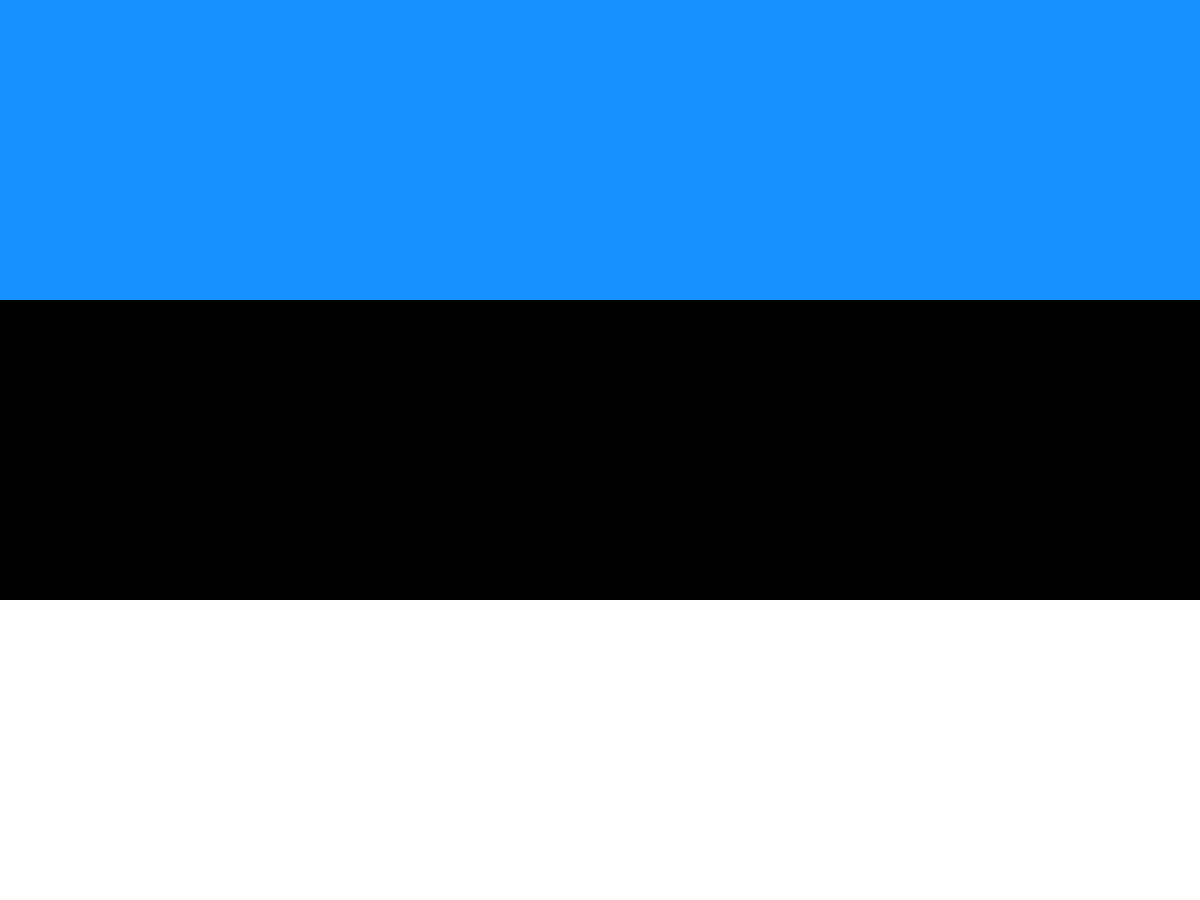
The flag of Estonia
The Estonian flag is a horizontal blue, black and white tricolour. Blue is at the top, black in the middle and white at the bottom.
The blue-black-white combination is one of Estonia's strongest national symbols.
The colours are traditionally associated with Estonia's sky and lakes, its history and land, and hope, light and the future.
The tricolour became a major symbol of Estonian national identity during the nineteenth-century national awakening and was restored as the national flag when Estonia regained independence.
What do the colours mean?
Blue is associated with the sky, lakes and sea and is also linked with loyalty and national identity. Black has been interpreted as representing Estonia's soil and the difficult history of the Estonian people. White is associated with purity, snow, light and hope for the future.
Different historical explanations exist for the colours, but the blue-black-white combination has been strongly associated with Estonian identity for more than a century.
The blue stripe
The upper blue stripe is the most immediately recognisable part of the flag. Blue has traditionally been connected with Estonia's sky, lakes and sea.
It also became an important colour of Estonian national identity during the national awakening of the nineteenth century.
The black stripe
The central black stripe has been associated with Estonia's soil and with the difficult periods experienced by the Estonian people.
Its position between blue and white gives the tricolour a strong visual contrast.
The white stripe
The lower white stripe is traditionally associated with light, purity, snow and the hope of a better future.
Together with blue and black, it creates the distinctive Estonian tricolour.
A short history of Estonia
Estonia has been inhabited for thousands of years by Finno-Ugric peoples. Medieval Estonia came under Danish, German and later Swedish and Russian influence before becoming part of the Russian Empire in the eighteenth century.
The nineteenth century saw a major Estonian national awakening, including the development of the language, literature, music and national symbols that helped shape modern Estonia.
Flag history timeline
1884 — blue, black and white flagThe tricolour was consecrated as the flag of the Estonian Students' Society at Otepää.
1918 — independenceEstonia declared independence and the tricolour became the national flag.
1940 — Soviet occupationEstonia was incorporated into the Soviet Union and the national tricolour was prohibited.
1980s — national revivalThe blue-black-white flag re-emerged during Estonia's Singing Revolution.
1991 — restored independenceEstonia regained independence and restored the historic tricolour.
TodayThe blue-black-white flag remains one of the country's central national symbols.
The Estonian national awakening
During the nineteenth century, Estonians experienced a cultural and political national awakening. The Estonian language, literature, newspapers, music and folklore became increasingly important expressions of national identity.
The blue-black-white flag emerged from this movement and later became a powerful symbol of independence.
The Estonian Students' Society
The modern tricolour was first associated with the Estonian Students' Society. The flag was consecrated in 1884 at Otepää and quickly became a symbol of Estonian national culture.
Its colours survived periods when the flag itself was officially banned.
Independence in 1918
Estonia declared independence on 24 February 1918. The blue-black-white tricolour became the national flag of the new republic.
Estonia's first period of independence lasted until the Soviet occupation in 1940.
Soviet occupation and the flag
Following the Soviet occupation in 1940, Estonia's national symbols were suppressed. The blue-black-white flag could not be openly used as the national flag.
For many Estonians, however, the tricolour remained an important symbol of national identity and the hope of restored independence.
The Singing Revolution
In the late 1980s, Estonia became a major centre of the peaceful movement known as the Singing Revolution. Large gatherings used traditional songs and national symbols to express demands for greater freedom.
The blue-black-white flag became highly visible again and helped symbolise the restoration of independence.
Independence restored in 1991
Estonia restored its independence in 1991 as the Soviet Union collapsed. The historic blue-black-white tricolour was restored as the national flag.
The flag therefore carries memories of both the first republic and the peaceful independence movement of the late twentieth century.
Tallinn — the capital
Tallinn is Estonia's capital and largest city. Its historic centre contains one of Europe's best-preserved medieval old towns, with city walls, towers, churches and merchant buildings.
Modern Tallinn is also a major technology, business and cultural centre.
The Baltic Sea
Estonia's western and northern coastline opens onto the Baltic Sea. The country has thousands of islands and islets, giving it a distinctive maritime geography.
The sea has played an important role in Estonia's trade, fishing, culture and connections with Finland and Sweden.
Estonia's islands
Estonia has many islands, with Saaremaa and Hiiumaa among the largest. Saaremaa is known for its coastline, forests, windmills and traditional villages.
The islands are important for tourism and wildlife and form a distinctive part of Estonian geography.
Forests, lakes and bogs
Forests cover a large share of Estonia, while lakes, wetlands and bogs are widespread. These landscapes support wildlife and provide opportunities for hiking, nature tourism and conservation.
Estonia's relatively flat terrain and northern location give its countryside a distinctive Baltic character.
Climate
Estonia has a temperate climate influenced by the Baltic Sea. Winters are cold, while summers are generally mild.
Day length changes dramatically through the year, with very long summer days and short winter daylight.
Wildlife
Estonia's forests and wetlands support animals such as moose, wild boar, brown bears, wolves, lynx and many bird species.
Its wetlands and islands are particularly important habitats for migratory birds.
Suur Munamägi
Suur Munamägi is the highest point in Estonia, at just over 300 metres above sea level. It is located in the hilly Võru region in the southeast of the country.
Although Estonia is generally flat, the southeast has a more varied landscape.
Languages
Estonian is the official language. It belongs to the Finnic branch of the Uralic language family and is closely related to Finnish, although the two languages are not mutually identical.
Russian is also widely spoken by part of the population, particularly in some urban and northeastern areas.
Estonian culture
Estonian culture places strong emphasis on music, singing, literature, folklore and seasonal traditions. The country's huge Song Festival is one of its best-known cultural events.
Choirs and traditional songs played an important role in the national awakening and later in the Singing Revolution.
Estonian food
Traditional Estonian food reflects the northern climate and local agriculture. Common foods include rye bread, potatoes, pork, fish, dairy products and berries.
Seasonal ingredients such as mushrooms and forest berries are also important in home cooking.
The Estonian economy
Estonia has a modern, open economy based on services, manufacturing, technology, logistics and trade. It is a member of the European Union and euro area.
Digital technology has become a particularly visible part of the country's economy and public services.
Estonia's digital society
Estonia is internationally known for its digital public services. Citizens can access many government services online, and the country has developed systems for digital identity and electronic administration.
Estonia also became well known for its e-residency programme, which allows approved people from around the world to access certain Estonian digital business services.
Estonia today
Estonia is a parliamentary republic and a member of the European Union, NATO and the euro area. Its location on the Baltic Sea gives it close connections with the other Baltic and Nordic countries.
The country combines a strong national identity with a modern digital economy and a deep connection to its language, landscape and cultural traditions.
Why is Estonia's flag interesting?
The Estonia flag is interesting because the simple blue-black-white tricolour carries more than a century of national history. It survived occupation, reappeared during the Singing Revolution and became a symbol of restored independence.
Its three colours also provide a simple visual link between Estonia's sky and sea, land and difficult history, and hope for the future.
Explore Estonia on FlagAtlas
Continue exploring Estonia and the world's flags with these FlagAtlas resources.