About Fiji
Fiji is an island country in the South Pacific, made up of more than 300 islands. It lies roughly halfway between New Zealand and Hawaii and is part of Melanesia.
Suva is the capital and a major political and commercial centre. The two largest islands, Viti Levu and Vanua Levu, contain most of Fiji's population.
CapitalSuva
RegionMelanesia
PopulationAbout 900,000
CurrencyFijian dollar
Official languagesEnglish, iTaukei, Fiji Hindi
Largest islandViti Levu
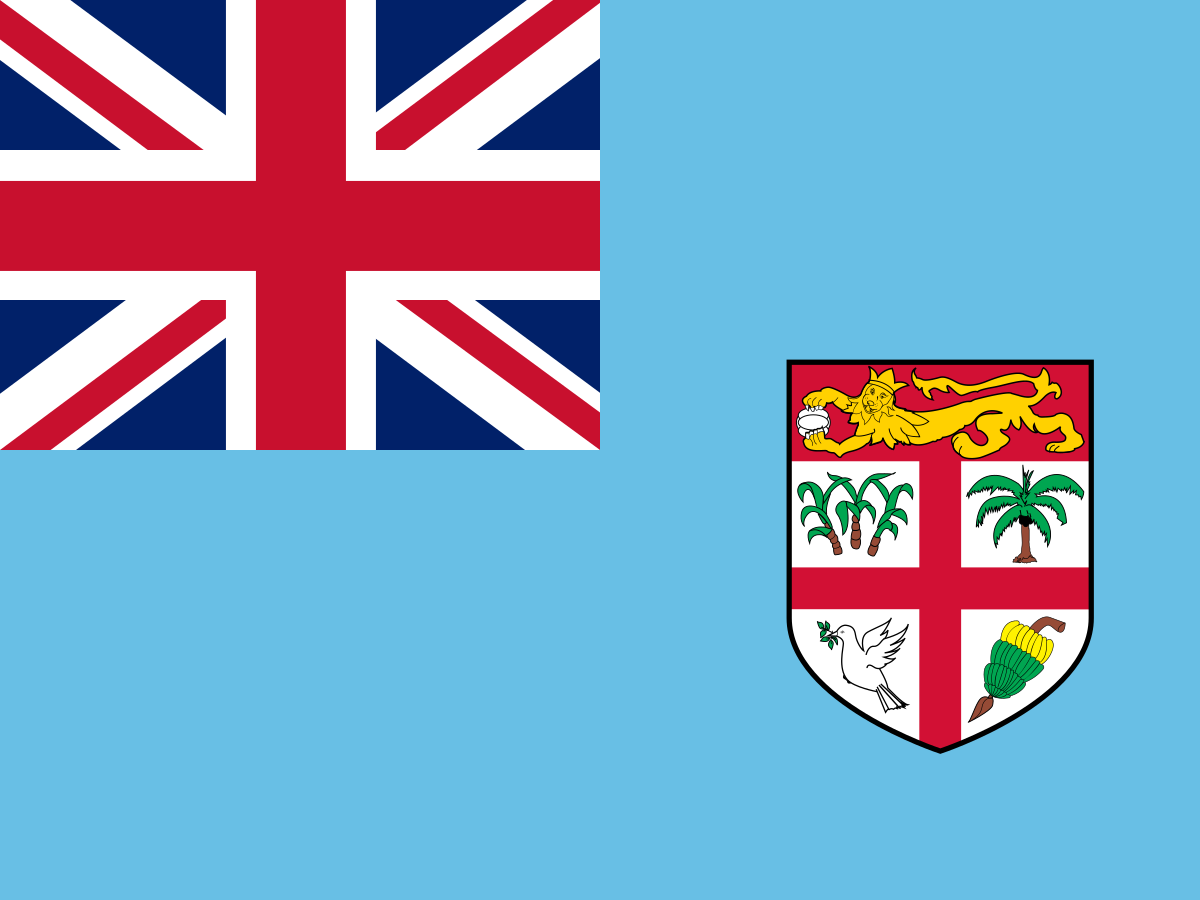
The flag of Fiji
The Fiji flag is a light-blue field featuring the Union Jack in the upper hoist corner and the country's coat of arms on a shield at the fly.
Fiji kept the Union Jack when it became independent in 1970.
The light blue represents the Pacific Ocean, while the shield contains symbols connected with Fiji's agriculture, trade, peace and colonial history.
The current flag was adopted on 10 October 1970, the day Fiji became independent from Britain.
What does the light blue mean?
The flag's light blue background represents the Pacific Ocean surrounding Fiji. It also gives the flag a bright, tropical appearance that reflects the country's island geography.
Fiji's location in the Pacific is central to its identity, economy and connections with neighbouring island states.
The Union Jack
The Union Jack in the canton reflects Fiji's history as a British colony and its former status within the British Empire.
Unlike many former British colonies, Fiji chose to retain the Union Jack on its national flag after independence in 1970.
The shield on the flag
The coat of arms on the shield contains several symbols. A British lion holds a coconut palm, while the shield itself includes sugarcane, a coconut palm, bananas and a dove of peace.
The images represent Fiji's agricultural traditions, natural resources, peace and historical links with Britain.
The lion and coconut palm
The British lion on the shield holds a coconut palm. The lion reflects the country's historical relationship with Britain, while the coconut palm represents an important tropical crop and part of island life.
Coconut products have long been important to Fiji's rural communities and economy.
The sugarcane, bananas and coconut
The shield includes sugarcane, bananas and coconut, reflecting crops that have played an important role in Fiji's agriculture and economy.
Sugarcane in particular became one of Fiji's most important commercial crops during the colonial period.
The dove of peace
A white dove appears in the shield and represents peace. It is one of the most distinctive elements of the coat of arms.
The dove adds a peaceful message to a flag that otherwise contains strong symbols of colonial and agricultural history.
A short history of Fiji
Fiji has been inhabited for thousands of years by peoples of the wider Pacific and Melanesian world. European explorers arrived later, followed by increasing contact with traders, missionaries and settlers.
Fiji became a British colony in 1874 and remained under British rule until independence in 1970.
Flag history timeline
Pre-European periodIndigenous Fijian societies developed across the islands with complex chiefly systems and strong maritime traditions.
1874 — British colonyFiji was formally ceded to Britain and became a British colony.
1960s — move toward independenceFiji developed representative institutions and negotiations for self-government.
1970 — independenceFiji became independent on 10 October and adopted the current light-blue flag.
1987 — coupsTwo military coups changed Fiji's political system and led to major constitutional changes.
1997 — new constitutionA new constitution restored a more inclusive parliamentary framework.
2000 and 2006 — further political crisesFiji experienced another coup in 2000 and a military takeover in 2006.
British colonial Fiji
Britain formally took control of Fiji in 1874. During the colonial period, the sugar industry expanded and large numbers of indentured workers were brought from India.
This history helped create the multicultural society that exists in Fiji today, including the important iTaukei and Indo-Fijian communities.
Independence in 1970
Fiji became independent from Britain on 10 October 1970. Rather than replacing the Union Jack with a completely new design, the new state retained it as part of the national flag.
The light-blue flag therefore combines independence with a visible reminder of Fiji's colonial history.
The 1987 coups
In 1987, two military coups disrupted Fiji's political system after disputes over the country's government and ethnic representation.
The events had a lasting effect on Fiji's constitutional development and relations between its major communities.
Fiji's multicultural society
Fiji has a diverse population. The country's indigenous iTaukei people form the largest ethnic group, while Indo-Fijians, descendants of Indian indentured labourers, form another major community.
Fijian, Indian and other Pacific, Asian and European influences can be seen in the country's food, languages, music and religious life.
Suva — the capital
Suva is Fiji's capital and one of the largest urban centres in the South Pacific. It lies on the southeast coast of Viti Levu and is home to government institutions, businesses and the University of the South Pacific.
Suva is also an important regional centre for Pacific diplomacy and organisations.
Viti Levu and Vanua Levu
Viti Levu is Fiji's largest island and contains Suva, Nadi and most of the country's population. Vanua Levu is the second-largest island and has extensive forests, farms and smaller settlements.
Together these two islands account for most of Fiji's land area and population.
The Pacific islands
Fiji's hundreds of islands range from large mountainous islands to small coral islands and atolls. Many have beaches, lagoons, reefs and tropical forests.
The islands' geography makes Fiji particularly dependent on maritime transport and vulnerable to tropical cyclones and rising sea levels.
Climate
Fiji has a tropical maritime climate with warm temperatures throughout the year. The wetter season generally runs through the warmer months, while the southeast-facing parts of the larger islands are especially wet.
Fiji can be affected by tropical cyclones, particularly during the South Pacific cyclone season.
Coral reefs and marine life
Fiji is surrounded by extensive coral reefs that support colourful fish, sea turtles, sharks and many other marine species.
The country's reefs are important for biodiversity, fishing and tourism, but they are vulnerable to warming seas, coral bleaching and other environmental pressures.
Wildlife
Fiji has distinctive island wildlife including fruit bats, parrots, iguanas and many endemic birds and reptiles. The surrounding ocean supports whales, dolphins, turtles and diverse reef fish.
Because Fiji is an island nation, protecting habitats is especially important for species found nowhere else.
Agriculture
Agriculture remains important, with sugarcane, coconuts, ginger, taro, cassava and tropical fruit among the main crops.
Sugarcane has historically been one of Fiji's most important commercial agricultural products, particularly on Viti Levu and Vanua Levu.
Tourism
Tourism is one of Fiji's most important industries. Visitors are attracted by its beaches, coral reefs, diving, resorts and tropical landscapes.
Tourism also provides employment and foreign exchange, but the sector can be affected by global economic conditions and extreme weather.
Languages
Fiji recognises English, iTaukei and Fiji Hindi as official languages. English is widely used in government and education, while iTaukei and Fiji Hindi are important community languages.
Fiji's linguistic diversity reflects its indigenous Pacific heritage and the history of Indian migration during the colonial period.
Fijian culture
Fijian culture places strong emphasis on community, hospitality, family and village traditions. The kava ceremony, known locally as yaqona, is an important traditional social practice.
Music, dance, rugby and traditional handicrafts are also prominent parts of modern Fijian culture.
Food in Fiji
Fijian cuisine combines indigenous Pacific ingredients with Indian, Chinese and other influences. Common foods include root vegetables, fish, coconut, cassava, taro and spicy curries.
Indo-Fijian cooking has also become an important part of the national food culture.
Rugby in Fiji
Rugby is hugely popular in Fiji, particularly rugby sevens. The national teams have achieved major international success, including Olympic gold medals in rugby sevens.
Rugby is an important source of national pride and is played widely in schools, villages and communities.
The economy
Fiji's economy is based on services, tourism, agriculture, manufacturing and remittances. Tourism is particularly important, while sugar and other agricultural products remain significant.
As a Pacific island state, Fiji also plays an important role in regional trade and diplomacy.
Fiji today
Fiji is a parliamentary republic in the South Pacific and one of the region's most important political and economic centres. It has experienced periods of political instability but has also developed a strong national identity built around its multicultural population and island geography.
Climate change, rising seas and stronger extreme-weather risks are major long-term concerns for Fiji and other Pacific island states.
Why is Fiji's flag interesting?
The Fiji flag is unusual because it combines a British Union Jack, a Pacific-blue background and a detailed coat of arms. It tells several stories at once: Fiji's colonial past, its island environment, its agricultural economy and its aspiration for peace.
It is also a useful example of how a newly independent country can choose to retain important elements of an older flag rather than starting completely from scratch.
Explore Fiji on FlagAtlas
Continue exploring Fiji and the world's flags with these FlagAtlas resources.