About Finland
Finland is a northern European country known for its forests, lakes, islands and long winters. It borders Sweden, Norway and Russia and has a long coastline on the Baltic Sea.
Helsinki is the capital and largest city. Finland is one of the Nordic countries and is well known for its education system, technology sector, design and close connection with nature.
CapitalHelsinki
RegionNorthern Europe
PopulationAbout 5.6 million
CurrencyEuro (€)
Official languagesFinnish & Swedish
Highest pointHalti
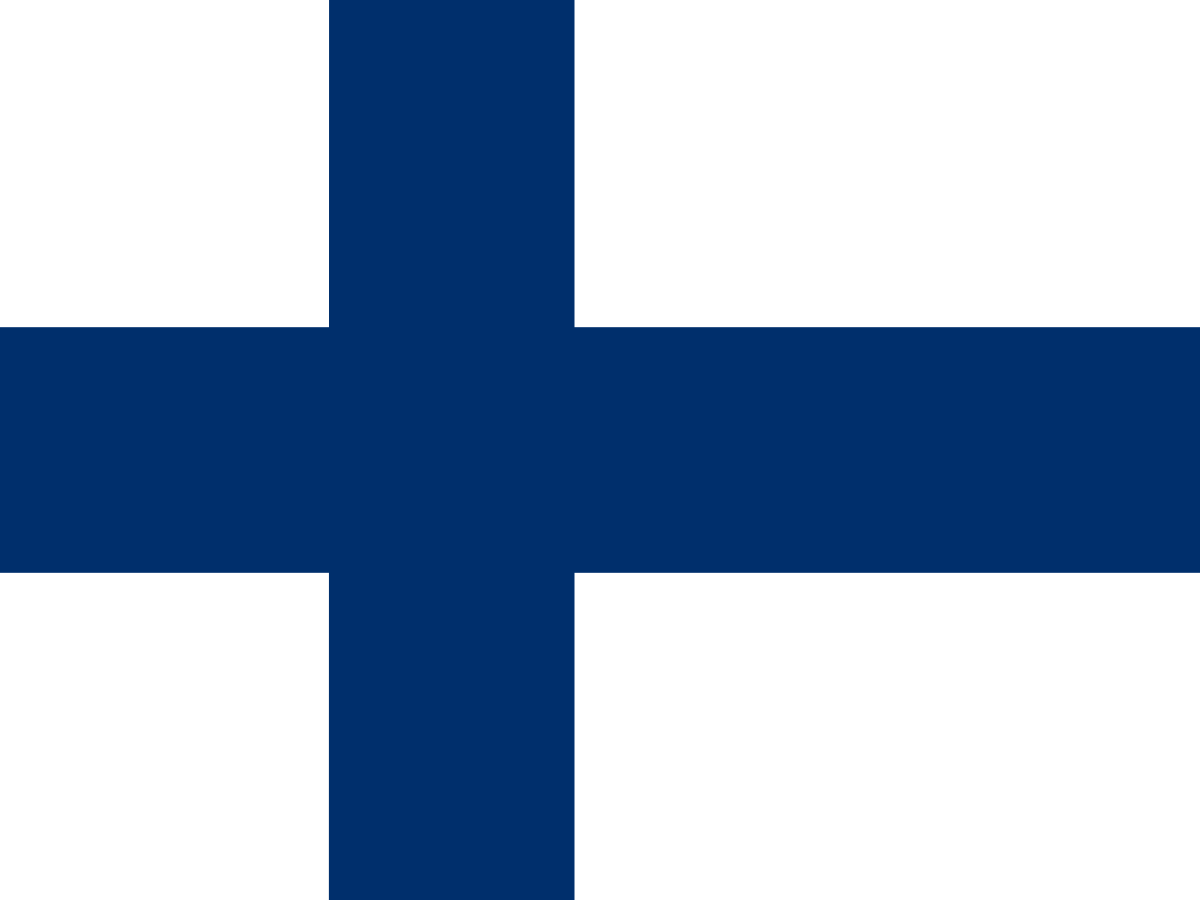
The flag of Finland
The Finnish flag is a white field with a bold blue Nordic cross. The vertical part of the cross is positioned towards the hoist, following the traditional Nordic flag design.
The Finnish flag was officially adopted in 1918.
The blue cross is traditionally associated with Finland's lakes and sky, while the white background represents snow and the country's winter landscape.
The Nordic cross also visually connects Finland with its Scandinavian and wider Nordic neighbours.
What do the colours mean?
Blue is traditionally associated with Finland's many lakes and the sky. White represents the snow-covered landscape.
The combination creates a simple national symbol strongly linked to Finland's natural environment.
The blue Nordic cross
The blue Nordic cross is the defining feature of the Finnish flag. Its design follows the tradition used by other Nordic countries, including Sweden, Denmark, Norway and Iceland.
The cross reflects Finland's cultural and historical connections with the wider Nordic region.
Why is Finland's flag a Nordic cross?
The Nordic cross became an important visual tradition in northern Europe. Finland adopted it partly to emphasise its Nordic identity and its close historical and cultural connections with Sweden and the other Nordic countries.
The cross design also makes the Finnish flag immediately recognisable while keeping it visually related to neighbouring flags.
A short history of Finland
Finland's history has been shaped by its position between Sweden and Russia. For centuries it was part of the Kingdom of Sweden, before becoming an autonomous Grand Duchy within the Russian Empire in 1809.
Finland declared independence in 1917 and adopted the current national flag shortly afterwards.
Flag history timeline
1809 — Grand DuchyFinland became an autonomous Grand Duchy within the Russian Empire after centuries under Swedish rule.
Late 19th century — national awakeningFinnish language, literature and national identity grew increasingly important.
1917 — independenceFinland declared independence from Russia on 6 December.
1918 — flag adoptedThe blue-and-white Nordic cross became Finland's national flag.
1939–1940 — Winter WarFinland fought the Soviet Union during the Winter War.
1941–1944 — Continuation WarFinland again fought the Soviet Union during the Second World War period.
1995 — EU membershipFinland joined the European Union.
2023 — NATO membershipFinland joined NATO, strengthening its security relationship with other Nordic and European states.
Finnish independence
Finland declared independence on 6 December 1917, following the Russian Revolution. The new country then experienced a civil war in 1918 before establishing a parliamentary political system.
Independence Day is celebrated every year on 6 December and is one of Finland's most important national occasions.
The Finnish national awakening
During the nineteenth century, Finnish intellectuals, writers, musicians and political activists helped strengthen a distinct Finnish national identity.
The publication of the national epic Kalevala and the work of figures such as Jean Sibelius contributed to this cultural movement.
The Winter War
In 1939, the Soviet Union invaded Finland, beginning the Winter War. Finland's forces resisted for months despite being much smaller than the Soviet military.
Finland eventually agreed to territorial concessions in 1940, but the conflict became a powerful part of Finnish national memory.
Finland during the Second World War
Finland fought the Soviet Union again during the Continuation War from 1941 to 1944. After the war, Finland maintained its independence while navigating a difficult geopolitical position next to the Soviet Union.
This period helped shape Finland's later emphasis on national defence and pragmatic diplomacy.
Helsinki — the capital
Helsinki is Finland's capital and largest city. It sits on the Gulf of Finland and is known for its coastal setting, architecture, design and public spaces.
The city is the centre of Finnish government, business, culture and higher education.
The Finnish lakes
Finland is famous for its enormous number of lakes. The country contains tens of thousands of lakes, many surrounded by forests and rocky shorelines.
This lake landscape is so important to Finnish identity that the country is often called the "Land of a Thousand Lakes", even though it has far more than a thousand.
Forests and nature
Forests cover a large part of Finland and are central to the country's landscape and economy. Pine, spruce and birch are particularly common.
Finnish people have strong traditions of hiking, camping, fishing, berry picking and spending time in nature.
Climate
Finland has a cold northern climate with long winters and relatively short summers. Southern Finland has milder conditions than Lapland in the north.
Snow cover can last for several months in northern areas, while summer brings very long daylight hours.
The midnight sun
In northern Finland, the sun can remain above the horizon for weeks during summer. This phenomenon is known as the midnight sun.
In winter, the reverse occurs: northern areas experience very short days and periods of polar night.
The Northern Lights
Finland is one of the best-known places to see the Northern Lights, or aurora borealis. They are particularly visible in Finnish Lapland on clear, dark nights.
The colourful lights are caused by charged particles from the Sun interacting with Earth's atmosphere.
Lapland
Finnish Lapland occupies the northern part of the country and is famous for snowy landscapes, forests, reindeer and winter tourism.
Rovaniemi is a major tourist centre and is marketed as the home of Santa Claus, while the region also has a strong Sámi cultural heritage.
The Sámi
The Sámi are the Indigenous people of northern Fennoscandia. In Finland, Sámi communities are concentrated mainly in the far north.
Traditional Sámi livelihoods include reindeer herding, fishing and crafts, and Sámi languages form an important part of Finland's cultural diversity.
Wildlife
Finland's forests and wetlands support wildlife including moose, brown bears, wolves, lynx, reindeer and many bird species.
The country's large areas of relatively undeveloped forest provide important habitats for northern European wildlife.
Saunas
The sauna is one of Finland's most famous cultural traditions. Saunas are used for relaxation, socialising and wellbeing and can be found in homes, public buildings and holiday cottages.
Finland has millions of saunas, making them an everyday part of life rather than simply a tourist attraction.
Finnish design
Finland has a strong international reputation for design and architecture. Designers such as Alvar Aalto helped establish a distinctive Finnish style based on practical forms, natural materials and clean lines.
Finnish design can be seen in furniture, glassware, textiles, buildings and everyday products.
Finnish education
Finland is widely associated with a high-performing education system. Finnish schools emphasise teacher training, equality of access and relatively low levels of standardised testing compared with many countries.
Education is an important part of Finland's national identity and social model.
Languages
Finland has two national languages: Finnish and Swedish. Finnish belongs to the Uralic language family and is closely related to Estonian, while Swedish is a North Germanic language.
The country also recognises Sámi languages in the northern Sámi homeland.
Finnish culture
Finnish culture includes literature, design, music, sauna traditions, outdoor life and distinctive seasonal celebrations. Jean Sibelius is one of the country's best-known composers, while the epic Kalevala is central to Finnish literary heritage.
Modern Finnish culture also has a strong reputation for technology, architecture and popular music.
Finnish food
Finnish cuisine makes extensive use of local ingredients such as rye, potatoes, fish, berries, mushrooms and oats.
Popular foods include salmon, rye bread, karjalanpiirakka (Karelian pies) and various berry-based desserts.
The Finnish economy
Finland has a high-income economy based on services, manufacturing, technology, forestry and engineering. The country has historically been strong in telecommunications, electronics, machinery and paper products.
Finland is also part of the European Union and uses the euro.
Finland today
Finland is a parliamentary republic and a member of the European Union and NATO. It is known for high living standards, strong public institutions, extensive forests and lakes, and a highly educated population.
Its long border with Russia gives Finland a particularly important strategic position in northern Europe.
Why is Finland's flag interesting?
The Finland flag looks extremely simple, but the blue Nordic cross carries a lot of meaning. Blue links the flag to Finland's lakes and sky, while white evokes its snow and winter landscape.
The Nordic cross also places Finland visually within the family of northern European flags, reflecting the country's strong Nordic identity.
Explore Finland on FlagAtlas
Continue exploring Finland and the world's flags with these FlagAtlas resources.