About France
France is one of Europe's largest countries and has territory on the Atlantic Ocean, the English Channel, the Mediterranean Sea and the borders of several European neighbours. It also has overseas territories around the world.
Paris is the capital and largest city. France is a major European political, economic and cultural power and is a founding member of the European Union.
CapitalParis
RegionWestern Europe
PopulationAbout 68 million
CurrencyEuro (€)
Official languageFrench
Highest pointMont Blanc
The flag of France
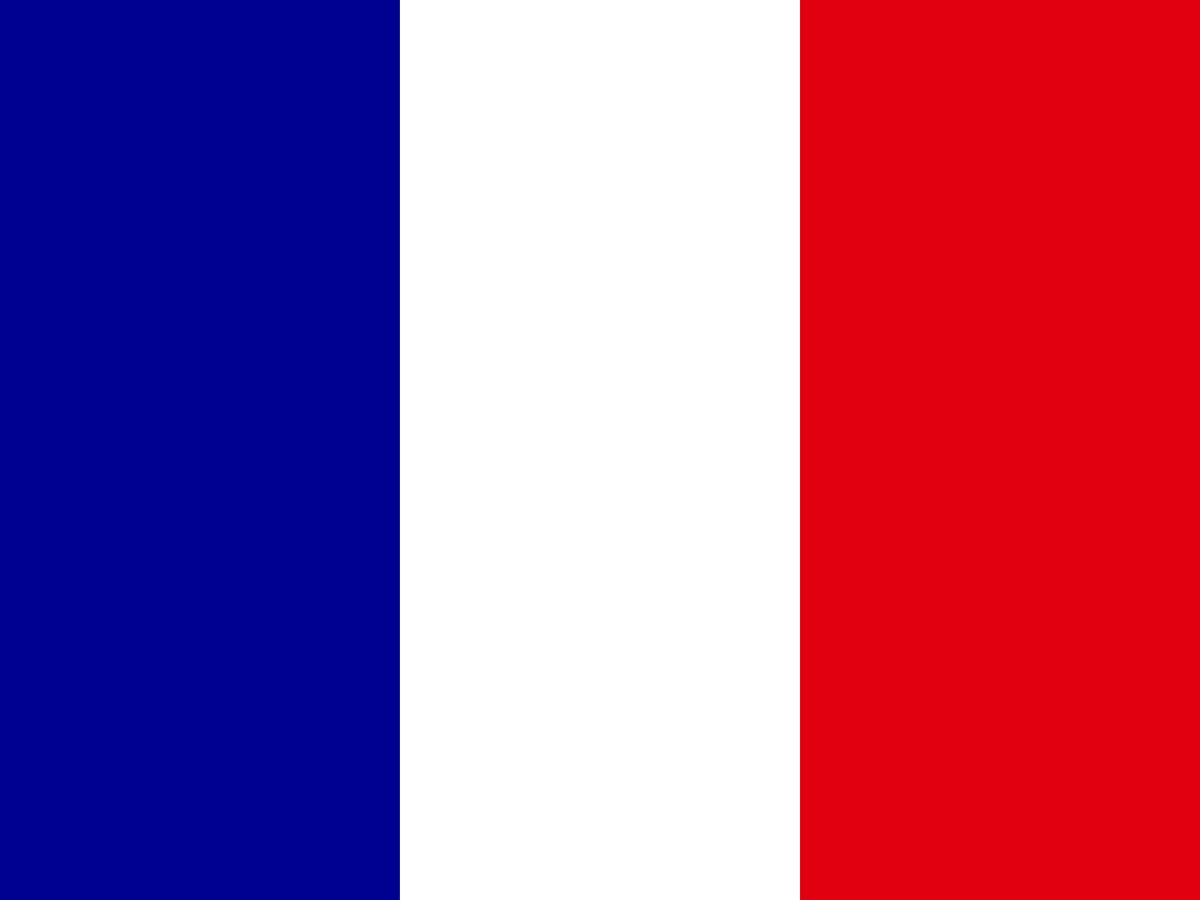
The French flag is a vertical blue, white and red tricolour. The three bands are equal in width, with blue nearest the flagpole.
The tricolore became one of the defining symbols of the French Revolution and the French Republic.
The modern flag developed during the revolutionary period and was formally restored as the national flag in the nineteenth century.
Its simple design has also influenced many other national flags and political movements around the world.
What do the colours mean?
The colours of the French tricolore have acquired several interpretations over time. During and after the Revolution, blue and red were associated with Paris, while white was associated with the monarchy and the historic French royal colour.
Modern republican tradition often connects the colours with the ideals of the French Revolution, including liberty, equality and fraternity, although these are better understood as republican ideals than as a fixed official colour code.
The blue stripe
The blue stripe is positioned next to the flagpole. Blue and red were historically associated with the city of Paris and became important revolutionary colours.
Today blue is simply one of the three national colours of France and appears throughout French national symbolism.
The white stripe
The central white stripe has a particularly interesting history. White was the traditional colour associated with the French monarchy before the Revolution.
Its inclusion in the tricolore helped create a visual compromise between revolutionary Paris and the older French royal tradition.
The red stripe
The red stripe, on the outer edge of the flag, was another traditional colour of Paris. Blue and red became strongly associated with the revolutionary movement in 1789.
Together with white, the colours eventually became the enduring symbol of the French Republic.
The French Revolution
The tricolore is closely connected with the French Revolution of 1789. During the early revolutionary period, blue and red from Paris were combined with white to create a new national symbol.
The flag therefore represents one of the most important political transformations in European history.
A short history of France
France has a long history stretching from prehistoric settlements and Roman Gaul through medieval kingdoms, the French monarchy, revolution, empire and the modern republic.
The country has had several constitutional systems, including monarchies, empires and republics, before the establishment of the present Fifth Republic in 1958.
Flag history timeline
Before 1789White was strongly associated with the French monarchy, while blue and red were associated with Paris.
1789 — French RevolutionBlue and red were combined with white to form the revolutionary tricolore.
1794 — national flagThe vertical blue-white-red arrangement was established as the French national flag.
1814–1830 — RestorationThe Bourbon monarchy restored the white royal flag for a period.
1830 — tricolore restoredThe July Revolution brought the tricolore back as the national flag.
1848 — Second RepublicThe tricolore remained the symbol of republican France.
1958 — Fifth RepublicThe Constitution of the Fifth Republic confirmed the tricolore as the national emblem.
Liberty, Equality, Fraternity
Liberté, Égalité, Fraternité — Liberty, Equality, Fraternity — is the national motto of France. It became particularly associated with the French Republic during the revolutionary and republican traditions.
Although the three colours are often explained through these ideals, the historical origins of the tricolore are more directly connected to Paris, the monarchy and the Revolution.
The French Republic
France is currently the French Republic, governed under the Constitution of the Fifth Republic established in 1958. The president is head of state and the prime minister leads the government.
The French political system combines a directly elected president with a parliament made up of the National Assembly and Senate.
Napoleon and the tricolore
Napoleon Bonaparte used the tricolore extensively during the French Revolutionary and Napoleonic periods. French armies carried the flag across Europe during the Napoleonic Wars.
Its association with revolutionary France helped make the tricolore an internationally recognised symbol of political change.
Paris — the capital
Paris is France's capital and one of the world's most famous cities. It is located on the River Seine and is a major centre for politics, finance, fashion, art, food and tourism.
Landmarks including the Eiffel Tower, Louvre and Notre-Dame have made Paris an important part of France's global cultural identity.
The French regions
Metropolitan France contains a wide range of landscapes, from Atlantic and Mediterranean coasts to forests, plains, hills and the Alps and Pyrenees. France also has overseas territories in the Caribbean, Indian Ocean, Pacific and South America.
This gives France a remarkably varied geography and means the country has territory in several different parts of the world.
The Alps and Mont Blanc
The French Alps contain some of Europe's highest mountains. Mont Blanc, on the French-Italian border, is the highest mountain in France and Western Europe.
The Alps are important for skiing, tourism, biodiversity and freshwater resources.
The Pyrenees
The Pyrenees form a natural mountain barrier between France and Spain. They stretch from the Atlantic to the Mediterranean.
The mountains support forests, alpine habitats, traditional communities and major winter and summer tourism industries.
The Atlantic and Mediterranean coasts
France has extensive coastlines on both the Atlantic Ocean and Mediterranean Sea. The Atlantic coast includes beaches, estuaries and the Bay of Biscay, while the Mediterranean coast is known for its warmer climate and resort towns.
France's maritime position has played an important role in trade, fishing, exploration and tourism.
Climate
France has several climate zones. Much of the country has a temperate climate, while Mediterranean areas have hot, dry summers and the mountains have colder alpine conditions.
The Atlantic Ocean moderates temperatures in the west, while eastern and mountainous regions experience greater seasonal extremes.
Wildlife and landscapes
France contains forests, wetlands, alpine habitats, Mediterranean landscapes and coastal ecosystems. Wildlife includes red deer, wild boar, chamois, marmots, foxes and many bird species.
Protected areas and national parks help conserve habitats from the Alps and Pyrenees to the Mediterranean coast.
French agriculture
France is one of Europe's major agricultural producers. Important products include wheat, maize, grapes, dairy products, beef, poultry and sugar beet.
Wine, cheese and other agricultural products are strongly associated with French regional identity and international exports.
French food
French cuisine is famous worldwide for its regional variety and emphasis on ingredients, technique and presentation. Well-known foods include bread, cheese, pastries, stews, seafood and regional dishes.
French culinary traditions have had a major influence on professional cooking around the world.
French wine
France is one of the world's best-known wine-producing countries. Major wine regions include Bordeaux, Burgundy, Champagne, the Rhône Valley and the Loire Valley.
Wine production is deeply connected with French geography, agriculture, history and regional culture.
French culture and the arts
France has had enormous influence on European and global culture. Its contributions include literature, painting, sculpture, cinema, fashion, architecture and philosophy.
Paris in particular became a major international centre for artists and writers, especially from the nineteenth century onwards.
The French language
French is the official language of France and is spoken across the country and in many overseas territories. It is also one of the world's major international languages.
France has regional languages and dialects, including Breton, Occitan, Corsican, Alsatian and several others.
France and the European Union
France is one of the founding members of the modern European integration project and remains one of the EU's most influential member states.
It uses the euro and works closely with Germany and other European countries on economic, political and security policy.
The French economy
France has a large, diversified high-income economy based on services, manufacturing, tourism, agriculture, aerospace, transport, luxury goods and technology.
Major French companies operate internationally in industries including aviation, automobiles, energy, food, fashion and finance.
France today
France is a major European and global power with a permanent seat on the United Nations Security Council, membership of the EU and NATO, and a large overseas presence.
Its national identity combines republican institutions with a long history of monarchy, revolution, empire and cultural influence.
Why is France's flag interesting?
The France flag looks simple, but its three colours tell a complicated political story. The blue and red of Paris were joined with the white of the monarchy during the Revolution, creating a symbol that survived changing governments, empires and restorations.
Today the tricolore is one of the world's most recognisable republican flags.
Explore France on FlagAtlas
Continue exploring France and the world's flags with these FlagAtlas resources.