About Gabon
Gabon is a country on the west coast of Central Africa, crossed by the equator and bordered by Equatorial Guinea, Cameroon and the Republic of the Congo. Its coastline faces the Atlantic Ocean.
Libreville is the capital and largest city. Gabon is famous for its extensive tropical rainforests, biodiversity and relatively low population density.
CapitalLibreville
RegionCentral Africa
PopulationAbout 2.3 million
CurrencyCentral African CFA franc
Official languageFrench
EquatorPasses through Gabon
The flag of Gabon
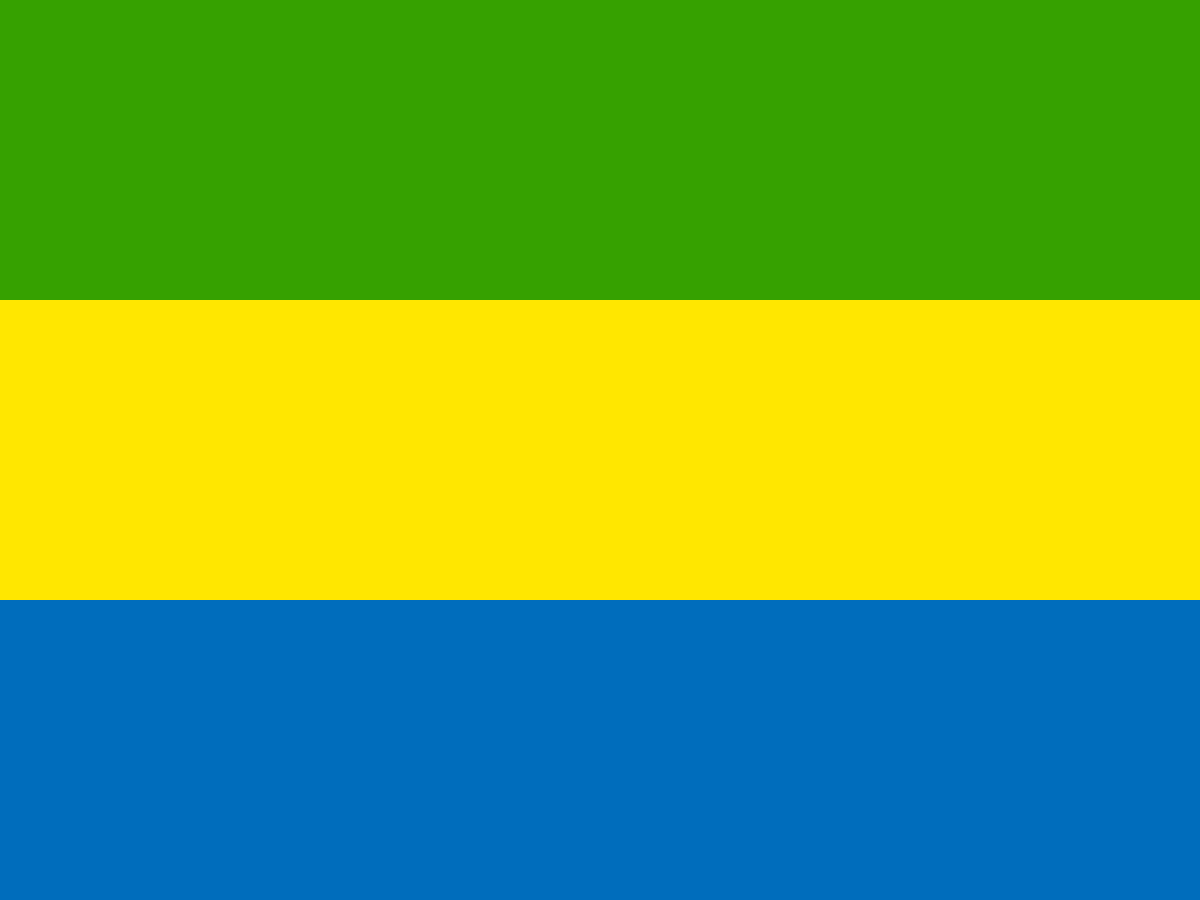
Gabon has a horizontal green, yellow and blue tricolour. The colours reflect three defining features of the country: its forests, its equatorial position and the Atlantic Ocean.
Gabon is one of the few countries whose flag symbolism is closely tied to its location on the equator.
The yellow band is commonly associated with the equator and the sun, while green and blue represent the country's forests and Atlantic waters.
The flag was adopted in 1960, when Gabon became independent from France.
What do the colours mean?
The green stripe represents Gabon's forests and vegetation, the yellow stripe is associated with the equator and the sun, and the blue stripe represents the Atlantic Ocean.
Together, the three colours capture Gabon's geography particularly well: rainforest, equatorial Africa and the sea.
The green stripe
Green is a natural choice for Gabon because much of the country is covered by tropical rainforest. Forests dominate large areas of the interior and support exceptional biodiversity.
Forest resources have also played an important role in Gabon's economy, particularly timber production.
The yellow stripe
The central yellow band is associated with the equator, which crosses Gabon, and with the country's tropical sunlight.
Putting the yellow band between green and blue also creates a simple visual representation of Gabon's position between its forests and the Atlantic coast.
The blue stripe
Blue represents the Atlantic Ocean along Gabon's western coastline. The sea is important for fishing, trade, transport and coastal communities.
Gabon has a relatively short coastline compared with some African countries, but it includes important estuaries, beaches and marine habitats.
The equator and Gabon
The equator crosses Gabon through the central part of the country. This gives Gabon a distinctive geographical identity within Central Africa.
The equatorial position contributes to Gabon's warm, humid climate and helps explain the country's extensive rainforest.
A short history of Gabon
Gabon has been home to many African peoples and communities for centuries. European traders and explorers arrived along the coast from the fifteenth century onwards, followed by increasing French influence during the nineteenth century.
Gabon became part of French Equatorial Africa and eventually gained independence from France in 1960.
Flag history timeline
Before European ruleNumerous African communities developed across the region, with trade and migration shaping Gabon's population.
19th century — French influenceFrance expanded its control over Gabon and the surrounding region.
1910 — French Equatorial AfricaGabon became part of the French colonial federation of French Equatorial Africa.
1960 — independenceGabon became independent from France and adopted its green, yellow and blue national flag.
1970s — oil developmentPetroleum production became increasingly important to Gabon's economy.
2002 — national parksGabon established a major network of national parks to protect its forests and wildlife.
TodayGabon remains one of Central Africa's most forested countries and continues to balance oil, mining, forestry and conservation.
French colonial Gabon
Gabon became part of the French colonial system during the nineteenth century and later formed part of French Equatorial Africa alongside neighbouring territories.
French remains Gabon's official language, reflecting the country's colonial history and its continuing connections with the wider Francophone world.
Independence in 1960
Gabon gained independence from France on 17 August 1960. Independence Day is now one of the country's major national celebrations.
The flag adopted by the new republic retained the three colours that strongly connect Gabon with its forests, equator and Atlantic location.
Libreville — the capital
Libreville is Gabon's capital and largest city. It sits on the Atlantic coast and is the country's main political, commercial and transport centre.
The city grew during the colonial period and today contains much of Gabon's government, business and cultural activity.
The Atlantic coast
Gabon's Atlantic coastline includes beaches, mangroves, estuaries and lagoons. Coastal waters support fisheries and marine ecosystems as well as ports and shipping.
The meeting of rainforest and ocean makes Gabon especially rich in biodiversity.
Gabonese rainforest
Gabon contains enormous areas of tropical rainforest within the Congo Basin. Forests cover more than four-fifths of the country, making Gabon one of Africa's most heavily forested states.
The forests store carbon, regulate water systems and provide habitat for thousands of plant and animal species.
Loango National Park
Loango National Park is famous for the unusual meeting of forest, savannah, wetlands and Atlantic coastline. It is particularly known for wildlife that can be seen close to the beach.
Hippos, elephants, buffalo and gorillas are among the species associated with the park, while marine life can be seen offshore.
Ivindo National Park
Ivindo National Park protects large areas of rainforest and is known for spectacular waterfalls and rivers. It is an important refuge for forest wildlife.
The park forms part of Gabon's wider conservation network and demonstrates the country's commitment to protecting major rainforest ecosystems.
Wildlife
Gabon is exceptionally rich in wildlife. Its forests are home to forest elephants, western lowland gorillas, chimpanzees, mandrills, buffalo and many bird species.
Gabon has become particularly well known for efforts to protect forest elephants and other large mammals from poaching.
Gorillas and primates
Gabon contains important populations of western lowland gorillas, chimpanzees and mandrills. Dense forests provide habitat for many species of primate.
Conservation programmes and protected areas are important because habitat loss and illegal hunting can threaten these animals.
Forest elephants
The forest elephant is smaller than the better-known savanna elephant and is adapted to life in Central Africa's dense forests. Gabon is one of its most important remaining strongholds.
Protecting forest elephants is a major conservation priority because ivory poaching has had a serious impact on populations across Central Africa.
Climate
Gabon has a predominantly equatorial tropical climate, with high temperatures, high humidity and substantial rainfall. Rainfall patterns vary across the country, with a generally wetter northern and coastal environment.
The climate supports the dense rainforest that dominates much of Gabon's landscape.
Agriculture
Agriculture includes crops such as cassava, plantains, bananas, rice, maize and vegetables. Farming is important for rural communities, although Gabon imports a significant share of its food.
Forest products and commercial agriculture both contribute to the rural economy.
Oil and the economy
Petroleum has been central to Gabon's economy since major oil production developed in the twentieth century. Oil exports have generated substantial national income.
Gabon has also sought to diversify through mining, timber processing, agriculture and other industries while reducing its dependence on oil.
Timber and natural resources
Gabon has extensive timber resources, particularly valuable tropical hardwoods. Forestry has long been an important economic activity.
The country has increasingly emphasised local processing and sustainable forest management rather than simply exporting raw timber.
Gabon and conservation
Gabon has made conservation a major part of its national identity. A large network of protected areas was established in 2002, including 13 national parks.
The country's forests are also important in global discussions about carbon storage, biodiversity and climate change.
Languages
French is the official language of Gabon and is widely used in government, education and business. Numerous indigenous languages are also spoken.
These languages belong mainly to the Bantu language family and reflect the country's diverse communities.
Gabonese culture
Gabon has a rich cultural tradition of music, dance, storytelling, masks and sculpture. Different ethnic groups maintain their own customs and artistic traditions.
Traditional wood carving is particularly important, while modern Gabonese culture blends African traditions with French and other international influences.
Traditional masks
Gabon is famous for its traditional wooden masks, which have been used in ceremonies, dances and rites by different communities.
Styles vary considerably between ethnic groups, and Gabonese masks have also influenced international interest in African art.
Food in Gabon
Gabonese food often uses cassava, plantains, fish, meat, peanuts and leafy vegetables. Coastal communities make extensive use of seafood, while forest regions traditionally rely on a wider range of locally available foods.
French influence can also be seen in some modern urban cuisine.
Gabon today
Gabon is a relatively small-population country with significant natural resources and one of the largest remaining rainforest areas in Africa. Its economy remains closely connected to oil, manganese and timber, while conservation has become increasingly important.
The country is also part of the Central African Economic and Monetary Community and uses the Central African CFA franc.
Why is Gabon's flag interesting?
Gabon's flag is a good example of a national symbol that directly reflects geography. Green represents the rainforest, yellow the equator and sun, and blue the Atlantic Ocean.
Few flags tell the story of a country's physical landscape quite so clearly, making Gabon's simple tricolour particularly memorable.
Explore Gabon on FlagAtlas
Continue exploring Gabon and the world's flags with these FlagAtlas resources.