About The Gambia
The Gambia is a small country in West Africa almost completely surrounded by Senegal, apart from its short Atlantic coastline. Its territory follows the course of the Gambia River deep into Senegal.
Banjul is the capital, while the greater urban area around Serrekunda is the country's largest population centre. The river is central to the country's geography, history and economy.
CapitalBanjul
RegionWest Africa
PopulationAbout 2.4 million
CurrencyDalasi
Official languageEnglish
Major riverGambia River
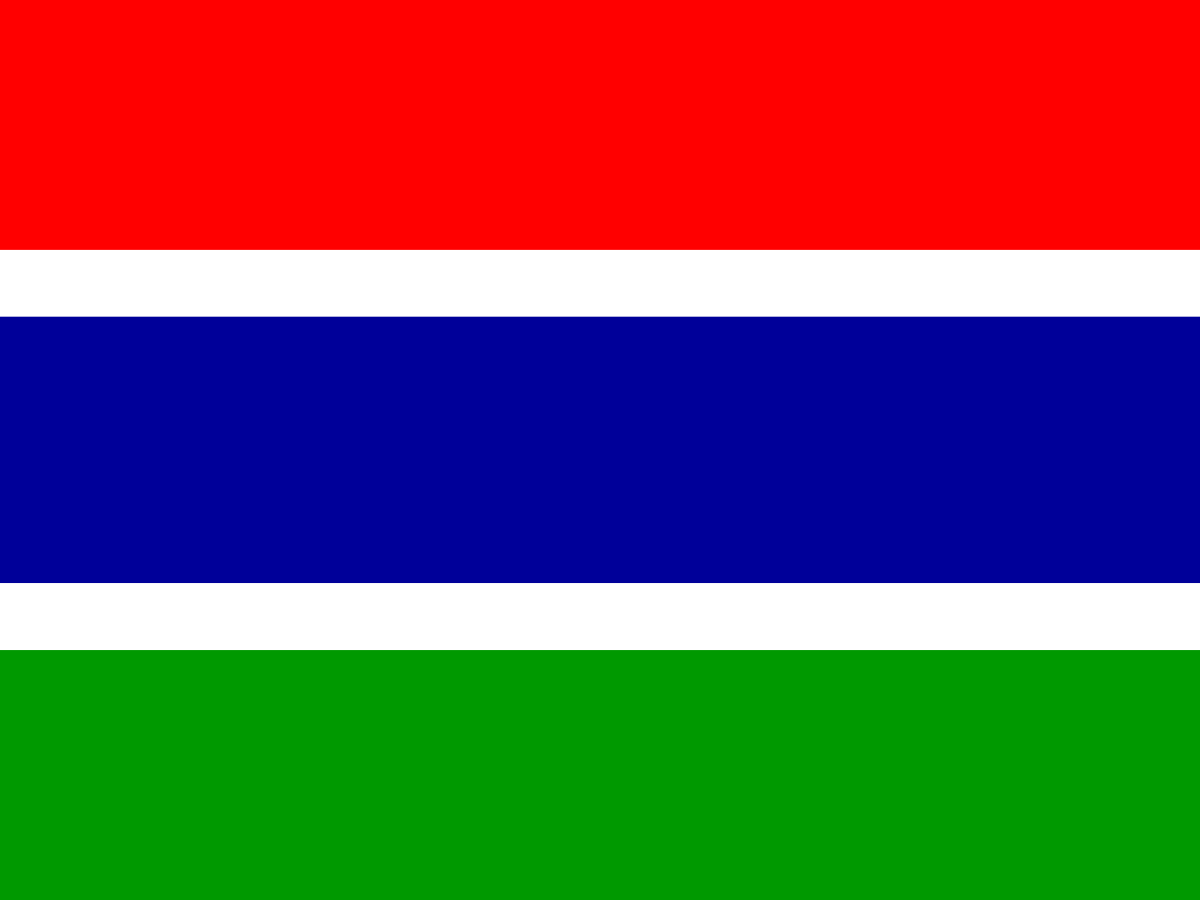
The flag of The Gambia
The Gambian flag has horizontal bands of red, blue and green, separated by two narrow white stripes.
The flag's colours are closely connected to the country's natural landscape.
Red represents the sun and savannah, blue represents the Gambia River, green represents the forests and agricultural land, while white represents peace and unity.
The current flag was adopted in 18 February 1965, when The Gambia became independent from Britain.
What do the colours mean?
The red band represents the sun and the savannah, the blue band represents the Gambia River, and green represents the forests and agricultural land. The two narrow white stripes symbolise peace and unity.
The colours therefore tell a compact story about the country's landscape and national identity.
The red stripe
Red is associated with the sun and the savannah. The Gambia has a tropical climate with a pronounced dry season, during which the landscape in many areas becomes much drier and more golden.
The red band gives the flag a strong, warm upper section and reflects the importance of sunlight in the country's environment.
The blue stripe
The central blue band represents the Gambia River, the defining geographical feature of the country.
The river runs through almost the entire country and has shaped settlement, transport, agriculture, fishing and trade for centuries.
The green stripes
Green represents the country's forests and agricultural land. Farming remains important to Gambian communities, while trees and vegetation are particularly significant during the rainy season.
Green also provides a strong contrast with the red and blue bands in the national design.
The white stripes
The two narrow white stripes represent peace and unity. They separate the three main colours and give the flag its distinctive appearance.
The white bands are narrow but important: without them, the red, blue and green sections would form a much simpler tricolour.
The Gambia River
The Gambia River is the central geographical feature of the country. It flows from Guinea through Senegal and The Gambia before reaching the Atlantic Ocean.
The river has historically provided transport routes, fishing grounds, fertile land and access to inland trade. It is also one of the key reasons the country has its unusual narrow shape.
Why is The Gambia so narrow?
The Gambia's borders largely follow the Gambia River. During the colonial period, British control centred on the river and its trading routes, while surrounding territory became part of French Senegal.
The result is a long, narrow country extending inland from the Atlantic coast.
A short history of The Gambia
The region has a long history of trade and powerful West African states, including connections with the Mali and Songhai empires. European traders later established coastal and river settlements.
Britain eventually controlled The Gambia as a colony and protectorate before the country became independent in 1965.
Flag history timeline
Before European ruleThe region was connected to major West African trading networks and states, including Mali and Songhai.
15th century — European contactPortuguese sailors reached the Gambia River and became involved in Atlantic trade.
17th–19th centuries — British influenceBritain expanded control around the Gambia River and established Bathurst, now Banjul.
1888 — colony establishedThe Gambia became a separate British colonial territory.
1965 — independenceThe Gambia became independent on 18 February and adopted the current flag.
1970 — republicThe country became a republic while retaining Dawda Jawara as president.
1994 — military coupYahya Jammeh seized power in a military coup.
2017 — political transitionAdama Barrow became president following a contested election and regional intervention after Jammeh initially refused to leave office.
British colonial history
Britain's influence in The Gambia grew around the river and its trading settlements. Bathurst, now Banjul, became an important colonial centre.
The surrounding region was largely controlled by France as part of Senegal, which explains the unusual shape of the modern country.
Independence in 1965
The Gambia became independent from Britain on 18 February 1965. The country chose to retain its existing geographic identity while adopting a distinctive new flag.
Independence Day remains one of the country's major national celebrations.
The republic and Dawda Jawara
In 1970, The Gambia became a republic, with Dawda Jawara serving as its first president. He remained in office until the military coup of 1994.
Jawara's long period in government made him one of the central figures in the country's post-independence history.
The 1994 coup and Yahya Jammeh
In 1994, Lieutenant Yahya Jammeh led a military coup and became head of state. His government remained in power for more than two decades.
Jammeh eventually lost the 2016 election to Adama Barrow but initially refused to leave office, leading to a regional political and military intervention in 2017.
Banjul — the capital
Banjul is The Gambia's capital and is located on St Mary's Island near the mouth of the Gambia River. It was founded as a British colonial settlement and was originally called Bathurst.
Although Banjul is the official capital, the wider Greater Banjul Area contains much of the country's population and economic activity.
The Atlantic coast
The Gambia has a relatively short Atlantic coastline with sandy beaches, lagoons and coastal resorts. Tourism is concentrated particularly around the coastal area west of Banjul.
The coast is also important for fishing and maritime trade.
Climate
The Gambia has a tropical climate with a distinct wet season and dry season. Rainfall is concentrated mainly between June and October, while the rest of the year is generally much drier.
The dry season is influenced by the Harmattan, a dry and dusty wind that blows from the Sahara region.
Wildlife
The Gambia has a wide variety of birdlife and other wildlife despite its small size. Species include monkeys, baboons, hippos, crocodiles, antelope and many wetland and woodland birds.
The river and its surrounding wetlands are particularly important habitats.
Abuko Nature Reserve
Abuko Nature Reserve is one of The Gambia's best-known protected areas. It preserves woodland and wetland habitat close to the country's main urban areas.
Visitors may see monkeys, antelope, crocodiles and a wide variety of birds.
The River Gambia National Park
The River Gambia National Park protects several islands in the middle of the Gambia River. It is especially well known for its primate conservation work.
The park includes the Chimpanzee Rehabilitation Project, which has helped provide a protected environment for rescued chimpanzees.
Agriculture
Agriculture is important to The Gambia's rural economy. Major crops include groundnuts, rice, millet, maize, cassava and vegetables.
Groundnuts, also known as peanuts, have historically been particularly important to exports and rural livelihoods.
Groundnuts and trade
Groundnuts have played a major role in The Gambia's economic history. During the colonial period, peanut production and export became central to the country's trading economy.
Although the economy has diversified, agriculture remains important for employment and food production.
Tourism
Tourism is one of The Gambia's major sources of foreign currency. Visitors are attracted by beaches, warm weather, wildlife, birdwatching and cultural experiences.
The country's relatively compact size means visitors can combine coastal resorts with trips inland along the river.
Birdwatching in The Gambia
The Gambia is a popular destination for birdwatchers. Its river, wetlands, mangroves, forests and savannah create habitats for a large variety of African and migratory birds.
Birdwatching tourism is an important part of the country's nature-tourism industry.
Languages
English is the official language, reflecting The Gambia's British colonial history. Many indigenous languages are widely spoken, including Mandinka, Wolof, Fula, Jola and Serer.
The country's linguistic diversity reflects its position within the wider cultural region of West Africa.
Gambian culture
Gambian culture includes strong traditions of music, dance, storytelling and community life. The griot tradition of oral historians and musicians is important across parts of West Africa.
Music styles, drumming and dance remain central to festivals, celebrations and everyday cultural expression.
Food in The Gambia
Gambian cuisine often features rice, fish, peanuts, vegetables, cassava and spicy sauces. Popular dishes include benachin, domoda and yassa.
Peanuts are particularly important in sauces and are a distinctive ingredient in many Gambian dishes.
The economy
The Gambian economy is based on services, tourism, agriculture, trade and remittances. Tourism is especially important because of the country's Atlantic beaches and wildlife.
The small domestic market and limited natural resources mean The Gambia remains closely connected to regional trade and overseas income.
The Gambia today
The Gambia is a small West African republic with a population of around 2.4 million. Its identity is strongly connected to the Gambia River, Atlantic coast and diverse West African culture.
The country continues to develop its tourism, agriculture and services sectors while strengthening democratic institutions after decades of authoritarian rule.
Why is The Gambia's flag interesting?
The Gambia flag is a remarkably clear geographical symbol. Red represents the sun and savannah, blue represents the Gambia River, green represents forests and agricultural land, and white represents peace and unity.
Unlike many flags where the colour meanings require interpretation, The Gambia's design tells the story of the country's landscape almost at a glance.
Explore The Gambia on FlagAtlas
Continue exploring The Gambia and the world's flags with these FlagAtlas resources.