About Germany
Germany is a large country in Central Europe bordered by nine countries and stretching from the North and Baltic Seas to the Alps. It is Europe's largest economy and one of the world's major industrial and trading powers.
Berlin is the capital and largest city. Germany is a federal republic made up of 16 states, known as Länder.
CapitalBerlin
RegionCentral Europe
PopulationAbout 84 million
CurrencyEuro (€)
Official languageGerman
States16 Länder
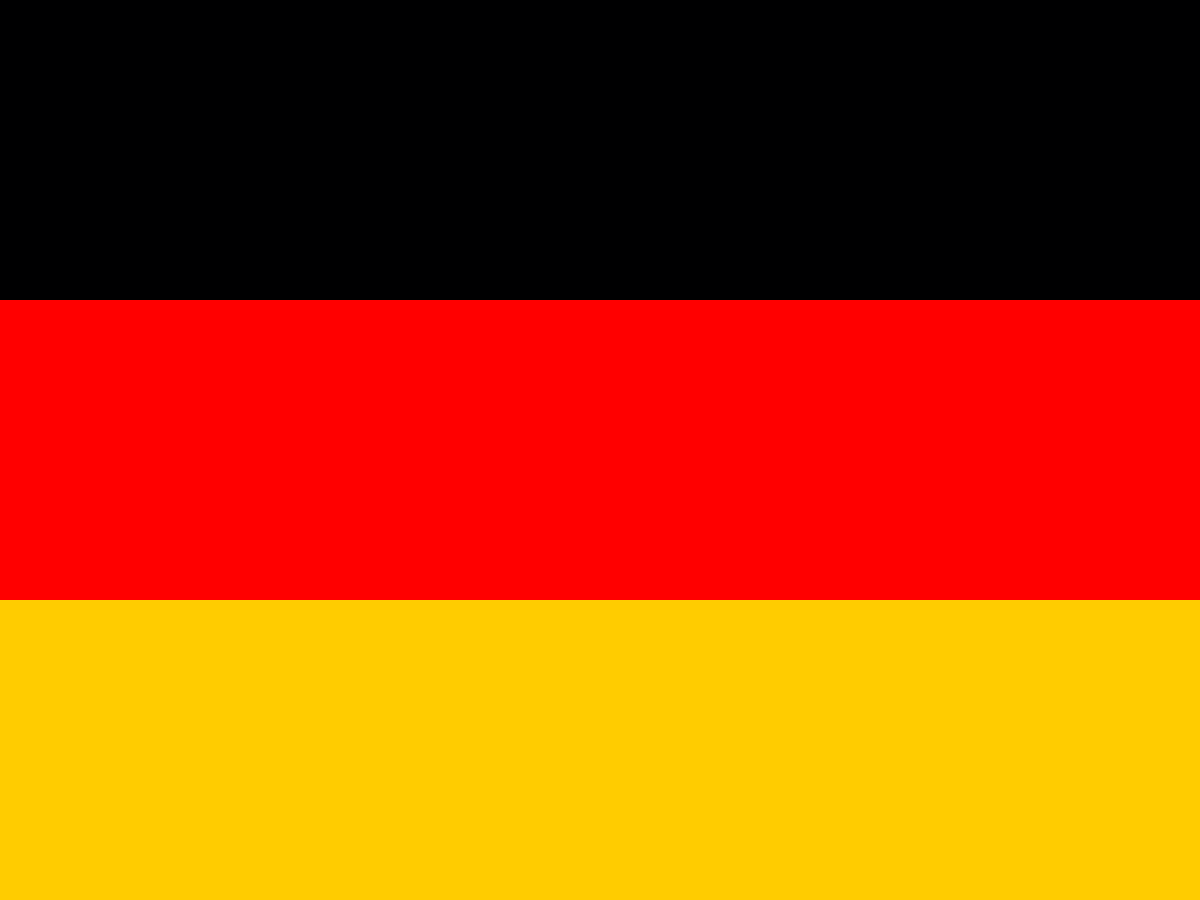
The flag of Germany
Germany's national flag is a horizontal black, red and gold tricolour. Unlike some flags where the colours represent the landscape, Germany's colours have a strongly political history.
Black, red and gold became associated with German national unity, liberalism and democracy during the nineteenth century.
The colours were later adopted by the Weimar Republic and became the colours of the modern Federal Republic of Germany.
The current flag was confirmed as the national flag of the Federal Republic in 1949.
What do the colours mean?
There is no single official modern definition assigning one fixed meaning to each of Germany's three colours. Their importance comes primarily from their historical association with German unity, freedom and democratic government.
The combination became particularly powerful during the nineteenth-century movement for a united and constitutional Germany.
The black stripe
Black forms the upper stripe of the German flag. The colour combination of black, red and gold became associated with German national and democratic movements during the early nineteenth century.
Black was part of the colours later adopted by the German Confederation and nationalist movements seeking unity.
The red stripe
Red forms the middle stripe. Together with black and gold, it became a symbol of the growing German national movement during the nineteenth century.
The colours were used by political groups campaigning for German unity and constitutional freedoms.
The gold stripe
Gold forms the lower stripe of the German flag. It completes the famous black-red-gold combination that became associated with national unity and democratic ideals.
The combination remains strongly connected with Germany's modern democratic identity.
The Napoleonic Wars and the origins of black-red-gold
The modern history of Germany's colours is often linked to the Wars of Liberation against Napoleon. Volunteer soldiers and patriotic movements used black, red and gold symbols during this period.
One important association is the Lützow Free Corps, whose uniforms were black with red and gold details. The colours subsequently became symbols of German nationalism and liberalism.
The German democratic movement
During the nineteenth century, black-red-gold became associated with calls for German unity, constitutional government and political freedoms.
The colours were prominently displayed at the Hambach Festival of 1832, an important event in the history of German liberal and national movements.
The Frankfurt Parliament
The Frankfurt Parliament of 1848–49 attempted to create a united German nation-state with a constitutional government. Black-red-gold was used as the symbol of the movement.
Although the attempt ultimately failed, the colours survived as an important symbol of German democratic aspirations.
A short history of Germany
The modern German state was created in 1871 when the German Empire was proclaimed under Prussian leadership. Before that, the German-speaking lands were divided among many states and kingdoms.
Germany later experienced the First World War, the Weimar Republic, the Nazi dictatorship, the Second World War and division into East and West Germany before reunification in 1990.
Flag history timeline
Early 19th centuryBlack-red-gold became associated with German national and liberal movements during the Wars of Liberation.
1832 — Hambach FestivalBlack-red-gold appeared prominently at a major gathering calling for national unity and political freedoms.
1848–49 — Frankfurt ParliamentThe colours became associated with the attempt to create a united constitutional Germany.
1871 — German EmpireGermany unified under Prussian leadership and adopted a different black-white-red imperial flag.
1919 — Weimar RepublicBlack-red-gold returned as the national colours of Germany's democratic republic.
1933–1945 — Nazi GermanyThe Nazi regime replaced the republican flag with its own symbols.
1949 — two German statesWest Germany adopted black-red-gold, while East Germany used a similar tricolour with an emblem.
1990 — reunificationBlack-red-gold became the flag of the reunified Federal Republic of Germany.
The German Empire
The German Empire was established in 1871 after a series of wars and political agreements led by Prussia. Its flag used black, white and red rather than the democratic black-red-gold colours.
The imperial colours remained important in German political history and were later used by groups opposed to the Weimar Republic.
The Weimar Republic
After Germany's defeat in the First World War, the Weimar Republic was established in 1919. It restored black-red-gold as the national colours.
The colours represented the democratic constitution and were strongly associated with republican Germany.
Nazi Germany and the flag
After taking power in 1933, the Nazi regime rejected the Weimar Republic's symbolism. In 1935, the swastika flag became Germany's sole national flag under Nazi rule.
After the Second World War and the fall of the Nazi regime, Nazi symbols were banned in Germany and black-red-gold was restored as the symbol of the democratic republic.
East and West Germany
In 1949, Germany was divided into the Federal Republic of Germany in the west and the German Democratic Republic in the east. West Germany used the plain black-red-gold tricolour.
East Germany initially used the same basic tricolour but added its state emblem in 1959. After reunification in 1990, the plain black-red-gold flag became the national flag of the whole country.
German reunification
On 3 October 1990, East and West Germany were formally reunited. The black-red-gold flag of the Federal Republic became the flag of the reunified country.
German Unity Day is celebrated every year on 3 October.
Berlin — the capital
Berlin is Germany's capital and largest city. It has played a major role in German history, including as the capital of the German Empire, the divided city of the Cold War and the capital of reunified Germany.
Landmarks such as the Brandenburg Gate, Reichstag and remnants of the Berlin Wall attract visitors from around the world.
The Brandenburg Gate
The Brandenburg Gate is one of Germany's best-known landmarks. Built in the eighteenth century, it later became a powerful symbol of Berlin's division and reunification.
It stands close to the former Berlin Wall and today represents a united Germany.
The Rhine River
The Rhine is one of Europe's most important rivers and flows through western Germany. It has been central to trade, transport and settlement for centuries.
The Rhine valley is also famous for vineyards, castles and dramatic landscapes.
The Alps and Zugspitze
Southern Germany reaches into the Alps. Germany's highest mountain is the Zugspitze, at almost 3,000 metres above sea level.
Bavaria's mountain landscapes are important for tourism, skiing, hiking and agriculture.
Germany's forests
Forests cover a significant part of Germany, including the famous Black Forest in Baden-Württemberg. Forests provide timber, recreation, wildlife habitat and important ecosystem services.
Germany has a long tradition of forestry and is often associated with the concept of sustainable forest management.
Climate
Germany has a predominantly temperate seasonal climate. Western areas are influenced by the Atlantic, while eastern areas can experience more continental conditions.
Summers are generally moderate to warm and winters are cooler, with colder conditions in the mountains.
Wildlife
Germany's forests, wetlands, rivers and mountains support wildlife including red deer, wild boar, foxes, beavers, lynx and many bird species.
Species such as wolves have also returned to parts of Germany after being absent for many decades.
German agriculture
Germany produces a wide range of agricultural products including wheat, barley, potatoes, sugar beet, dairy products, pork and grapes.
Although agriculture is highly mechanised, farms and rural landscapes remain an important part of the country's identity.
German industry
Germany is one of the world's major industrial economies. It is particularly well known for automobiles, engineering, chemicals, machinery and advanced manufacturing.
Companies in the automotive and engineering sectors have helped make German manufacturing famous around the world.
German cars
Germany has a long automotive tradition and is home to major manufacturers including Volkswagen, Mercedes-Benz, BMW, Porsche and Audi.
The automobile industry remains an important employer and exporter, while Germany is also investing heavily in electric vehicles and new transport technologies.
German food
German cuisine varies by region and includes sausages, breads, potatoes, schnitzel, pretzels, sauerkraut and many regional dishes.
Germany also has an enormous variety of breads and baked goods, with regional traditions differing considerably between north and south.
Beer culture
Germany is famous for its beer traditions. The country has thousands of breweries and a huge variety of regional beers.
Bavaria is particularly famous for its beer culture and the Munich Oktoberfest, although beer traditions exist throughout Germany.
German culture
Germany has made major contributions to music, philosophy, literature, science, architecture and the arts. Figures such as Bach, Beethoven, Goethe, Kant and Einstein are associated with German-speaking cultural and scientific history.
Germany's museums, theatres and concert halls remain important parts of modern cultural life.
The German language
German is the official language and is one of Europe's most widely spoken first languages. It is also an important language of science, business and culture.
Germany has several regional dialects, and German is also an official language in Austria and one of the official languages of Switzerland and other countries.
Education and research
Germany has a strong tradition of universities, technical education and scientific research. The country is home to major research organisations and internationally respected universities.
The dual vocational training system, combining classroom learning with workplace training, is particularly well known.
Germany and the European Union
Germany is a founding member of the European integration project and remains the EU's largest economy. It uses the euro and plays a major role in European political and economic policy.
Germany has also been a central member of NATO and maintains close relationships with its European neighbours.
Germany today
Modern Germany is a federal parliamentary republic made up of 16 Länder. It is one of Europe's leading economies and a major centre for industry, research, culture and international trade.
The black-red-gold flag is now firmly associated with the country's democratic constitution and reunified national identity.
Why is Germany's flag interesting?
Germany's flag is interesting because its colours have survived dramatic changes in the country's political history. Black-red-gold moved from the nineteenth-century democratic movement to the Weimar Republic, disappeared under Nazi rule, and returned as the symbol of modern democratic Germany.
Few national flags have such a direct connection with the struggle for German unity, democracy and eventual reunification.
Explore Germany on FlagAtlas
Continue exploring Germany and the world's flags with these FlagAtlas resources.