About Ghana
Ghana is a country on the Gulf of Guinea in West Africa. It borders Côte d'Ivoire, Burkina Faso and Togo, with the Atlantic Ocean to the south.
Accra is the capital and largest city. Ghana is one of West Africa's major economies and is known for its history, cocoa production, gold, music and cultural influence.
CapitalAccra
RegionWest Africa
PopulationAbout 34 million
CurrencyGhanaian cedi
Official languageEnglish
Independence6 March 1957
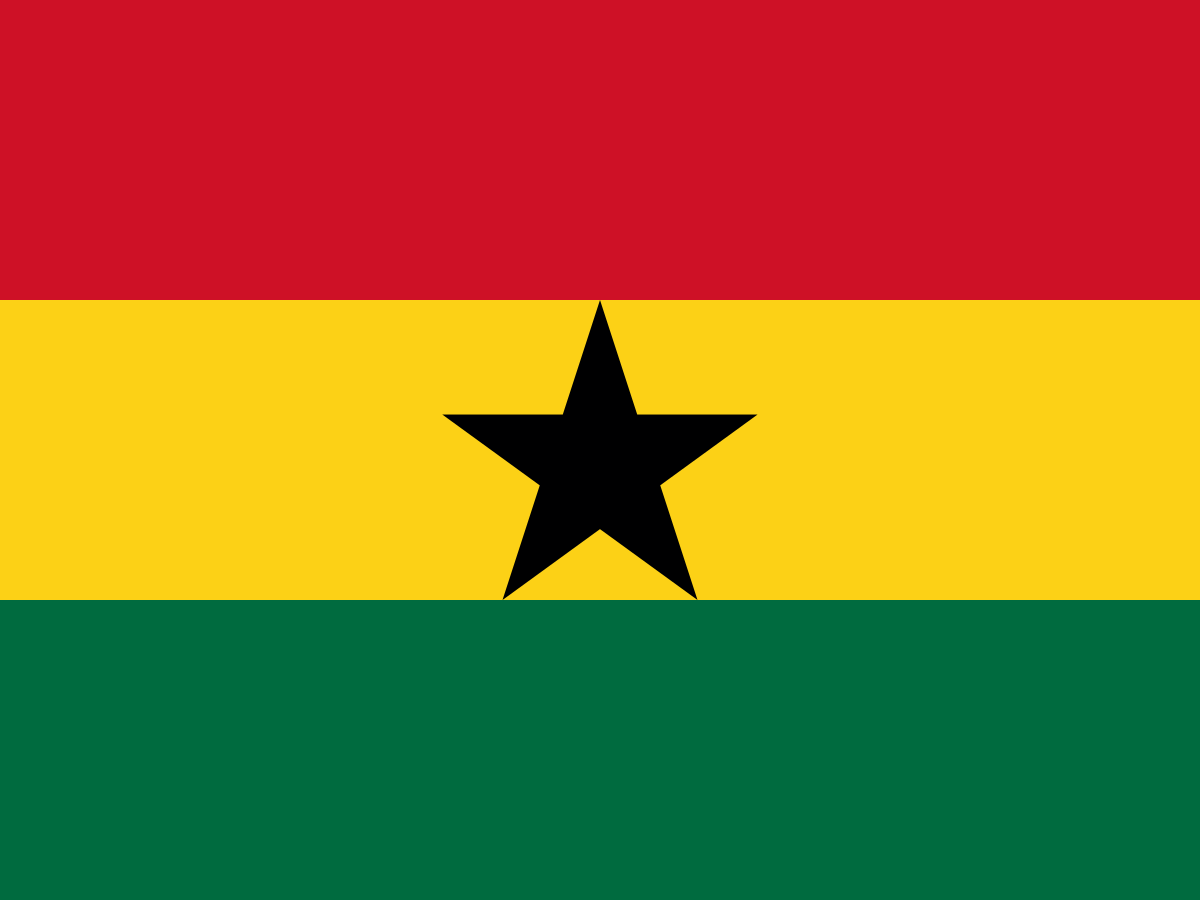
The flag of Ghana
Ghana's flag is a horizontal red, gold and green tricolour with a black five-pointed star in the centre of the gold band.
Ghana's flag became a powerful symbol of African independence.
Red is associated with the struggle and sacrifice of those who fought for independence, gold with the country's mineral wealth, green with its forests and natural resources, and the Black Star with African freedom and unity.
The flag was designed by Theodosia Okoh and first adopted when Ghana became independent in 1957.
What do the colours mean?
The red represents the blood and sacrifice connected with the struggle for independence, gold represents Ghana's mineral wealth, and green represents the country's forests and natural resources.
The Black Star is associated with African freedom and Pan-African unity. Together, the colours made Ghana's flag a powerful symbol during the wave of African decolonisation.
The red stripe
Red is associated with the blood and sacrifice of those who fought for Ghana's independence. Ghana's independence movement became an inspiration for other African territories seeking self-government.
The colour therefore carries a strong historical and political meaning rather than simply representing the landscape.
The gold stripe
Gold represents Ghana's mineral wealth. Gold mining has been important in the region for centuries and was a major reason the area became known historically as the Gold Coast.
Gold remains one of Ghana's important exports today.
The green stripe
Green represents Ghana's forests and natural resources. Much of southern Ghana is covered by vegetation suited to a tropical climate.
Ghana's forests are also important for cocoa production, timber, biodiversity and water resources.
The Black Star
The central Black Star represents African freedom and Pan-African unity. It was influenced by the Black Star Line, associated with Marcus Garvey's Pan-African movement.
Ghana's Black Star became an influential symbol far beyond the country itself and helped establish Ghana's identity as a leading voice in African independence.
The Gold Coast
Before independence, Ghana was known as the Gold Coast, a name linked to the region's long history of gold production and trade.
European powers established coastal trading forts, while powerful African states such as the Ashanti Kingdom controlled important inland territories and trade routes.
A short history of Ghana
The territory of modern Ghana has been home to many African states and societies. The Asante Kingdom became one of the most powerful states in the region, while European powers established trading settlements along the coast.
Britain eventually consolidated control over the Gold Coast. Ghana became independent in 1957 under the leadership of Kwame Nkrumah.
Flag history timeline
Before European rulePowerful states and trading networks developed across the region, including the Ashanti/Asante Kingdom.
15th century onwardsPortuguese and later other European traders established coastal trading contacts and forts.
19th century — British expansionBritain expanded control over the Gold Coast and fought several conflicts with the Asante state.
1957 — independenceThe Gold Coast became independent as Ghana on 6 March. The red, gold and green flag with the Black Star was adopted.
1960 — republicGhana became a republic with Kwame Nkrumah as its first president.
1966 — military coupNkrumah was overthrown, beginning a period of military and civilian governments.
1992 — Fourth RepublicA new constitution established Ghana's current democratic republic.
TodayGhana remains one of West Africa's more stable democracies and an important regional economy.
Kwame Nkrumah
Kwame Nkrumah was the leading figure in Ghana's independence movement and became the country's first prime minister and later president.
He promoted Pan-Africanism and argued that Ghana's independence should help inspire liberation across the rest of Africa. His government also invested heavily in infrastructure, education and industrial development.
Ghana's independence in 1957
Ghana became independent from Britain on 6 March 1957. It was the first sub-Saharan African country to achieve independence from colonial rule in the post-war period.
The event had enormous significance across Africa and internationally. Ghana's new flag, featuring the Black Star, became one of the best-known symbols of African independence.
Pan-Africanism
Ghana became a major centre of Pan-Africanism during the twentieth century. Nkrumah argued that political independence across Africa was interconnected.
Leaders, activists and intellectuals from other African and Caribbean countries visited Ghana, making Accra an important meeting place for the wider independence movement.
The Ashanti Kingdom
The Asante (Ashanti) Kingdom became one of the most powerful states in West Africa. Its influence was built partly on gold, trade, military organisation and strong political institutions.
The Asante capital of Kumasi remains an important cultural centre, and Asante traditions continue to influence Ghanaian identity.
The Golden Stool
The Golden Stool is one of the most important symbols of the Asante people. According to tradition, it represents the soul and unity of the Asante nation.
It is not simply a throne: its spiritual and political significance makes it a powerful symbol of Asante identity.
Accra — the capital
Accra is Ghana's capital and largest city. It is the country's main political, commercial and cultural centre and sits on the Atlantic coast.
Important landmarks include Independence Square, the Kwame Nkrumah Memorial Park and historic coastal districts.
Cape Coast and Elmina
Cape Coast Castle and Elmina Castle are major historic sites on Ghana's coast. They were European trading forts that became deeply connected with the transatlantic slave trade.
Today they are important heritage sites and places for education about the history and human consequences of the Atlantic slave trade.
Lake Volta
Lake Volta is one of the world's largest artificial lakes by surface area. It was created by the construction of the Akosombo Dam in the 1960s.
The lake and dam are important for electricity generation, fishing, transport and communities in eastern Ghana.
Kakum National Park
Kakum National Park protects tropical rainforest in southern Ghana and is famous for its canopy walkway, which allows visitors to walk above the forest floor.
The park provides habitat for monkeys, forest elephants, antelope, birds and many plant species.
Mole National Park
Mole National Park is Ghana's largest protected area and is known for savannah wildlife. Visitors can see elephants, antelope, warthogs, baboons and many bird species.
It is one of the country's most important wildlife-tourism destinations.
Climate
Ghana has a predominantly tropical climate, but rainfall varies considerably from the wetter forested south to the drier northern savannah.
Southern Ghana generally has two rainy seasons, while northern areas have a more pronounced single rainy season followed by a long dry period.
Wildlife
Ghana's forests, savannahs, wetlands and coastal ecosystems support wildlife including elephants, monkeys, antelope, crocodiles, hippos and hundreds of bird species.
Protected areas are important for conserving habitats while supporting tourism and local communities.
Cocoa production
Ghana is one of the world's major cocoa-producing countries. Cocoa farming is concentrated mainly in the forest belt and provides livelihoods for large numbers of farming households.
Cocoa beans are an important export and are central to Ghana's agricultural economy.
Gold mining
Gold has been mined in the region for centuries and remains one of Ghana's most important natural resources. The historic name Gold Coast reflects the importance of the trade.
Modern gold mining contributes significantly to exports and government revenue, although environmental and social impacts remain important issues.
Ghanaian food
Ghanaian cuisine includes dishes such as jollof rice, fufu, banku, waakye, kenkey and groundnut soup. Cassava, plantain, maize, rice and yams are common ingredients.
Food varies considerably by region, with coastal communities making extensive use of fish and northern cuisines featuring different grains and meats.
Ghanaian music
Ghana has had an enormous influence on African popular music. Traditional styles have mixed with international sounds to produce genres such as highlife and hiplife.
Ghana is also a major centre for contemporary Afrobeats and popular music across West Africa.
Kente cloth
Kente is a brightly coloured woven textile associated particularly with the Akan and Ewe peoples. Different patterns and colours can carry cultural meanings.
Kente has become an internationally recognised symbol of Ghanaian and wider African heritage.
Languages
English is Ghana's official language. Ghana is also home to many widely spoken African languages, including Akan varieties, Ewe, Ga and Dagbani.
This linguistic diversity reflects the country's many ethnic and cultural communities.
Ghanaian culture
Ghanaian culture is shaped by many ethnic traditions, including Akan, Mole-Dagbani, Ewe, Ga-Dangme and others. Music, dance, festivals, textiles and storytelling remain important parts of everyday life.
Festivals such as Homowo, Aboakyir and various Asante celebrations demonstrate the country's cultural diversity.
The Ghanaian economy
Ghana has a diverse economy based on services, agriculture, mining, manufacturing and energy. Gold and cocoa are major exports, while oil and gas have also become important.
Accra and Kumasi are major commercial centres, and Ghana's position on the Gulf of Guinea supports regional trade.
Ghana today
Modern Ghana is a democratic republic with a population of more than 30 million. It has become an important political, economic and cultural centre in West Africa.
Its independence history, Pan-African role, natural resources and cultural influence continue to shape its national identity.
Why is Ghana's flag interesting?
Ghana's flag is important far beyond Ghana itself. Its red, gold and green colours helped establish a visual language for African independence, while the Black Star became a powerful symbol of Pan-African freedom.
The flag therefore represents not only one country's history, but a much wider chapter in the history of twentieth-century Africa.
Explore Ghana on FlagAtlas
Continue exploring Ghana and the world's flags with these FlagAtlas resources.