About Greece
Greece is a country in southeastern Europe with a mainland and thousands of islands in the Aegean, Ionian and Mediterranean seas. It sits at the crossroads of Europe, Asia and Africa.
Athens is the capital and largest city. Greece is famous for its ancient civilisations, Orthodox Christian heritage, maritime history, islands, mountains, food and tourism.
CapitalAthens
RegionSoutheastern Europe
PopulationAbout 10.4 million
CurrencyEuro (€)
Official languageGreek
Highest pointMount Olympus
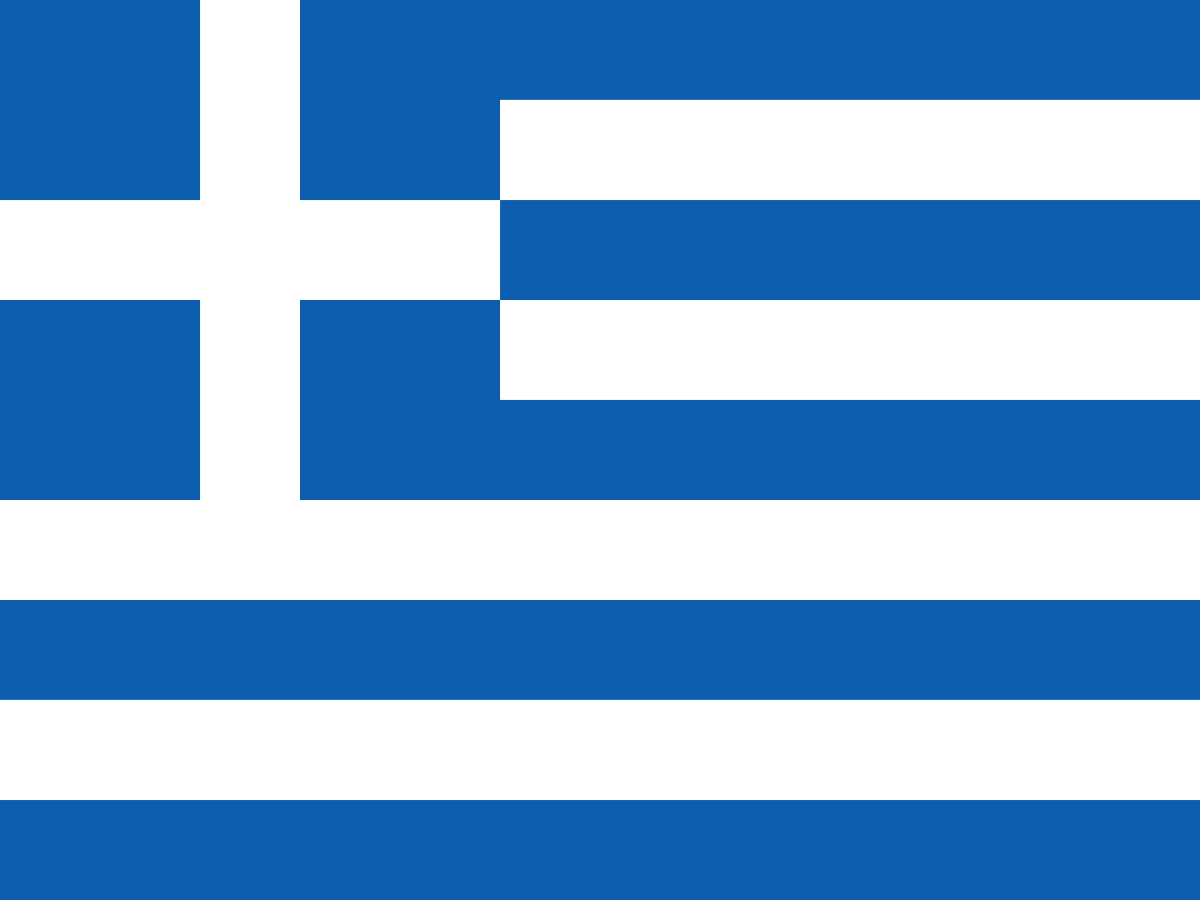
The flag of Greece
The Greek flag has nine alternating blue and white horizontal stripes and a white cross on a blue square in the upper hoist corner.
The Greek flag combines Christian symbolism with imagery associated with the sea and the country's struggle for independence.
The cross is strongly associated with Greek Orthodox Christianity, while blue and white are traditionally linked with the sea and sky.
The current design became Greece's sole national flag in 1978, although the blue-and-white colours and cross have much older associations.
What do the colours mean?
There is no single official legal colour code assigning one fixed meaning to every element. In popular explanations, blue is associated with the Greek seas and sky, while white is often linked with brightness, purity or the waves of the sea.
The design is also deeply connected with Greek Orthodox Christianity and the country's nineteenth-century independence struggle.
The blue stripes
Blue dominates the Greek flag and is commonly associated with the sea and sky. Greece's geography makes the sea especially important, with thousands of islands and a very long coastline.
The blue-and-white combination has been used in Greek symbolism for centuries.
The white stripes
The white stripes contrast strongly with the blue and are often interpreted as representing the white of the waves or purity.
The alternating pattern creates one of Europe's most recognisable national flags.
The Greek cross
The white cross on the blue canton represents the importance of Christianity and the Greek Orthodox tradition in Greek history.
Christian symbolism was particularly important during the Greek War of Independence, when the struggle was presented partly as a fight for national and religious freedom.
Why nine stripes?
The nine stripes are traditionally associated with the nine syllables of the Greek revolutionary motto “Eleftheria i Thanatos” — “Freedom or Death.”
However, historians note that the exact historical reason for choosing nine stripes is not completely certain. The nine-syllable explanation became an established popular interpretation.
The Greek War of Independence
The modern Greek state emerged from the Greek War of Independence against the Ottoman Empire, which began in 1821.
The revolt attracted international support from philhellenes across Europe and America. Greece was recognised as an independent state in the early 1830s.
A short history of Greece
Greece's history includes the ancient Minoan and Mycenaean civilisations, the classical city-states of Athens and Sparta, the Hellenistic world, Roman and Byzantine rule, Ottoman rule and the creation of the modern Greek state.
Greek language and culture have influenced European philosophy, science, politics, art and literature for thousands of years.
Flag history timeline
Ancient GreeceGreek city-states developed distinctive symbols, military standards and religious traditions, although there was no single national Greek flag.
Byzantine eraChristian symbols became central to the political and religious identity of the Greek-speaking Byzantine world.
1821 — War of IndependenceGreek revolutionaries used various blue-and-white and cross-based flags during the uprising against Ottoman rule.
1822 — first national flag frameworkThe provisional Greek government established national colours and symbols during the struggle for independence.
1832 — independent GreeceThe new Greek kingdom continued to use blue and white national symbolism.
1970s — changing flag useDifferent periods saw different official uses of the land and naval flags.
1978 — current flagThe striped blue-and-white flag became the sole national flag of Greece.
Ancient Greece
Ancient Greece was not a single unified country in the modern sense. It consisted of independent city-states such as Athens, Sparta, Corinth and Thebes.
Greek-speaking communities created influential traditions in philosophy, mathematics, theatre, politics, architecture and science.
Athens and democracy
Athens is famous for developing an early form of democracy in the fifth century BC. Citizens participated directly in political decision-making, although the system excluded women, slaves and many residents.
Athenian political ideas later influenced democratic thought around the world.
Sparta
Sparta was a powerful Greek city-state known for its highly militarised society. Spartan culture placed great emphasis on discipline, communal life and military training.
Sparta became one of Athens' main rivals during the Peloponnesian War.
Alexander the Great
Alexander the Great of Macedon conquered a vast territory stretching from Greece and Egypt into Persia and parts of Central Asia.
His campaigns helped spread Greek language and culture across a huge area, creating the Hellenistic world.
The Byzantine Empire
For many centuries, much of the Greek-speaking eastern Mediterranean formed part of the Byzantine Empire, whose capital was Constantinople.
Greek language and Orthodox Christianity became central to Byzantine identity, leaving a major legacy in modern Greece.
Ottoman rule
Much of Greece was under Ottoman rule for several centuries before the nineteenth-century independence movement.
Greek communities preserved their language, religion and cultural traditions during this period, helping shape the identity of the modern Greek nation.
The Greek War of Independence and philhellenism
The Greek independence struggle inspired philhellenism, a movement of support for Greek independence among Europeans and Americans who admired ancient Greek culture.
Poet Lord Byron famously travelled to Greece and died at Missolonghi in 1824 while supporting the independence cause.
Athens — the capital
Athens is the capital of Greece and one of the world's oldest continuously inhabited cities. It is dominated by the Acropolis and the Parthenon.
Modern Athens combines ancient monuments with a large contemporary metropolitan area and is the centre of Greek government, business and culture.
The Acropolis and Parthenon
The Acropolis rises above Athens and contains some of the world's most famous ancient monuments. The Parthenon was built in the fifth century BC as a temple dedicated to Athena.
The site is one of the defining symbols of ancient Greek civilisation and is recognised as a UNESCO World Heritage Site.
Mount Olympus
Mount Olympus is Greece's highest mountain and, in ancient Greek mythology, the home of the gods.
The mountain reaches almost 3,000 metres and is now a protected national park known for its dramatic scenery and biodiversity.
The Greek islands
Greece has thousands of islands and islets, although only a few hundred are inhabited. Major island groups include the Cyclades, Ionian Islands, Dodecanese, Sporades and North Aegean islands.
Islands such as Crete, Rhodes, Corfu, Santorini and Mykonos are major tourism destinations.
Crete
Crete is Greece's largest island and the centre of the ancient Minoan civilisation. The Palace of Knossos is one of the island's best-known archaeological sites.
Crete is also famous for its mountains, beaches, olive oil, food and distinctive regional culture.
Santorini
Santorini is famous for its volcanic caldera, whitewashed villages and spectacular views across the Aegean Sea.
The island's landscape was shaped by one of the largest volcanic eruptions of the ancient world, which transformed the surrounding region.
Climate
Greece has a predominantly Mediterranean climate, with hot, dry summers and mild, wetter winters in many coastal areas.
Mountain regions are cooler and receive more snow, while northern Greece can experience greater seasonal temperature variation.
Wildlife
Greece has diverse wildlife across its mountains, forests, wetlands and seas. Species include brown bears, wolves, wild goats, dolphins, sea turtles and many migratory birds.
The Mediterranean monk seal and loggerhead sea turtle are among the country's notable marine species.
Marine life and the Mediterranean
Greece's extensive coastline and island waters support rich marine ecosystems. The loggerhead sea turtle nests on several Greek beaches, while dolphins and other marine mammals occur in surrounding waters.
Marine conservation is increasingly important because tourism, fishing and coastal development place pressure on fragile ecosystems.
Greek mythology
Greek mythology includes famous gods and heroes such as Zeus, Athena, Poseidon, Apollo, Artemis, Hercules and Odysseus.
These stories have influenced Western literature, art, theatre and popular culture for thousands of years.
Greek language
Greek is one of the world's oldest documented living languages. Written Greek has a history stretching back more than three thousand years.
Modern Greek developed through many historical stages, including Ancient Greek, Koine Greek and Medieval Greek.
Greek food
Greek cuisine is famous for ingredients such as olive oil, olives, feta, yoghurt, vegetables, fish, herbs and grains. Popular dishes include moussaka, souvlaki, spanakopita and Greek salad.
Regional food traditions vary considerably between the mainland and islands.
Olive oil and olives
Olive cultivation has been important in Greece since ancient times. Olive oil remains a major part of Greek cooking and agriculture.
Olive trees are particularly well suited to the Mediterranean climate and are deeply connected with Greek cultural traditions.
Greek culture
Greek culture has had a profound influence on Europe and the wider world through philosophy, literature, theatre, architecture, music and art.
Modern Greek culture combines ancient traditions with Byzantine, Ottoman, Mediterranean and contemporary influences.
Greek Orthodox Christianity
The Greek Orthodox Church is a major part of Greek history and identity. Orthodox Christianity shaped art, architecture, festivals and community life for centuries.
Churches and monasteries can be found throughout mainland Greece and the islands.
The Greek economy
Greece's economy is based on services, tourism, shipping, manufacturing, agriculture and trade. Tourism and maritime shipping are particularly important.
Greece is a member of the European Union and uses the euro.
Tourism
Tourism is one of Greece's most important industries. Visitors come for ancient monuments, beaches, islands, food, climate and cultural heritage.
Athens, Crete, the Cyclades and many coastal areas attract millions of visitors each year.
Greece today
Modern Greece is a parliamentary republic and a member of the European Union and NATO. Its identity combines ancient heritage, Byzantine and Orthodox traditions and a modern European outlook.
The blue-and-white flag is now one of the country's most recognisable symbols, strongly associated with the sea, Christianity and the modern Greek state.
Why is Greece's flag interesting?
Greece's flag combines several layers of national identity. The cross reflects the importance of Orthodox Christianity, the blue and white connect strongly with the sea and sky, and the nine stripes are traditionally linked with the revolutionary motto “Freedom or Death”.
Its design therefore connects modern Greece with both its religious heritage and the struggle that created the independent Greek state.
Explore Greece on FlagAtlas
Continue exploring Greece and the world's flags with these FlagAtlas resources.