About Guinea-Bissau
Guinea-Bissau is a small country on the Atlantic coast of West Africa, bordered by Senegal and Guinea. It also includes the Bijagós archipelago off the coast.
Bissau is the capital and largest city. The country is known for its mangrove ecosystems, islands, cashew production, Portuguese colonial history and the independence movement led by Amílcar Cabral.
CapitalBissau
RegionWest Africa
PopulationAbout 2 million
CurrencyWest African CFA franc
Official languagePortuguese
Independence24 September 1973
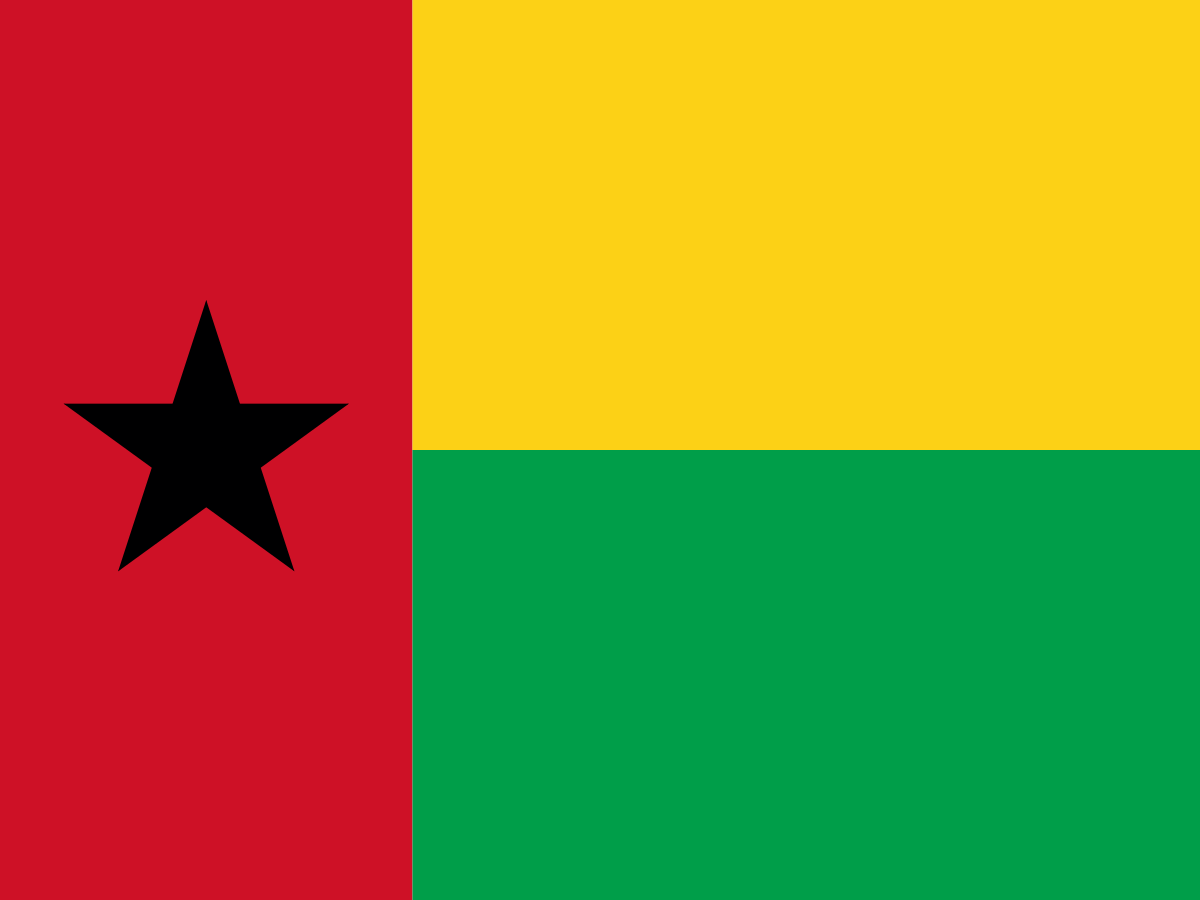
The flag of Guinea-Bissau
Guinea-Bissau's flag combines a vertical red band at the hoist with horizontal yellow and green bands and a black five-pointed star.
The design is strongly connected with the country's independence struggle.
Red is associated with the struggle and sacrifice of the liberation movement, yellow with the sun and the country's resources, green with its vegetation and agriculture, and the Black Star with African unity and the people.
The flag was adopted in 1973, when the African Party for the Independence of Guinea and Cape Verde (PAIGC) proclaimed independence.
What do the colours mean?
Guinea-Bissau's colours are part of the wider Pan-African tradition. The red is linked with the struggle for liberation, yellow with the sun and the country's wealth, and green with vegetation and agriculture.
The Black Star is a symbol of African unity and the people. Its use connects Guinea-Bissau's flag with the broader anti-colonial movements of twentieth-century Africa.
The red band
The vertical red band is associated with the blood, sacrifice and struggle of the independence movement.
Its position at the hoist gives the flag a distinctive appearance and visually separates Guinea-Bissau's design from the closely related flag of neighbouring Guinea.
The yellow band
Yellow represents the sun and is associated with the country's resources and prosperity.
The bright yellow band is one of the features that links Guinea-Bissau's flag to the Pan-African colour tradition.
The green band
Green represents vegetation, agriculture and the country's natural environment. Guinea-Bissau has extensive wetlands, mangroves, forests and agricultural areas.
The green section reflects the importance of the land to rural communities and the national economy.
The Black Star
The five-pointed Black Star represents African unity and the people. It is a major symbol of the independence movement and connects Guinea-Bissau to wider Pan-African ideals.
The star is also a visual link to other African independence flags that adopted the black star as a symbol of liberation.
Why does Guinea-Bissau's flag look like Guinea's?
Guinea-Bissau and neighbouring Guinea both use red, yellow and green, but their layouts are different. Guinea has three vertical stripes, while Guinea-Bissau has a red vertical band and two horizontal stripes.
This difference makes the two flags easier to distinguish despite their shared Pan-African colours.
A short history of Guinea-Bissau
The region has a long history of West African kingdoms and coastal trading networks. Portuguese traders and colonists established a presence from the fifteenth century, eventually creating Portuguese Guinea.
The independence movement led by the PAIGC fought Portugal for more than a decade. Guinea-Bissau declared independence in 1973, and Portugal recognised it in 1974.
Flag history timeline
Before European colonisationCommunities and kingdoms developed across the region, with strong links to wider West African trade networks.
15th century onwards — Portuguese presencePortuguese traders and colonists established coastal settlements and trading networks.
Late 19th century — Portuguese GuineaPortugal consolidated colonial control over the territory.
1956 — PAIGC foundedAmílcar Cabral and colleagues established the African Party for the Independence of Guinea and Cape Verde.
1963 — armed struggleThe PAIGC launched an armed independence struggle against Portuguese rule.
24 September 1973 — declaration of independenceThe PAIGC proclaimed the independent Republic of Guinea-Bissau and adopted the red, yellow, green and Black Star flag.
1974 — Portuguese recognitionFollowing Portugal's Carnation Revolution, Portugal recognised Guinea-Bissau's independence.
TodayGuinea-Bissau is an independent republic and member of the African Union and ECOWAS.
Portuguese Guinea
During the colonial period the territory was known as Portuguese Guinea. Portuguese control was strongest around coastal settlements and administrative centres, while resistance continued in many rural areas.
Colonial rule shaped the country's language, institutions and connections with Portugal, but also fuelled the independence movement.
Amílcar Cabral
Amílcar Cabral was the leading intellectual and political figure of Guinea-Bissau's independence struggle. He co-founded the PAIGC and developed a highly organised liberation movement.
Cabral emphasised political education, national unity and the importance of building support among rural communities. He was assassinated in 1973, shortly before independence was formally recognised.
The PAIGC
The African Party for the Independence of Guinea and Cape Verde (PAIGC) led the armed struggle against Portuguese colonial rule.
The movement fought for independence in both Guinea-Bissau and the Portuguese colony of Cape Verde. Its symbols and colours became central to the identity of the future Guinea-Bissau state.
Independence in 1973–74
The PAIGC declared Guinea-Bissau independent on 24 September 1973. Portugal recognised the country's independence in 1974 after the Carnation Revolution ended the Portuguese dictatorship.
The independence process was one of the most important moments in Guinea-Bissau's modern history.
Bissau — the capital
Bissau is Guinea-Bissau's capital and largest city. It lies on the Geba River estuary and contains the country's main government institutions, port and commercial activity.
Portuguese colonial architecture can still be found in parts of the city, alongside busy markets and modern neighbourhoods.
The Bijagós Archipelago
The Bijagós Archipelago consists of dozens of islands and islets off Guinea-Bissau's coast. It is one of West Africa's most important coastal ecosystems.
The islands are known for mangroves, mudflats, forests, beaches and marine wildlife, including populations of sea turtles and hippos.
Mangrove ecosystems
Guinea-Bissau has extensive mangrove forests, particularly around its rivers and coastal islands. Mangroves protect coastlines, provide nursery habitat for fish and support local livelihoods.
The country's mangroves are also important for storing carbon and maintaining biodiversity.
Marine wildlife
The waters around Guinea-Bissau support important populations of sea turtles, dolphins, manatees and fish. Coastal ecosystems provide feeding and breeding grounds for many species.
Conservation of the Bijagós region is therefore important far beyond Guinea-Bissau itself.
Orango Islands and hippos
The Orango Islands in the Bijagós Archipelago are famous for their population of saltwater or estuarine hippos. These unusual animals have adapted to life around the islands' wetlands and mangroves.
The archipelago is one of the country's most distinctive natural environments.
Climate
Guinea-Bissau has a tropical climate with a pronounced wet season and dry season. The coastal areas receive substantial rainfall, while the dry season can be strongly influenced by the Harmattan winds.
Seasonal rainfall is crucial to agriculture and freshwater supplies.
Wildlife
The country's forests, wetlands, mangroves and islands support hippos, monkeys, crocodiles, manatees, sea turtles and many bird species.
Protected areas and community-managed ecosystems are important for conserving this biodiversity.
Cashew production
Cashew nuts are one of Guinea-Bissau's most important exports and provide income for a large part of the rural population.
Cashew production is particularly important to the national economy, although dependence on a single major agricultural export also creates economic vulnerability.
Rice and agriculture
Agriculture employs a large share of Guinea-Bissau's population. Rice is an important staple crop, while cashews, palm products, peanuts and other crops are also produced.
Traditional rice cultivation in coastal wetlands is closely connected with local environmental knowledge.
Guinea-Bissau culture
Guinea-Bissau is culturally diverse, with communities including the Balanta, Fula, Mandinka, Manjaco, Papel and Bijagó peoples among others.
Music, dance, oral traditions, masks, ceremonies and community festivals are important parts of cultural life.
The Bijagó people
The Bijagó people live mainly in the islands of the Bijagós Archipelago and have distinctive social, spiritual and cultural traditions.
Their relationship with the islands and surrounding ecosystems is an important part of Guinea-Bissau's cultural heritage.
Languages
Portuguese is the official language, while Guinea-Bissau Creole is widely used as a common language. Many African languages are spoken by different ethnic communities.
This multilingual environment reflects the country's African, Portuguese and regional history.
Guinea-Bissau food
Guinea-Bissau cuisine commonly uses rice, fish, seafood, cassava, peanuts, palm oil and chilli. Coastal communities make extensive use of fish and shellfish.
Food traditions vary between ethnic groups and regions, with West African ingredients forming the basis of most everyday meals.
The economy
Guinea-Bissau's economy relies heavily on agriculture and natural resources, with cashew nuts being particularly important. Fishing, forestry and services also contribute.
The economy is vulnerable to fluctuations in agricultural prices and faces significant infrastructure and development challenges.
Tourism
Guinea-Bissau has considerable tourism potential through its islands, beaches, wildlife, mangroves and cultural heritage.
The Bijagós Archipelago is particularly attractive for nature tourism, although limited infrastructure means the country receives far fewer visitors than many other West African destinations.
Guinea-Bissau today
Modern Guinea-Bissau is a small West African republic with a population of around two million. Its identity is strongly shaped by its independence struggle, Portuguese heritage, diverse ethnic communities and exceptional coastal ecosystems.
The national flag remains a direct reminder of the liberation movement that created the modern state.
Why is Guinea-Bissau's flag interesting?
Guinea-Bissau's flag tells the story of its independence unusually clearly. The red band recalls the liberation struggle, the yellow and green reflect the country's resources and environment, and the Black Star connects the country with African unity.
Its layout also makes it instantly distinguishable from neighbouring Guinea, despite both countries sharing the same Pan-African colours.
Explore Guinea-Bissau on FlagAtlas
Continue exploring Guinea-Bissau and the world's flags with these FlagAtlas resources.