About Guinea
Guinea is a country on the Atlantic coast of West Africa, bordered by Guinea-Bissau, Senegal, Mali, Côte d'Ivoire, Liberia and Sierra Leone.
Conakry is the capital and largest city. Guinea is known for its mineral wealth, especially bauxite, as well as its mountains, rivers, forests and diverse cultures.
CapitalConakry
RegionWest Africa
PopulationAbout 13 million
CurrencyGuinean franc
Official languageFrench
Independence2 October 1958
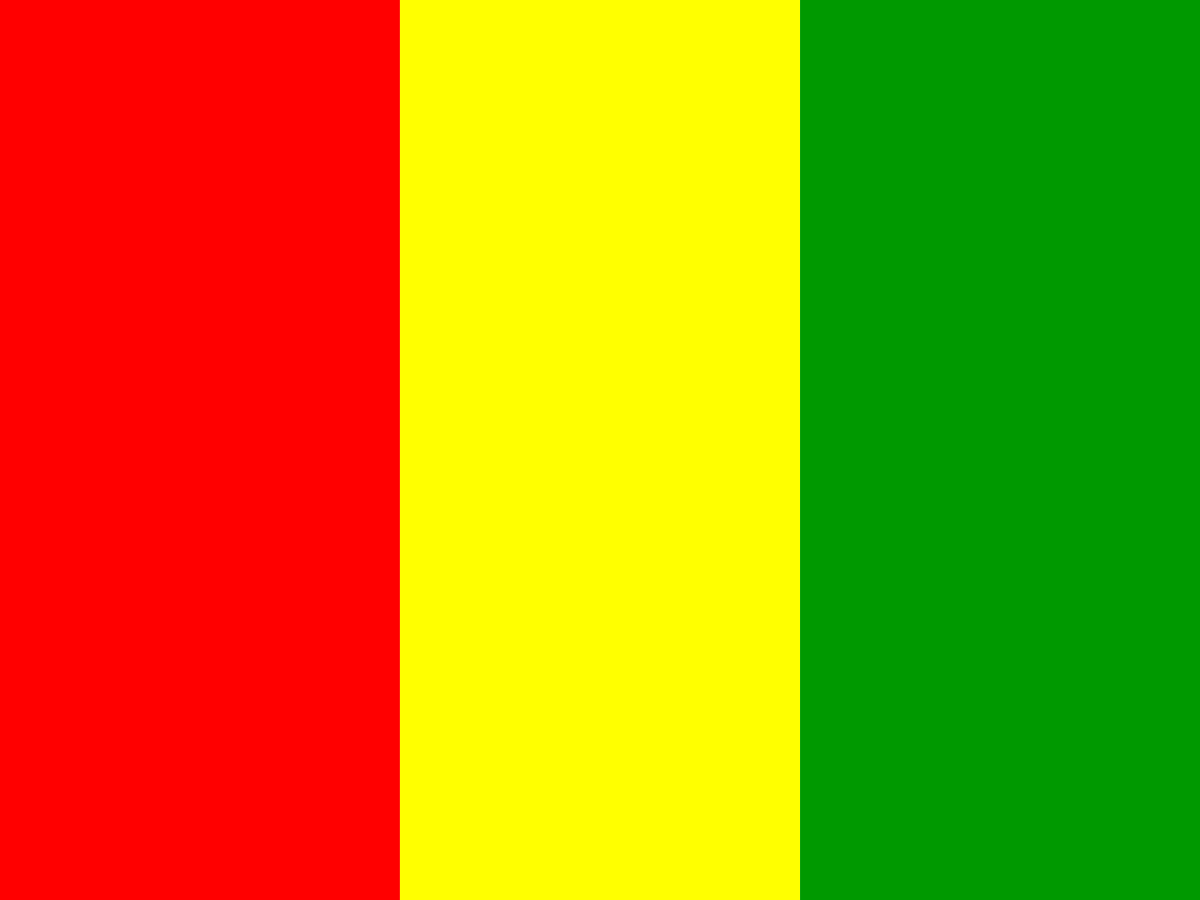
The flag of Guinea
Guinea's flag is a vertical red, yellow and green tricolour. It was adopted when Guinea became independent from France in 1958.
The three colours are Pan-African colours.
Red is associated with the blood and sacrifice of those who fought for independence, yellow with the sun and Guinea's mineral wealth, and green with the country's forests and agriculture.
The vertical arrangement is also significant in distinguishing Guinea's flag from several other West African flags that use the same Pan-African colours.
What do the colours mean?
The flag's red represents the blood and sacrifice connected with the struggle for independence. Yellow represents the sun and is associated with Guinea's mineral wealth. Green represents vegetation, forests and agriculture.
The colours are part of the wider Pan-African colour tradition shared by many African countries.
The red stripe
Red is associated with the blood and sacrifice of those who fought for Guinea's independence. It gives the flag a strong connection with the country's anti-colonial history.
Guinea's independence was particularly significant because it chose immediate independence from France rather than joining the proposed French Community in 1958.
The yellow stripe
Yellow represents the sun and is also associated with Guinea's mineral wealth. The country possesses major deposits of bauxite, iron ore, gold and other minerals.
Mining has therefore become one of the most important parts of Guinea's modern economy.
The green stripe
Green represents Guinea's vegetation, forests and agriculture. Guinea contains several distinct natural regions, from coastal lowlands to highlands and forested areas in the southeast.
The country's rainfall and rivers also make it agriculturally important in West Africa.
Pan-African colours
Guinea's red, yellow and green are part of the Pan-African colour tradition. These colours became strongly associated with African independence and unity during the twentieth century.
Several African countries use combinations of red, yellow and green, although their arrangements and specific meanings differ.
A short history of Guinea
Guinea has a long history of powerful West African states and trading networks. The region was influenced by the Mali Empire and later the Songhai and other regional states.
France established colonial rule in the nineteenth century. Guinea became independent in 1958 under the leadership of Ahmed Sékou Touré.
Flag history timeline
Medieval periodMuch of the region was influenced by major West African empires, including the Mali Empire.
19th century — French expansionFrance expanded its control over the region and incorporated Guinea into French West Africa.
1890s onwards — French GuineaThe territory became part of the French colonial system.
1958 — referendumGuinea rejected membership in the proposed French Community and voted for immediate independence.
2 October 1958 — independenceGuinea became independent and adopted its red, yellow and green national flag.
1958–1984 — Sékou TouréAhmed Sékou Touré led Guinea through its first decades of independence.
1984 — political transitionA military government took power following Sékou Touré's death.
TodayGuinea remains a mineral-rich West African state with major economic potential and continuing development challenges.
The Mali Empire
The territory of modern Guinea was influenced by the Mali Empire, one of medieval West Africa's most powerful states. Trade in gold and other goods connected the region with wider West African networks.
The empire's cultural and linguistic influence remains part of the historical background of Guinea and its neighbours.
French colonial rule
France gradually established control over Guinea during the nineteenth century. The territory became part of French West Africa.
Colonial rule transformed political administration, trade and infrastructure while also generating resistance and nationalist movements.
Independence in 1958
Guinea became independent on 2 October 1958. It was the only French West African territory to reject the constitutional proposal that would have kept it within the French Community.
President Charles de Gaulle had campaigned for the proposal, but Guineans voted overwhelmingly against it under the leadership of Ahmed Sékou Touré.
Ahmed Sékou Touré
Ahmed Sékou Touré became Guinea's first president and dominated the country's politics from independence until his death in 1984.
His government pursued a strongly nationalist and socialist direction and maintained close relationships with other newly independent African states.
Conakry — the capital
Conakry is Guinea's capital and largest city. It lies on a peninsula and is the country's principal political, commercial and transport centre.
The city has grown rapidly and faces challenges including traffic, infrastructure pressure and urban expansion.
The Fouta Djallon highlands
The Fouta Djallon is a mountainous region in central Guinea known for plateaus, valleys and waterfalls. It is sometimes described as the “water tower” of West Africa because several major rivers have their sources in or around the region.
The highlands are also culturally associated with Guinea's Fulani communities.
Mount Nimba
Mount Nimba lies in the southeastern part of Guinea along the borders with Liberia and Côte d'Ivoire. The area contains exceptional biodiversity and is protected as a UNESCO World Heritage site.
The landscape includes montane forests, grasslands and unusual plant and animal species.
Guinea's rivers
Guinea's highlands are the source of several important West African rivers, including the Niger, Senegal and Gambia river systems.
This makes Guinea particularly important for water resources far beyond its own borders.
Climate
Guinea has a predominantly tropical climate, with a pronounced rainy season and dry season. The coastal region can receive extremely high rainfall, while rainfall patterns vary across the country's natural regions.
The wet climate helps support forests, rivers and agriculture.
Wildlife
Guinea contains coastal wetlands, savannah, forests and mountain habitats supporting species such as chimpanzees, hippos, forest elephants, monkeys and many bird species.
Protected areas are particularly important in the southeast and highland regions.
Bauxite and mineral wealth
Guinea has some of the world's most important bauxite deposits, the ore used to produce aluminium. Mining is central to the country's economy and exports.
Guinea also has significant deposits of iron ore, gold and diamonds, giving it considerable natural-resource potential.
The Simandou iron ore project
Simandou in southeastern Guinea contains one of the world's major untapped high-grade iron ore deposits. Development of the project has involved major infrastructure and mining investment.
Its potential economic impact is enormous, although large mining projects also bring environmental, social and infrastructure challenges.
Agriculture
Agriculture employs a large share of Guinea's population. Important products include rice, cassava, bananas, coffee, cocoa, palm products and fruit.
The country's rainfall, fertile areas and diverse landscapes provide strong agricultural potential.
Guinean food
Guinean cuisine commonly uses rice, cassava, plantains, vegetables, fish, meat and groundnuts. Regional food traditions vary between the coast, highlands and forest regions.
Rice-based dishes and sauces are particularly common in everyday meals.
Guinean culture
Guinea has a rich cultural heritage shaped by many ethnic communities, including Fulani, Malinké and Susu peoples among others.
Music, dance, storytelling and traditional instruments are important parts of cultural life.
Music and the djembe
Guinea is famous for its contribution to West African music, especially the djembe drum traditions associated with the Manding cultural world.
Guinean musicians and national dance companies helped introduce West African music and dance to international audiences during the twentieth century.
Languages
French is Guinea's official language, but many African languages are widely spoken. These include Pular, Maninka, Susu and several other regional languages.
Guinea's multilingual society reflects its ethnic and geographical diversity.
The economy
Guinea's economy is heavily influenced by mining, particularly bauxite. Agriculture, services, construction and other natural resources are also important.
Mining revenue provides major opportunities for development, but the country continues to face infrastructure, poverty and governance challenges.
Tourism
Guinea has significant tourism potential based on its mountains, waterfalls, forests, islands, wildlife and cultural heritage.
Fouta Djallon, the Mount Nimba region and the coastal areas offer some of the country's most striking landscapes.
Guinea today
Modern Guinea is a resource-rich West African country with a population of more than 13 million. Its mineral wealth gives it major economic potential, particularly through bauxite and iron ore.
The country also possesses exceptional natural resources, including forests, rivers, mountains and biodiversity.
Why is Guinea's flag interesting?
Guinea's flag is a simple three-colour design, but its history is powerful. The red, yellow and green colours connect the country to the wider Pan-African movement, while the adoption of the flag in 1958 marked Guinea's decision to become immediately independent from France.
It is therefore a flag closely tied to African decolonisation and national independence.
Explore Guinea on FlagAtlas
Continue exploring Guinea and the world's flags with these FlagAtlas resources.