About Guyana
Guyana is a country on the northeastern coast of South America, bordered by Venezuela, Brazil and Suriname. It faces the Atlantic Ocean and is culturally and historically closely connected with the Caribbean.
Georgetown is the capital and largest city. Guyana is famous for its enormous rainforests, rivers, waterfalls, biodiversity and, increasingly, its offshore oil industry.
CapitalGeorgetown
RegionSouth America
PopulationAbout 800,000
CurrencyGuyanese dollar
Official languageEnglish
Independence26 May 1966
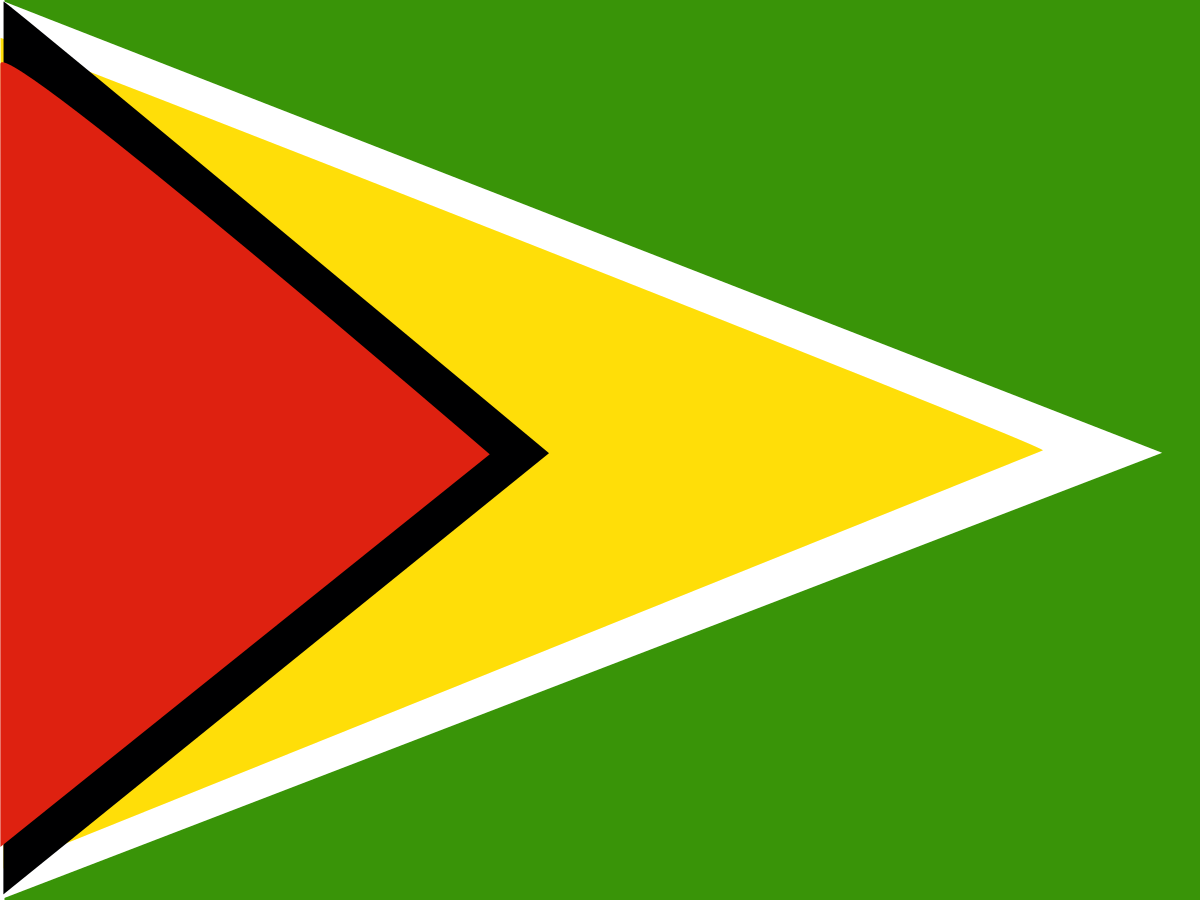
The flag of Guyana — the Golden Arrowhead
Guyana's flag is known as the Golden Arrowhead. It was adopted at independence in 1966 and was designed by Whitney Smith, an American vexillologist.
The flag uses five main colours and a powerful arrow-like design.
Green represents forests and agriculture, white represents rivers and water, gold represents mineral wealth, black represents endurance, and red represents zeal and dynamism.
The red triangle and golden arrowhead create the impression of forward movement, reflecting the country's development and aspirations.
What do the colours mean?
The flag's green represents forests and agriculture. White represents rivers and water. Gold represents mineral resources. Black symbolises endurance and perseverance, while red represents zeal and dynamism.
The colours together reflect Guyana's natural resources, landscape and the determination of its people.
The green field
Green covers most of the flag and represents Guyana's forests and agricultural resources. Guyana contains one of South America's great rainforest landscapes.
Much of the country's interior remains sparsely populated and heavily forested.
The white borders
The narrow white borders represent rivers and water. Guyana is a country of major rivers, wetlands and coastal waterways.
The Essequibo, Demerara and Berbice are among the country's best-known river systems.
The golden arrowhead
The large golden triangle represents Guyana's mineral wealth. Gold, bauxite, diamonds and other minerals have historically been important to the economy.
Its arrowhead shape also gives the flag its name and creates a sense of movement and forward progress.
The black triangle
Black represents endurance and perseverance. It forms a narrow border between the red triangle and the golden arrowhead.
The colour adds contrast and reinforces the idea of determination in the national flag.
The red triangle
Red represents zeal and dynamism. The red triangle points towards the centre of the flag and gives the Golden Arrowhead its strongest sense of movement.
It is intended to express energy and the drive to build the nation.
A short history of Guyana
Guyana's history includes Indigenous societies, Dutch settlement, British colonial rule, African and Indian migration, and a long movement towards independence.
The territory was known as British Guiana before becoming independent in 1966. Its population today reflects this complex history.
Flag history timeline
Before European colonisationIndigenous peoples including Arawakan and Cariban-speaking communities lived across the region.
17th century — Dutch settlementDutch colonies developed along Guyana's rivers, particularly around Essequibo, Demerara and Berbice.
1814 — British controlBritain took permanent control of the colonies that became British Guiana.
1834 — abolition of slaverySlavery was abolished in British Guiana, followed by the arrival of indentured workers from India and elsewhere.
1953 — internal self-governmentPolitical reforms expanded local participation, although constitutional change was highly controversial.
26 May 1966 — independenceBritish Guiana became the independent state of Guyana and adopted the Golden Arrowhead flag.
1970 — republicGuyana became a republic within the Commonwealth.
TodayGuyana is a multilingual, multicultural South American state with a rapidly changing economy.
Indigenous peoples
Before European colonisation, the region was home to many Indigenous peoples, including communities speaking Arawakan and Cariban languages.
Indigenous communities continue to live in Guyana, particularly in the interior, and retain important languages, traditions and knowledge of the rainforest.
Dutch Guiana
The first major European settlements were established by the Dutch, who developed colonies along Guyana's rivers. Plantation agriculture became increasingly important.
Different Dutch colonies eventually became the territories of Essequibo, Demerara and Berbice.
British Guiana
Britain took control of the colonies and eventually united them as British Guiana. Sugar plantations became central to the colonial economy.
The abolition of slavery in the nineteenth century transformed the labour system, with large numbers of indentured workers arriving from India.
Indian heritage
People of Indian descent form one of Guyana's largest population groups. Many ancestors arrived as indentured labourers after the abolition of slavery.
Indian Guyanese culture has strongly influenced Guyana's food, music, religion, festivals and politics.
African heritage
Guyana has a large population of African descent, whose ancestors include people brought to the colony under slavery and later free communities.
African Guyanese traditions have contributed significantly to the country's music, religion, food and cultural identity.
Independence in 1966
Guyana became independent from Britain on 26 May 1966. British Guiana became the independent country of Guyana and joined the Commonwealth.
The Golden Arrowhead was adopted as the national flag and has remained one of the country's defining symbols.
Becoming a republic
Guyana became a republic in 1970. The country retained its membership of the Commonwealth and developed its own republican institutions.
Georgetown remained the national capital and the centre of government.
Georgetown
Georgetown is Guyana's capital and largest city. It sits near the Atlantic coast and is protected by an extensive drainage and sea-defence system.
The city is known for its wooden colonial-era buildings, canals, markets and distinctive Caribbean-influenced architecture.
Kaieteur Falls
Kaieteur Falls is one of Guyana's most famous natural attractions. The Potaro River plunges over a sandstone plateau in a spectacular single-drop waterfall.
Its combination of height, volume and remote rainforest setting makes Kaieteur very different from the better-known tourist waterfalls of other continents.
The Essequibo River
The Essequibo River is Guyana's largest river and one of the major rivers of northern South America. It flows north through the country's interior before reaching the Atlantic.
The river basin contains forests, wetlands and many islands and is central to Guyana's geography.
Guyana's rainforest
Much of Guyana's interior is covered by tropical rainforest. The country has one of the highest proportions of forest cover in the world.
Large areas remain relatively remote, supporting exceptional biodiversity and storing substantial amounts of carbon.
Iwokrama Rainforest
The Iwokrama Rainforest is a major protected area in central Guyana covering around a million acres. It is known for research, conservation and sustainable forest management.
Wildlife includes jaguars, giant river otters, harpy eagles and many other rainforest species.
Wildlife
Guyana's forests and rivers support extraordinary wildlife including jaguars, giant anteaters, giant river otters, tapirs, harpy eagles, black caimans and many species of monkeys.
The country's relatively low population density has helped preserve large natural habitats.
The giant river otter
The giant river otter is one of Guyana's most impressive mammals. It lives in rivers and wetlands and is highly adapted to an aquatic lifestyle.
Healthy river systems and protected forests are essential to its survival.
The harpy eagle
Guyana's rainforest is home to the powerful harpy eagle, one of the world's largest and most impressive forest eagles.
It hunts mammals and other prey in the forest canopy and is an important symbol of Guyana's wild interior.
Climate
Guyana has a predominantly tropical climate, with warm temperatures throughout the year and seasonal rainfall patterns.
The coastal plain is densely settled and agricultural, while the interior is dominated by rainforest, savannah and mountains.
Agriculture
Agriculture remains important, particularly in the coastal plain where drainage and irrigation support farming. Major products include rice, sugar, fruit, vegetables and livestock.
The coastal region contains most of Guyana's population and much of its agricultural activity.
Gold and bauxite
Gold and bauxite have long been important to Guyana's economy and help explain the golden arrowhead on the national flag.
Mining takes place mainly in the interior and provides employment and export income, although it also creates environmental pressures.
Offshore oil
Guyana has become one of the world's most closely watched new oil-producing countries following major offshore discoveries in the Stabroek Block.
Oil production has transformed government revenues and economic expectations, while also creating debates about environmental protection, inequality and how the new wealth should be managed.
Guyana and Venezuela
Guyana has a long-running territorial dispute with Venezuela over the Essequibo region, which Guyana administers and controls.
The dispute dates back to nineteenth-century boundary claims and remains an important issue in Guyanese national life.
Guyana and the Caribbean
Although Guyana is geographically in South America, it is culturally and politically closely connected with the Caribbean. It is a member of CARICOM and has strong links with Caribbean music, food and traditions.
English as the official language also makes Guyana unusual in mainland South America.
Languages
English is Guyana's official language and the country is the only sovereign English-speaking state in South America. Guyanese Creole is widely spoken informally.
Languages associated with Indian, African, Indigenous and other communities also form part of Guyana's cultural landscape.
Guyanese food
Guyanese cuisine reflects the country's African, Indian, Indigenous, Chinese, Portuguese and Caribbean influences. Popular foods include pepperpot, cook-up rice, roti, curry, metemgee and cassava-based dishes.
Food is one of the clearest ways to see Guyana's multicultural history.
Guyana's culture
Guyana's culture combines Caribbean, South Asian, African, Indigenous, European and Chinese influences. Music, cricket, festivals, food and religious traditions reflect this diversity.
Events such as Mashramani celebrate national identity and Guyana's republican heritage.
Mashramani
Mashramani, often shortened to “Mash”, is Guyana's annual Republic Day carnival. It includes music, dancing, colourful costumes, floats and street celebrations.
The festival celebrates Guyana's identity and became particularly associated with the country's transition to a republic.
Cricket
Cricket is hugely popular in Guyana and throughout the Caribbean. Guyanese players have been important figures in West Indies cricket.
The sport is an important part of the country's shared Caribbean identity.
The economy
Guyana's economy has historically depended on agriculture, mining, forestry and services, but offshore oil has dramatically increased its economic growth and investment.
The country's challenge is to turn natural-resource wealth into long-term improvements in infrastructure, education, healthcare and living standards while protecting its environment.
Tourism
Guyana offers a very different tourism experience from many Caribbean destinations. Visitors come for rainforest, wildlife, waterfalls, rivers, birdwatching and adventure travel.
Kaieteur Falls, Iwokrama and the country's remote interior are among its major attractions.
Guyana today
Modern Guyana is a small, multicultural South American republic with a rapidly expanding economy. Its enormous forests and exceptional biodiversity sit alongside a major new offshore oil industry.
The country's identity is also shaped by its Caribbean connections and the fact that it remains South America's only English-speaking sovereign state.
Why is Guyana's flag interesting?
Guyana's flag is unusual because its design looks almost like an arrow travelling across a field of green. The Golden Arrowhead brings together the country's natural resources, rivers, forests and the determination of its people.
It is a particularly good example of how a national flag can tell a country's geographical and economic story through its colours and shapes.
Explore Guyana on FlagAtlas
Continue exploring Guyana and the world's flags with these FlagAtlas resources.