About Honduras
Honduras is a country in Central America bordered by Guatemala, El Salvador and Nicaragua. It has a long Caribbean coastline and a smaller Pacific coastline through the Gulf of Fonseca.
Tegucigalpa is the capital. Honduras is known for tropical forests, mountains, Caribbean islands, Maya archaeology, coffee, agriculture and football.
CapitalTegucigalpa
RegionCentral America
PopulationAbout 10.3 million
CurrencyLempira
Official languageSpanish
Independence15 September 1821
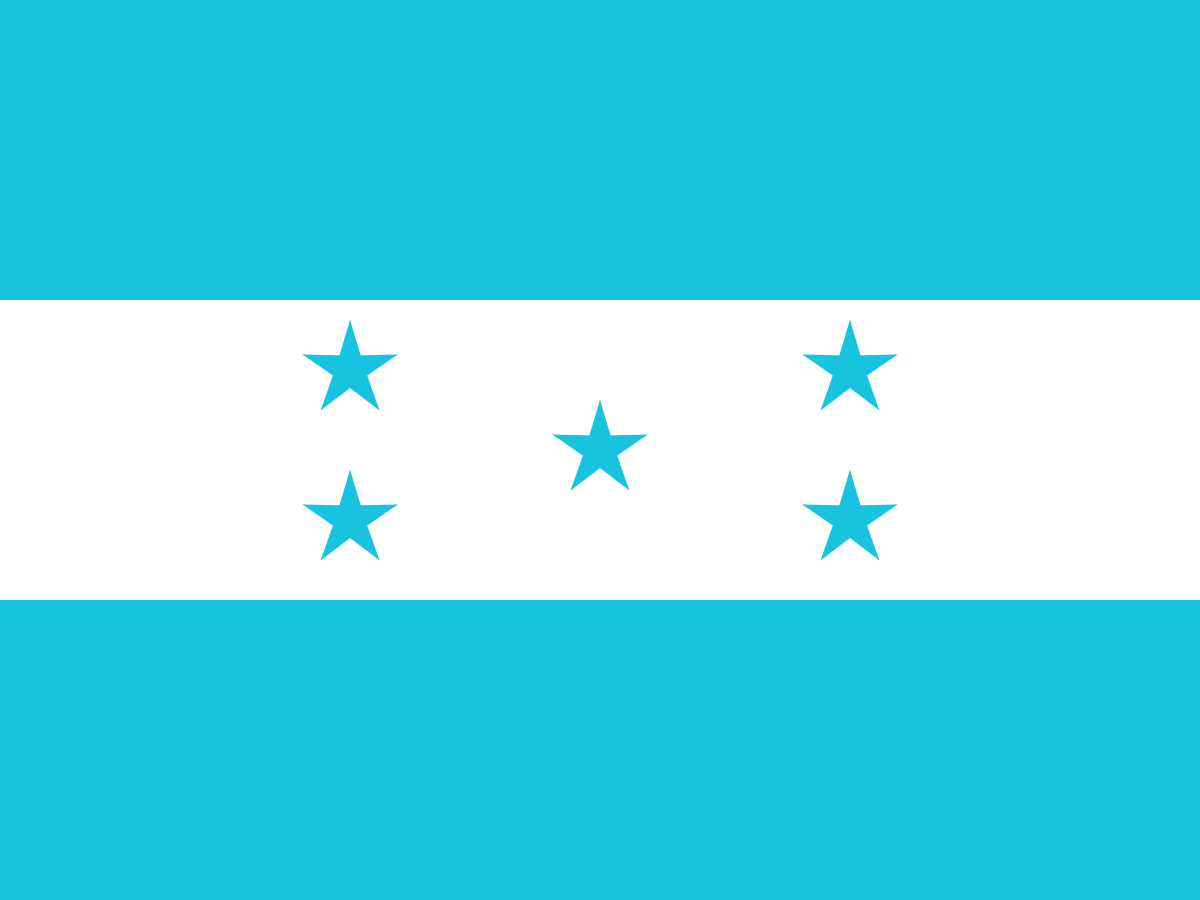
The flag of Honduras
Honduras's flag has three horizontal bands: blue, white and blue, with five blue five-pointed stars arranged in an X-like pattern in the centre.
The five stars are the most distinctive feature.
They represent the five former members of the United Provinces of Central America: Honduras, Guatemala, El Salvador, Nicaragua and Costa Rica. The arrangement expresses the idea of Central American unity.
The flag's design is closely related to the flags of the other Central American states and ultimately to the Central American Federation.
What do the colours mean?
The two blue bands are commonly associated with the Caribbean Sea and Pacific Ocean and with the sky and ideals of the nation. The central white band represents peace, purity and the land between the two seas.
The five blue stars are the key historical symbol, representing the five nations that formed the former Central American federation.
The five stars
The five stars represent Honduras, Guatemala, El Salvador, Nicaragua and Costa Rica. They recall the five states of the former United Provinces of Central America.
The central arrangement is often interpreted as expressing the hope that Central America could once again be united.
Why are there five stars?
The stars are not simply decorative. They preserve the memory of the Central American Federation, which existed in the nineteenth century before breaking apart.
Honduras's flag therefore carries a political and historical idea of regional unity within a very simple design.
A short history of Honduras
Honduras has a long Indigenous history, including the remarkable Maya civilisation at Copán. Spanish conquest began in the sixteenth century and the territory later became part of the Spanish Empire.
Honduras became independent from Spain in 1821, initially as part of the wider Central American independence movement.
Flag history timeline
Before European arrivalIndigenous peoples including Maya, Lenca and other communities lived across the region.
c. 5th–9th centuries — CopánCopán became one of the great Maya centres of the region.
1502 — Columbus reaches HondurasChristopher Columbus reached the Caribbean coast during his fourth voyage.
16th century — Spanish conquestSpanish forces established colonial control over the region.
15 September 1821 — independenceHonduras became independent from Spain alongside the other Central American provinces.
1823 — Central American federationHonduras joined the United Provinces of Central America.
1838 — federation endsHonduras became fully independent as the federation fragmented.
1866 — present flag adoptedHonduras adopted the basic blue-white-blue flag design with five stars.
TodayHonduras is a sovereign Central American republic with a diverse economy and rich cultural heritage.
The Maya civilisation
The Maya civilisation had a major presence in western Honduras, especially around Copán. Copán became a sophisticated centre of architecture, sculpture, astronomy and writing.
The site provides some of the most important evidence for Maya civilisation in Central America.
Copán
Copán is one of the most famous Maya archaeological sites. Its monuments include elaborate stelae, temples, plazas and the famous Hieroglyphic Stairway.
Copán was designated a UNESCO World Heritage Site and is one of Honduras's most important cultural attractions.
Indigenous peoples
Honduras is home to several Indigenous peoples, including the Lenca, Miskito, Garífuna, Pech, Tawahka and Tolupan communities.
Their languages, traditions, music, crafts and food remain an important part of Honduran culture.
Spanish colonial rule
Spain established colonial control over Honduras during the sixteenth century. Mining, agriculture and trade became important parts of the colonial economy.
Spanish influence remains visible in the country's language, religion, architecture and institutions.
Independence in 1821
Honduras declared independence from Spain on 15 September 1821, together with the other provinces of Central America.
The region then briefly became part of the Mexican Empire before forming the United Provinces of Central America.
The Central American Federation
Honduras, Guatemala, El Salvador, Nicaragua and Costa Rica formed the United Provinces of Central America in 1823.
Political disagreements eventually broke the federation apart. The five stars on Honduras's flag preserve the memory of this period.
Tegucigalpa
Tegucigalpa is Honduras's capital and one of the highest major capitals in Central America. It is built among hills and valleys and is closely connected with the neighbouring city of Comayagüela.
The capital is the country's main political and administrative centre.
Roatán and the Bay Islands
The Bay Islands, including Roatán, Utila and Guanaja, lie off Honduras's Caribbean coast. They are famous for clear water, coral reefs and diving.
The islands form part of the Mesoamerican Barrier Reef system, one of the world's most important coral reef environments.
The Caribbean coast
Honduras has a long Caribbean coastline with beaches, lagoons, mangroves and tropical forests. The region is culturally diverse and includes important Garífuna communities.
The Caribbean coast is also important for fishing, tourism and trade.
The Gulf of Fonseca
Honduras has a Pacific coastline around the Gulf of Fonseca, shared with El Salvador and Nicaragua.
The gulf contains mangroves, islands and productive coastal waters and provides Honduras with access to the Pacific.
Climate
Honduras has a varied tropical climate. The Caribbean coast is generally wetter, while the interior highlands are cooler and the Pacific side has pronounced wet and dry seasons.
Mountain elevation creates significant local differences in temperature and rainfall.
Rainforests and national parks
Honduras contains extensive tropical forests, including the La Mosquitia region in the northeast. Protected areas conserve forests, rivers and wildlife.
The country's natural habitats are important for biodiversity but face pressures from deforestation, agriculture and illegal land use.
Río Plátano Biosphere Reserve
The Río Plátano Biosphere Reserve is one of Honduras's most important protected landscapes. It contains tropical rainforest, rivers, wetlands and coastal ecosystems.
The reserve is a UNESCO World Heritage site and supports both biodiversity and traditional Indigenous and local communities.
Wildlife
Honduras supports wildlife including jaguars, ocelots, tapirs, spider monkeys, scarlet macaws, toucans and crocodilians.
The combination of rainforest, mountains, wetlands and coral reefs gives the country an unusually wide range of habitats.
The scarlet macaw
The brilliant scarlet macaw is one of Honduras's most recognisable birds. It is associated particularly with the tropical forests of La Mosquitia and other protected areas.
Conservation programmes work to protect nesting sites and reduce illegal wildlife trade.
Coffee
Coffee is one of Honduras's most important agricultural exports. It is grown mainly in the country's mountainous interior, where elevation and climate create suitable conditions.
Honduran coffee is exported around the world and supports large numbers of smallholder farmers.
Bananas and agriculture
Honduras has a long history of producing bananas and other tropical agricultural products for export. Other important crops include coffee, palm oil, sugar, maize and beans.
Agriculture remains an important source of employment and export earnings.
The banana industry
Bananas became particularly important to Honduras during the late nineteenth and early twentieth centuries. Large foreign-owned companies built railways, ports and plantations along the Caribbean coast.
This period had a profound influence on Honduran politics and the country's relationship with foreign businesses.
The economy
Honduras has a mixed economy based on agriculture, manufacturing, services, remittances and tourism. Textile and apparel manufacturing is particularly important.
Economic development is affected by inequality, infrastructure gaps, climate risks and vulnerability to hurricanes.
Football in Honduras
Football is hugely popular in Honduras and forms an important part of national culture. The country has a strong domestic league and the national team regularly competes in CONCACAF tournaments.
Football also contributed to the famous 1969 conflict with El Salvador, which became known as the “Football War”.
The Football War
The 1969 conflict between Honduras and El Salvador lasted only a few days, but football matches between the two countries occurred during a period of serious political and social tension.
The war was caused by deeper disputes over migration, land and political relations; the football matches became a highly visible trigger rather than the sole cause.
Honduran culture
Honduran culture combines Indigenous, Spanish, African and Caribbean influences. Music, dance, food, football, festivals and traditional crafts vary considerably between regions.
Garífuna culture is particularly important along the Caribbean coast.
The Garífuna
The Garífuna are a distinctive Afro-Indigenous Caribbean people with communities along Honduras's Caribbean coast. Their language, music and dance are recognised as an important part of world cultural heritage.
Punta music and dance are among the best-known expressions of Garífuna culture.
Honduran food
Honduran cuisine includes baleadas, tamales, pastelitos, beans, rice, plantains, seafood and carne asada. Coastal cuisine makes extensive use of coconut and seafood.
Baleadas are one of the country's best-known everyday foods: a flour tortilla folded around beans and other fillings.
Languages
Spanish is Honduras's official and most widely spoken language. Indigenous and minority languages are also spoken, including Miskito, Garífuna and several other languages.
Language diversity reflects Honduras's Indigenous and Caribbean heritage.
Tourism
Honduras offers Caribbean islands, coral reefs, Maya archaeology, rainforests, mountains and colonial towns. Roatán is particularly popular with divers, while Copán attracts visitors interested in Maya history.
Ecotourism is also important in protected areas such as Río Plátano and La Mosquitia.
Honduras today
Modern Honduras is a Central American republic with a population of more than 10 million. Its identity combines Central American history, Caribbean culture, Indigenous heritage and a strong love of football.
The five stars on its flag continue to represent a historical idea of Central American unity that has outlasted the federation itself.
Why is Honduras's flag interesting?
Honduras's flag is simple but carries a surprisingly large historical idea. The five stars are a reminder of a Central American federation that no longer exists, while the blue and white bands connect Honduras with its geography and regional identity.
It is a good example of how a national flag can preserve the memory of an earlier political union.
Explore Honduras on FlagAtlas
Continue exploring Honduras and the world's flags with these FlagAtlas resources.