About Hungary
Hungary is a landlocked country in Central Europe, bordered by Austria, Slovakia, Ukraine, Romania, Serbia, Croatia and Slovenia. Budapest is the capital and largest city.
Hungary is known for its long history, the Danube River, Lake Balaton, thermal baths, classical music, distinctive cuisine and scientific and cultural achievements.
CapitalBudapest
RegionCentral Europe
PopulationAbout 10 million
CurrencyForint
Official languageHungarian
National day20 August
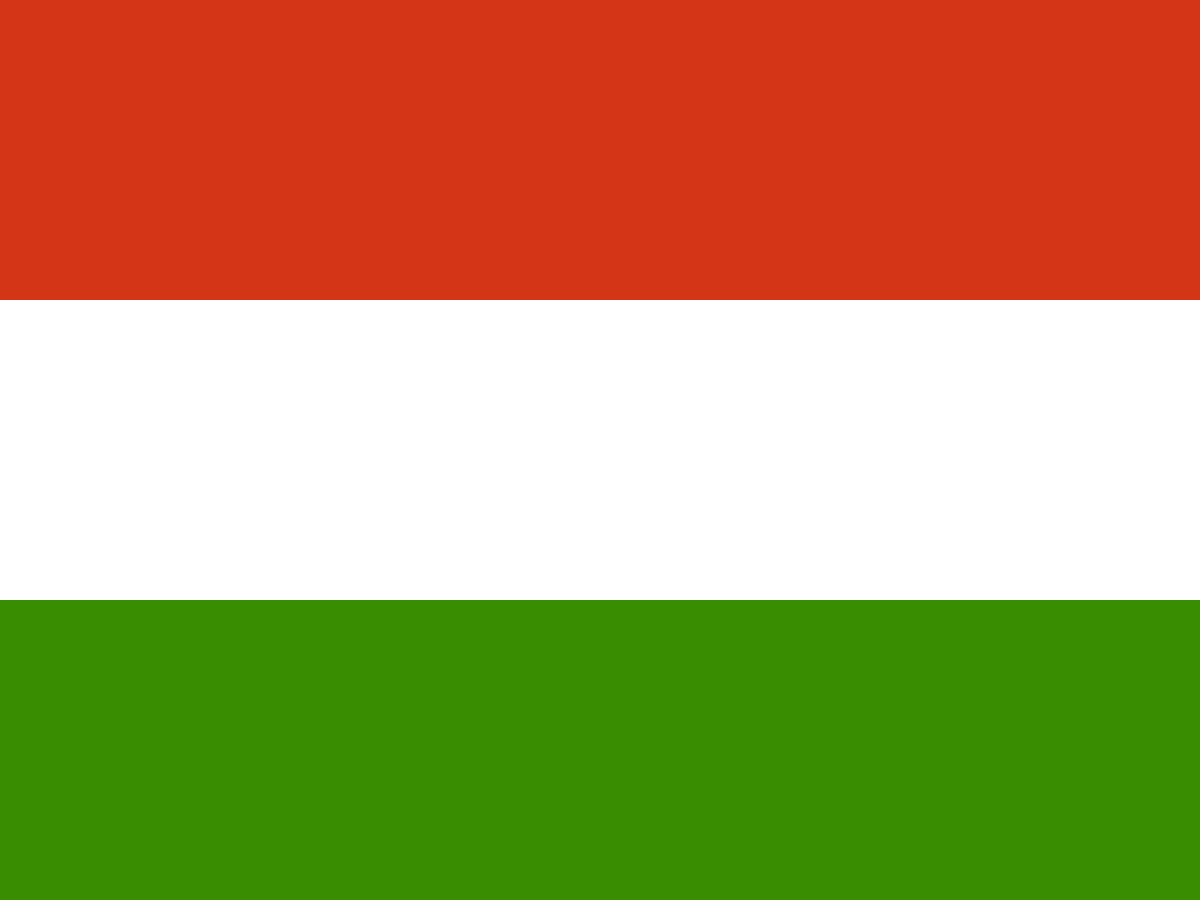
The flag of Hungary
Hungary's national flag is a simple horizontal tricolour of red, white and green. The modern design became an important national symbol during the nineteenth-century reform and revolutionary period.
The colours have deep historical associations.
Red is traditionally linked with strength, white with faithfulness or loyalty, and green with hope. Together they form one of Europe's most recognisable tricolours.
The plain civil flag does not normally contain a coat of arms. The Hungarian state has also used versions featuring the national coat of arms.
What do the colours mean?
The traditional interpretation gives red the meaning of strength, white faithfulness and green hope. These associations are widely used when explaining the Hungarian tricolour.
The colours also have a long historical connection with Hungarian heraldry and national movements.
The red stripe
Red is traditionally associated with strength and courage. It has deep roots in Hungarian heraldic and national symbolism.
Red became particularly prominent as a national colour during the nineteenth-century movement for Hungarian political and cultural independence.
The white stripe
White is traditionally associated with faithfulness and loyalty. It also contributes to the clean, balanced appearance of the tricolour.
The central white band separates the red and green fields and is one of the defining features of the modern flag.
The green stripe
Green is traditionally associated with hope. It is also linked with Hungary's landscape and agricultural traditions.
Alongside red and white, green forms the historic Hungarian colour combination used in national symbols and celebrations.
A short history of Hungary
Hungary's history stretches from the arrival of the Magyars in the Carpathian Basin to the medieval Kingdom of Hungary, Ottoman rule, Habsburg rule, the Austro-Hungarian Empire and the modern republic.
The country's history has repeatedly involved the interaction of Central European, Balkan and eastern influences.
History timeline
c. 895 — Magyar settlementMagyar tribes settled in the Carpathian Basin under Árpád's leadership.
1000/1001 — Kingdom of HungaryStephen I was crowned king and helped establish Hungary as a Christian European kingdom.
1241–42 — Mongol invasionThe Mongol invasion devastated much of the kingdom and led to major rebuilding and fortification.
1526 — Battle of MohácsHungarian forces suffered a major defeat by the Ottoman Empire, beginning a long period of political division.
1541 — Ottoman occupation of BudaCentral Hungary came under Ottoman rule while Habsburg Hungary and Transylvania followed different political paths.
1848 — Hungarian RevolutionA major nationalist and liberal revolution sought greater Hungarian autonomy within the Habsburg Empire.
1867 — Austro-Hungarian CompromiseHungary became one of the two equal political components of the Austro-Hungarian Empire.
1918–20 — collapse and Treaty of TrianonThe First World War ended the empire and Hungary lost large areas of its former territory.
1956 — revolutionHungarians rose against Soviet-backed communist rule; the uprising was suppressed by Soviet forces.
1989 — transition to democracyHungary peacefully dismantled its communist political system and became a democratic republic.
TodayHungary is a Central European parliamentary republic and a member of the European Union and NATO.
The Magyars
The Magyars were the ancestors of the modern Hungarian people who settled in the Carpathian Basin in the late ninth century.
The Hungarian language belongs to the Uralic language family and is not closely related to the neighbouring Slavic and Romance languages.
Saint Stephen I
Stephen I became Hungary's first king around the turn of the first millennium and played a central role in establishing a Christian Hungarian state.
He is one of Hungary's most important historical figures and is celebrated on 20 August, Hungary's principal national holiday.
The Kingdom of Hungary
The medieval Kingdom of Hungary became a major Central European state. Its territory and political influence changed considerably over the centuries.
Medieval Hungary included a much larger area than the modern Hungarian state.
The Mongol invasion
The Mongol invasion of 1241–1242 caused enormous destruction. King Béla IV later encouraged the rebuilding of towns and construction of stone fortifications.
This period helped transform Hungary's defensive architecture and urban development.
Ottoman Hungary
After the Battle of Mohács in 1526, Hungary was divided between Ottoman, Habsburg and Transylvanian spheres of power.
Ottoman rule lasted for much of central Hungary until Habsburg forces gradually reconquered the region in the late seventeenth century.
The Habsburg era
Hungary became closely linked with the Habsburg monarchy after the Ottoman period. Tensions between Hungarian political interests and Vienna shaped the country's history for centuries.
The relationship changed dramatically after the 1848 revolution and the 1867 compromise.
The Hungarian Revolution of 1848
The 1848 Hungarian Revolution demanded political reform, civil rights and greater national autonomy. Lajos Kossuth became one of its most prominent leaders.
The revolution was eventually defeated with military intervention by the Habsburgs and their Russian allies, but its ideas became central to modern Hungarian national identity.
Lajos Kossuth
Lajos Kossuth was a leading statesman of the 1848 revolution and became governor-president of revolutionary Hungary.
He later lived in exile and remained an important symbol of Hungarian independence and constitutional government.
The Austro-Hungarian Empire
The Austro-Hungarian Compromise of 1867 created a dual monarchy in which Austria and Hungary shared a ruler but had separate governments in many areas.
Budapest grew rapidly during this period and became one of Europe's major imperial capitals.
Treaty of Trianon
After the First World War, the Treaty of Trianon of 1920 drastically reduced Hungary's territory and population.
The treaty remains one of the most significant and emotionally charged events in modern Hungarian history.
Budapest
Budapest was formed in 1873 through the unification of Buda, Óbuda and Pest. The Danube divides the city into its historic western and eastern sides.
The city is famous for the Parliament Building, Buda Castle, Chain Bridge, thermal baths and its dramatic riverside skyline.
The Danube
The Danube River flows through Budapest and is one of Europe's great rivers. It has played an important role in Hungary's trade, transport and history.
The river also forms a natural and visual centre of Budapest, with several famous bridges connecting Buda and Pest.
Lake Balaton
Lake Balaton is the largest lake in Central Europe and one of Hungary's most popular holiday destinations.
Known as the “Hungarian Sea”, it is important for swimming, sailing, tourism, fishing and wine production around its shores.
Hungarian Great Plain
The Great Hungarian Plain, or Alföld, covers a large part of eastern and central Hungary. Its open landscapes have traditionally supported agriculture and livestock.
The region is closely associated with Hungarian horsemen, cattle herding and the traditional image of the puszta.
Hungarian puszta
The puszta is the open grassland landscape of the Great Plain. Traditional horse-riding culture, livestock and shepherding became closely associated with the region.
Today, parts of the landscape are protected within national parks.
Climate
Hungary has a temperate continental climate with warm summers and relatively cold winters. Rainfall varies across the country and drought can affect agriculture.
The country's inland location produces greater seasonal temperature differences than many parts of Western Europe.
Wildlife
Hungary's forests, wetlands, grasslands and rivers support red deer, wild boar, foxes, otters, beavers and many bird species.
The country lies along important European bird migration routes, making wetlands and protected areas valuable for conservation.
Hortobágy National Park
Hortobágy National Park is Hungary's largest protected area and a famous example of the puszta landscape. It is known for traditional pastoral culture and wildlife.
The park is also a UNESCO World Heritage site.
Hungarian language
Hungarian is the official language of Hungary and belongs to the Uralic language family. It is closely related to Finnish and Estonian at the broad language-family level, rather than to the surrounding Slavic and Romance languages.
Its grammar and vocabulary make it distinctive within Central Europe.
Hungarian culture
Hungarian culture has produced internationally important contributions to music, literature, mathematics, science, architecture and food.
Folk traditions include embroidery, dance, music and distinctive regional crafts.
Hungarian music
Hungary has a rich musical tradition including folk music and major classical composers such as Franz Liszt, Béla Bartók and Zoltán Kodály.
Bartók and Kodály in particular studied Hungarian folk music and incorporated its rhythms and melodies into concert music.
Hungarian food
Hungarian cuisine is famous for goulash, paprikash, lángos, stuffed cabbage, sausages and pastries. Paprika is one of the country's most recognisable ingredients.
Traditional cuisine combines Central European cooking with distinctive Hungarian spices and preparation methods.
Paprika
Paprika is one of the defining ingredients of Hungarian cuisine. Both sweet and hot varieties are used, and the spice is strongly associated with dishes such as goulash and paprikash.
The peppers used for paprika became important in Hungary after their introduction from the Americas.
Thermal baths
Hungary is famous for its thermal springs and baths. Budapest in particular has a long bathing tradition and contains several historic bathhouses.
The country's geology provides abundant naturally warm mineral-rich waters.
Rubik's Cube
The Rubik's Cube was invented by Hungarian architect and professor Ernő Rubik in 1974. It became one of the world's best-known puzzles.
The cube was originally created as a three-dimensional teaching tool and later became a global toy and competitive puzzle.
Hungarian inventions and science
Hungarian scientists and inventors have made major contributions to modern science and technology. These include the work associated with John von Neumann, Leo Szilard, Dennis Gabor and Albert Szent-Györgyi.
Hungarian-born scientists have played important roles in mathematics, physics, computing and medicine.
The Nobel tradition
Hungary and Hungarian-born scientists have a notable record of international scientific achievement. Albert Szent-Györgyi received the Nobel Prize in Physiology or Medicine for work connected with vitamin C and biological oxidation.
Hungarian scientific culture has also had a strong influence on mathematics and theoretical physics.
The economy
Hungary has a diversified European economy based on manufacturing, automotive production, services, pharmaceuticals, agriculture and tourism.
The country is closely integrated with European supply chains and is an important manufacturing location in Central Europe.
Football
Football is one of Hungary's most popular sports. The country enjoyed a golden era in the 1950s with the legendary Magical Magyars.
The Hungarian national team reached the 1954 World Cup final and famously defeated England 6–3 at Wembley in 1953.
The 1956 Revolution
The Hungarian Revolution of 1956 began as a popular uprising against the communist government and Soviet domination. Soviet forces eventually invaded and crushed the revolution.
The uprising became an enduring symbol of resistance to Soviet rule and played an important role in Hungary's modern national memory.
1989 and the end of communism
In 1989, Hungary peacefully dismantled its communist political system and began a transition to parliamentary democracy and a market economy.
Hungary became one of the early Central European states to move away from Soviet-style communist government.
Hungary today
Modern Hungary is a Central European republic and member of the European Union and NATO. Budapest is a major regional centre for business, culture and tourism.
The country's modern identity combines a very old historical tradition with a contemporary European economy and society.
Why is Hungary's flag interesting?
Hungary's flag is deceptively simple. Its red, white and green tricolour connects modern Hungary with centuries of national symbolism, while the design became especially important during the nineteenth-century struggle for political reform and national independence.
It is a good example of a flag whose power comes from historical continuity rather than a complicated emblem.
Explore Hungary on FlagAtlas
Continue exploring Hungary and the world's flags with these FlagAtlas resources.