About Iceland
Iceland is an island country in the North Atlantic, just south of the Arctic Circle. Reykjavik is the capital and largest city.
Iceland is famous for volcanoes, glaciers, geothermal springs, waterfalls, dramatic coastlines and a culture shaped by Norse settlement. Despite its northern location, the climate is moderated by the surrounding ocean.
CapitalReykjavik
RegionNorth Atlantic / Europe
PopulationAbout 390,000
CurrencyIcelandic króna
Official languageIcelandic
Settlement9th century
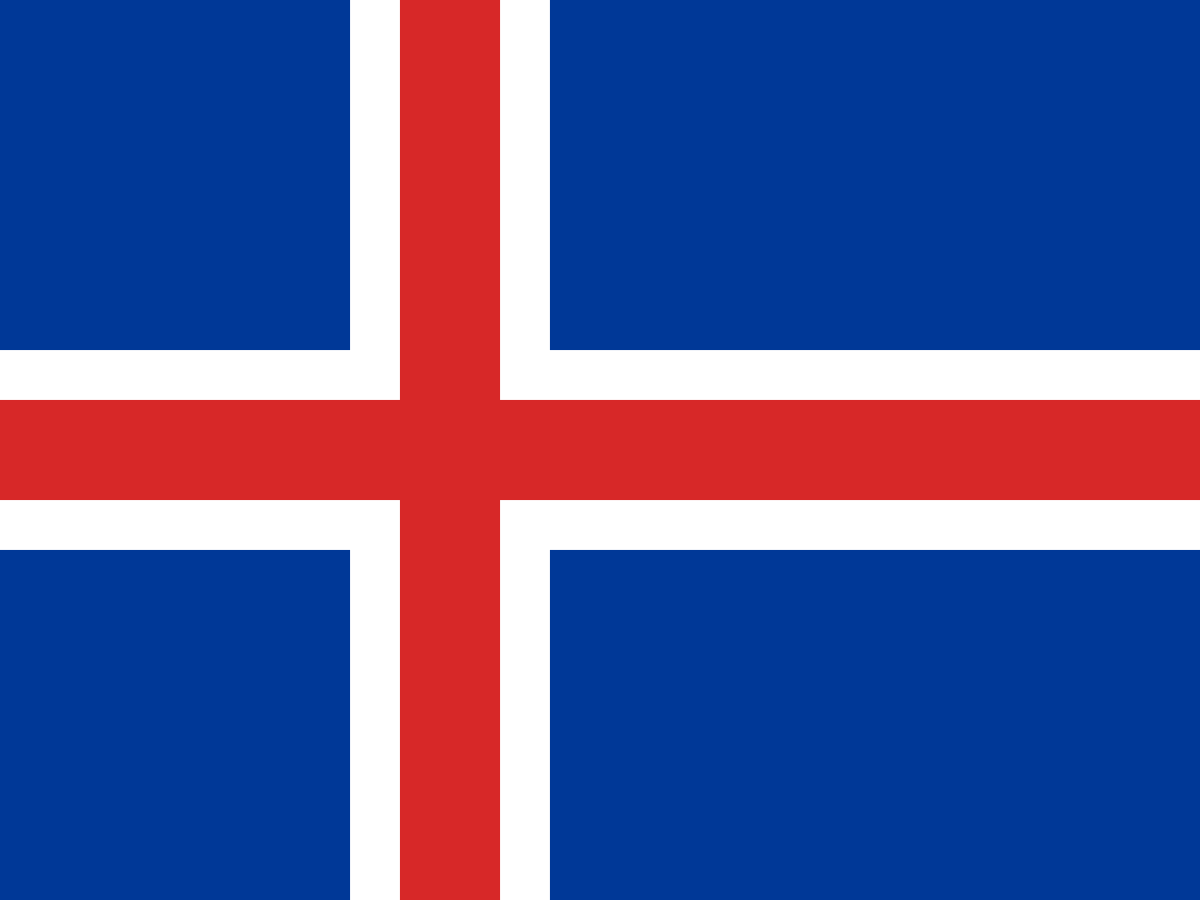
The flag of Iceland
Iceland's flag is a blue Nordic cross outlined in white with a red inner cross. The cross design connects Iceland with the other Nordic countries.
The colours are traditionally explained through Iceland's landscape.
Blue represents the mountains and sky, white represents ice and snow, and red represents the volcanic fires beneath the surface.
The current flag design was formally established in the early twentieth century and became the national flag of the independent Kingdom of Iceland in 1918.
What do the colours mean?
The traditional interpretation is particularly visual: blue for the mountains and sky, white for ice and snow, and red for volcanic fire.
Together, the colours capture the contrast that defines Iceland — glaciers and snow alongside active volcanoes and geothermal heat.
The blue field
Blue represents Iceland's mountains and sky. It also dominates the flag and provides the background for the white and red Nordic cross.
The surrounding North Atlantic is another defining feature of Iceland's geography and national identity.
The white cross
White represents ice and snow, reflecting Iceland's glaciers, winter landscapes and high mountain areas.
Glaciers cover a significant part of Iceland and are among the country's most recognisable natural features.
The red cross
Red represents the volcanic fires beneath the surface. Iceland sits on the Mid-Atlantic Ridge and is one of the world's most volcanically active regions.
Volcanic eruptions, lava fields and geothermal activity are central to the country's landscape.
The Nordic cross
Iceland's flag uses the Nordic cross, a design shared by Denmark, Finland, Norway, Sweden and Iceland.
The cross reflects Iceland's historical and cultural connections with the other Nordic countries and its Norse heritage.
A short history of Iceland
Iceland was settled mainly by Norse settlers and their Celtic companions during the late ninth and early tenth centuries. The settlers established the Althing, one of the world's oldest surviving parliamentary institutions.
Iceland later came under Norwegian and then Danish rule before becoming a sovereign kingdom in 1918 and a republic in 1944.
History timeline
Before settlementIceland was probably visited by Irish monks before permanent Norse settlement, although the extent of their presence is debated.
c. 874 — Norse settlementIngólfur Arnarson is traditionally regarded as one of the first permanent Norse settlers, establishing a farm at Reykjavik.
930 — Althing establishedIceland's national assembly, the Althing, was established at Þingvellir.
1000 — Christianity adoptedAt the Althing, Iceland adopted Christianity while allowing some private pagan practices to continue temporarily.
1262–1264 — Norwegian ruleIcelanders accepted the authority of the Norwegian king.
1380 — Danish-Norwegian unionIceland came under the Danish crown through the union of Denmark and Norway.
1874 — constitutionDenmark granted Iceland a constitution and limited self-government.
1918 — sovereign kingdomThe Act of Union established Iceland as a sovereign state in personal union with Denmark.
1944 — republicIceland became a republic on 17 June 1944 while Denmark was occupied during the Second World War.
TodayIceland is a modern Nordic republic known for high living standards, renewable energy and dramatic natural landscapes.
The Viking settlers
Iceland was settled mainly by Norse people from Scandinavia, along with people of Celtic origin who accompanied them. Settlement accelerated during the late ninth century.
The Icelandic sagas preserve stories about many of the early settlers and their families.
The Althing
The Althing (Alþingi) was established around 930 at Þingvellir. It served as Iceland's main assembly and legal institution for centuries.
It is often described as one of the world's oldest surviving parliamentary institutions and remains the name of Iceland's modern parliament.
Þingvellir
Þingvellir National Park is both a major historical site and a remarkable geological landscape. The Althing met there for centuries, while the area also lies on the boundary between the North American and Eurasian tectonic plates.
Þingvellir forms part of a UNESCO World Heritage Site.
Icelandic sagas
The Icelandic sagas are medieval works of literature describing families, settlers, conflicts and legendary events. They are among Iceland's most famous cultural achievements.
Written mainly in the thirteenth and fourteenth centuries, the sagas provide a unique window into medieval Icelandic society.
Norwegian and Danish rule
Iceland became subject to the Norwegian crown in the thirteenth century and later came under Danish rule. The island remained politically connected to Denmark for centuries.
Gradual constitutional reforms eventually led to sovereignty in 1918 and full republican independence in 1944.
Independence and the republic
The Act of Union of 1918 recognised Iceland as a sovereign state in personal union with Denmark. On 17 June 1944, Iceland became a republic.
17 June is now Iceland's national day and commemorates the birthday of Jón Sigurðsson, a leading nineteenth-century independence campaigner.
Reykjavik
Reykjavik is Iceland's capital and largest city. It is the country's political, cultural and economic centre.
The city is famous for its colourful buildings, Hallgrímskirkja church, harbour, museums and access to nearby geothermal and volcanic landscapes.
The Ring Road
Iceland's main road around much of the island is commonly known as the Ring Road. It links many of the country's major towns and natural attractions.
Road travel is a major part of tourism, although winter weather and remote terrain can make conditions challenging.
Volcanoes
Iceland sits on the Mid-Atlantic Ridge and above a geological hotspot, making it highly volcanically active. The country has many volcanic systems and frequent historical eruptions.
Volcanoes have created lava fields, craters, geothermal areas and new land.
Glaciers
Iceland contains several major glaciers, including Vatnajökull, the largest glacier in Europe by volume. Glacial ice feeds rivers and helps shape valleys and coastlines.
Climate change is causing many Icelandic glaciers to retreat.
Geothermal energy
Iceland makes extensive use of geothermal energy for heating and electricity. Hot water from underground is used to heat homes, greenhouses and swimming pools.
Geothermal resources are one reason Iceland can maintain a high standard of living while relying heavily on renewable energy.
Hydroelectric power
Hydropower is another major part of Iceland's renewable energy system. Rivers fed by glaciers and highland precipitation provide substantial potential for electricity generation.
Together, hydropower and geothermal energy supply almost all of Iceland's electricity generation.
The Blue Lagoon
The Blue Lagoon is one of Iceland's best-known geothermal attractions. Its warm mineral-rich waters are associated with the country's wider bathing and geothermal culture.
Geothermal bathing is a major part of everyday life as well as tourism in Iceland.
Waterfalls
Iceland has thousands of waterfalls created by its glaciers, rivers and volcanic landscape. Famous examples include Gullfoss, Seljalandsfoss and Skógafoss.
Waterfalls are among the country's most photographed natural attractions.
Climate
Despite its northern latitude, Iceland has a relatively mild maritime climate compared with many other places at similar latitudes. Winters are cool rather than extremely cold, while summers are short and mild.
Weather can change rapidly, particularly in the mountains and exposed coastal areas.
Wildlife
Iceland's wildlife includes Arctic foxes, reindeer, seals, whales and huge numbers of seabirds. Its offshore waters are particularly rich in marine life.
The island has no native land mammals apart from the Arctic fox; reindeer were introduced in the eighteenth century.
Puffins
The Atlantic puffin is one of Iceland's most famous birds. Large breeding colonies arrive during the summer months to nest on coastal cliffs and islands.
Puffins are closely associated with Icelandic wildlife and are a major attraction for visitors.
Whales
Iceland's surrounding waters support many species of whales and dolphins. Whale watching is a popular activity from several coastal towns.
Species seen in Icelandic waters can include minke whales, humpback whales, orcas and occasionally blue whales.
Fishing
Fishing has historically been one of the foundations of Iceland's economy. Cod, haddock, herring and other marine species support a major fishing and seafood industry.
Control of fishing grounds was also central to Iceland's twentieth-century disputes with the United Kingdom known as the Cod Wars.
The Cod Wars
The Cod Wars were a series of disputes between Iceland and the United Kingdom over fishing rights in the North Atlantic. Iceland progressively expanded the area in which it claimed exclusive fishing rights.
The disputes ended with the UK recognising Iceland's 200-nautical-mile exclusive economic zone in 1976.
Icelandic language
Icelandic is a North Germanic language that has retained many features of Old Norse. Modern Icelanders can still read medieval Icelandic texts with less difficulty than speakers of many other modern languages can read their medieval predecessors.
The language is closely connected with Iceland's literary tradition and national identity.
Icelandic culture
Icelandic culture combines Norse heritage, medieval literature, modern Nordic society and a strong connection with the natural environment.
Literature, music, design, visual art and outdoor activities are all important parts of modern Icelandic life.
Icelandic food
Traditional Icelandic food includes fish, lamb, dairy products, rye bread and skyr. Modern Icelandic cuisine has developed these ingredients alongside international influences.
Seafood remains particularly important because of the country's geography and fishing history.
Skyr
Skyr is a thick cultured dairy product that has been made in Iceland for centuries. It resembles yoghurt in texture but is technically a fresh cultured cheese.
It is now one of Iceland's best-known food products internationally.
The Northern Lights
The Northern Lights (aurora borealis) can often be seen in Iceland during the darker months of the year when skies are clear and solar activity is favourable.
The aurora is caused by charged particles from the Sun interacting with Earth's upper atmosphere.
The midnight sun
During summer, Iceland experiences extremely long daylight hours. Around the summer solstice, areas of northern Iceland can experience the midnight sun.
Even in Reykjavik, summer nights remain remarkably bright.
The economy
Iceland has a high-income economy based on fishing, tourism, renewable energy, aluminium production, services and technology.
Cheap renewable electricity has also supported energy-intensive industries, while tourism has become a major source of foreign income.
Tourism
Iceland is one of Europe's most popular nature-tourism destinations. Visitors come for volcanoes, glaciers, waterfalls, geothermal baths, the Northern Lights and dramatic coastal landscapes.
The famous Golden Circle, South Coast and Ring Road are among the country's best-known travel routes.
Iceland today
Modern Iceland is a small Nordic republic with a population of under 400,000. It combines a highly developed economy with extraordinary geological and natural environments.
Its flag reflects that landscape unusually well: blue mountains and sky, white ice and snow, and red volcanic fire.
Why is Iceland's flag interesting?
Iceland's flag is a brilliant example of a national symbol matching the physical landscape. The Nordic cross links Iceland to its Scandinavian heritage, while the colours tell the story of mountains, glaciers and volcanoes.
Few national flags capture the geography of their country quite so directly.
Explore Iceland on FlagAtlas
Continue exploring Iceland and the world's flags with these FlagAtlas resources.