About India
India is a vast country in South Asia stretching from the Himalayas to the Indian Ocean. New Delhi is the capital, while cities such as Mumbai, Kolkata, Chennai and Bengaluru are major cultural and economic centres.
India is known for its extraordinary linguistic and cultural diversity, ancient civilisations, religions, mountains, deserts, tropical forests, wildlife and rapidly growing economy.
CapitalNew Delhi
RegionSouth Asia
PopulationAbout 1.4 billion
CurrencyIndian rupee
Official languagesHindi & English
Independence15 August 1947
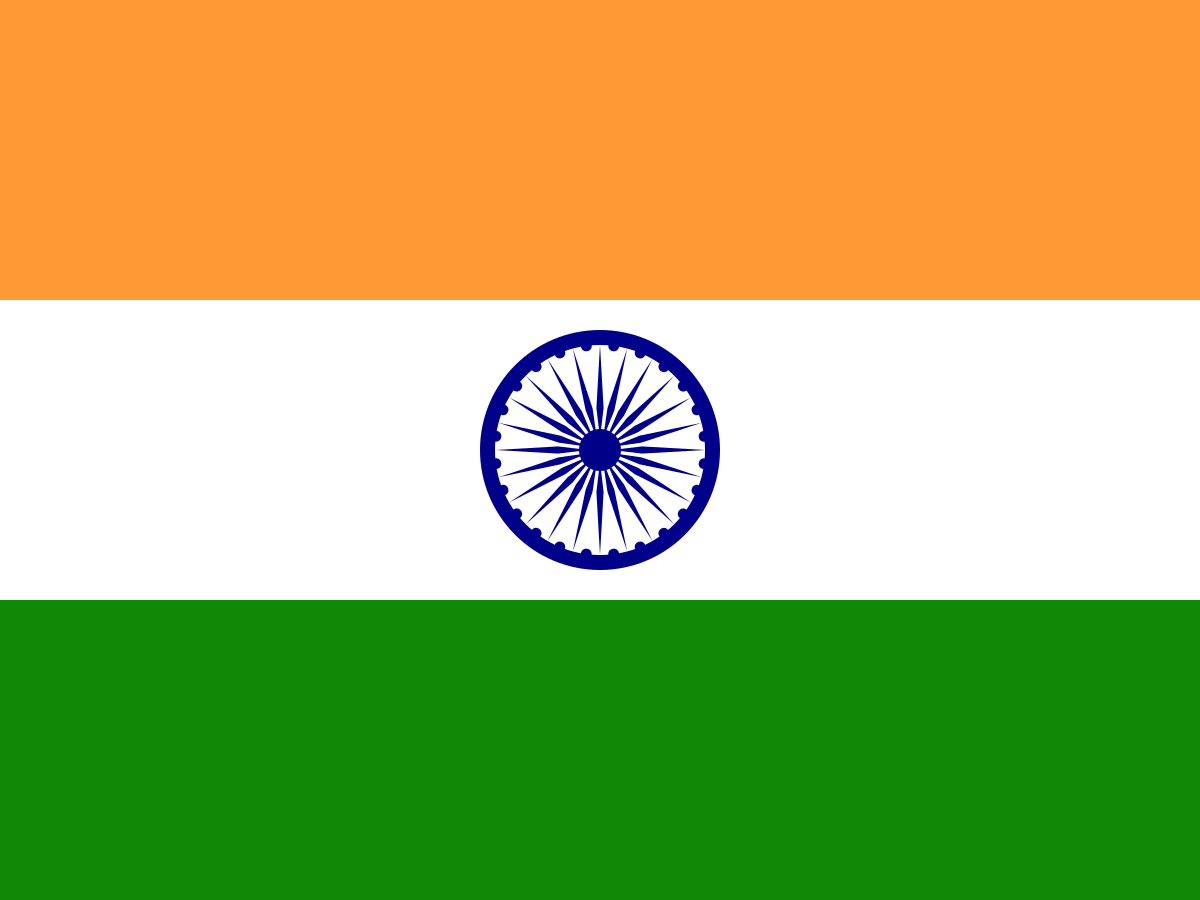
The flag of India
India's national flag is known as the Tiranga, meaning “tricolour”. It has three horizontal bands of saffron, white and green with a navy-blue Ashoka Chakra in the centre.
The Ashoka Chakra has 24 spokes.
The wheel comes from the Lion Capital of Ashoka at Sarnath and represents the eternal wheel of dharma, movement and righteous action.
The present flag was adopted by the Constituent Assembly on 22 July 1947, shortly before independence.
What do the colours mean?
The flag's saffron represents courage and sacrifice, white represents peace and truth, and green represents faith, fertility and prosperity. The navy-blue Ashoka Chakra represents dharma and the cycle of life.
These meanings are widely used in explanations of the modern Indian flag, although interpretations of the colours have varied over India's history.
The saffron band
Saffron is traditionally associated with courage, sacrifice and selflessness. It is the upper band of the Tiranga.
Saffron also has a long cultural and religious significance in South Asia, making it a particularly powerful colour in the national flag.
The white band
White represents peace and truth. The Ashoka Chakra sits at the centre of this band, making it the visual focus of the flag.
The white field also provides a strong contrast with the saffron and green bands and the dark blue wheel.
The green band
Green is traditionally associated with faith, fertility and prosperity. It is also naturally connected with India's agricultural landscapes.
From the Himalayan foothills to the tropical south, India contains an enormous range of green landscapes and farming regions.
The Ashoka Chakra
The Ashoka Chakra is a navy-blue wheel with 24 spokes. It is based on the Dharma Chakra represented on the Lion Capital of Ashoka at Sarnath.
The wheel symbolises dharma, righteous conduct and continual movement. Its position in the centre gives the flag a distinctive visual identity.
Why are there 24 spokes?
The Ashoka Chakra contains 24 spokes. They are commonly associated with principles and virtues connected with dharma and ethical living.
The important point for the flag is that the wheel represents movement rather than stagnation — a nation progressing through righteous action.
A short history of India
India's history spans thousands of years, from the Indus Valley Civilisation through ancient kingdoms and empires, the Mughal period, British rule and the independence movement.
India became independent from British rule on 15 August 1947 and adopted a democratic constitution in 1950.
History timeline
c. 2500 BCE — Indus Valley CivilisationLarge urban settlements such as Harappa and Mohenjo-daro flourished across parts of the Indian subcontinent.
c. 1500 BCE onward — Vedic periodIndo-Aryan languages and traditions developed and became important to the cultural history of northern India.
c. 322 BCE — Mauryan EmpireChandragupta Maurya founded a major empire that was later expanded under Ashoka.
3rd century BCE — AshokaEmperor Ashoka promoted Buddhism and dharma across a large part of South Asia.
4th–6th centuries — Gupta periodThe Gupta era became associated with major achievements in mathematics, astronomy, literature and art.
1526 — Mughal Empire beginsBabur established Mughal rule after the First Battle of Panipat.
18th–19th centuries — British expansionThe British East India Company expanded its control, followed by direct British Crown rule after the 1857 uprising.
1947 — independenceIndia became independent on 15 August 1947, alongside the partition that created India and Pakistan.
1950 — Republic of IndiaIndia's Constitution came into force on 26 January 1950 and the country became a republic.
TodayIndia is the world's most populous country and one of the world's largest economies.
The Indus Valley Civilisation
The Indus Valley Civilisation was one of the world's earliest urban civilisations. Cities such as Harappa and Mohenjo-daro had planned streets, drainage systems and sophisticated construction.
Its script remains undeciphered, so many details about the civilisation are still debated.
The Mauryan Empire
The Mauryan Empire became one of the largest states in ancient South Asia. Chandragupta Maurya established the empire and Ashoka later expanded it considerably.
Ashoka's reign is especially important because of his inscriptions and support for Buddhist teachings and dharma.
Emperor Ashoka
Ashoka ruled much of the Indian subcontinent in the third century BCE. After the devastating Kalinga War, he promoted a policy of dharma, tolerance and ethical conduct.
The Lion Capital at Sarnath, from which the Ashoka Chakra is derived, is now India's state emblem.
The Gupta period
The Gupta period is often remembered for major developments in mathematics, astronomy, medicine, literature and art.
Indian mathematicians helped develop important ideas about the decimal system and zero, although these developments evolved over long periods and across different traditions.
The Mughal Empire
The Mughal Empire ruled large parts of the Indian subcontinent from the sixteenth to the nineteenth centuries. Mughal rulers combined Central Asian, Persian and Indian traditions.
Architecture from the period includes the Taj Mahal, one of the world's most famous buildings.
The Taj Mahal
The Taj Mahal in Agra was commissioned by Mughal emperor Shah Jahan as a mausoleum for Mumtaz Mahal. Built largely from white marble, it is one of India's most recognisable landmarks.
The monument is a UNESCO World Heritage Site and a major symbol of India's architectural heritage.
British rule
British influence expanded through the East India Company before the British Crown took direct control after the uprising of 1857. India became a central part of the British Empire.
British rule transformed administration, transport and trade while also generating major economic, political and social conflicts.
The Indian independence movement
The independence movement brought together many political traditions and leaders. Mahatma Gandhi became internationally famous for promoting nonviolent resistance, while many other activists and organisations played important roles.
The movement ultimately led to independence in 1947, but also to the traumatic Partition of British India.
Mahatma Gandhi
Mahatma Gandhi was a major leader of India's independence movement. He promoted nonviolent resistance, civil disobedience and mass political participation.
His campaigns helped turn opposition to British rule into a broad popular movement, although India's independence was the result of the efforts of many different leaders and groups.
Independence and Partition
India became independent on 15 August 1947. The end of British rule was accompanied by the Partition of British India into India and Pakistan.
Partition caused enormous migration and communal violence and remains one of the defining events of modern South Asian history.
The Republic of India
India's Constitution came into force on 26 January 1950, establishing the Republic of India. The constitution created a parliamentary democratic system and a federal structure.
Republic Day is celebrated annually on 26 January.
New Delhi
New Delhi is India's capital and the seat of the central government. The modern city includes major institutions, government buildings, monuments and diplomatic missions.
Delhi itself has a much longer history and contains archaeological and architectural remains from several different periods.
The Himalayas
The Himalayas form India's northern frontier and contain some of the world's highest mountains. The range influences India's climate and is the source region for major rivers.
The Indian Himalayas include landscapes ranging from forests and alpine meadows to glaciers and high mountain deserts.
The Ganges
The Ganges is one of India's most important rivers, supporting agriculture, cities and ecosystems across northern India. It also has enormous religious significance in Hinduism.
The wider Ganges basin is one of the world's most densely populated regions.
The Thar Desert
The Thar Desert lies mainly in northwestern India, particularly Rajasthan, and extends into Pakistan. Despite its arid climate, it supports distinctive communities, agriculture and wildlife.
The desert landscape is closely associated with Rajasthan's forts, colourful textiles and traditional culture.
Climate
India has an exceptionally varied climate, ranging from alpine conditions in the Himalayas to tropical climates in the south and arid desert conditions in the northwest.
The summer monsoon is crucial to agriculture and water supplies across much of the country.
Wildlife
India supports extraordinary wildlife including Bengal tigers, Asian elephants, Indian rhinoceroses, leopards, lions, crocodiles and hundreds of bird species.
National parks and wildlife reserves protect important habitats, although many species remain under pressure from habitat loss and human-wildlife conflict.
The Bengal tiger
The Bengal tiger is one of India's best-known animals and a national symbol. India contains the world's largest population of wild tigers.
Project Tiger, launched in 1973, created protected reserves and helped improve tiger conservation.
Indian elephants
The Asian elephant occurs in several parts of India, particularly forested areas and wildlife corridors. Elephants are culturally important as well as ecologically significant.
Habitat fragmentation and conflict between elephants and people are major conservation challenges.
Languages
India has extraordinary linguistic diversity. Hindi and English are used by the Union government, while the Constitution recognises numerous other scheduled languages including Bengali, Tamil, Telugu, Marathi, Gujarati, Punjabi and many more.
Language is a major part of India's regional identities and cultural traditions.
Indian culture
Indian culture encompasses a huge range of religions, languages, cuisines, music, dance, literature, clothing and festivals. Hindu, Muslim, Sikh, Buddhist, Jain, Christian and other traditions all contribute to modern India.
Regional differences are often as striking as the differences between countries elsewhere in the world.
Indian festivals
Major Indian festivals include Diwali, Holi, Eid, Navratri, Durga Puja, Pongal, Onam and Vaisakhi, among many others.
Festivals vary by religion and region and often combine religious observance with food, music, family gatherings and public celebrations.
Indian food
Indian cuisine varies enormously by region. Well-known dishes and ingredients include curries, biryani, dosa, samosas, naan, dal, paneer, spices and chutneys.
Rice, wheat, lentils, vegetables, dairy products and regional spice combinations create thousands of different culinary traditions.
Bollywood
Bollywood refers broadly to the Hindi-language film industry centred in Mumbai. India also has major film industries in Tamil, Telugu, Malayalam, Bengali and other languages.
Indian cinema is one of the world's largest film industries and has a huge domestic and international audience.
Yoga
Yoga developed from ancient Indian philosophical and spiritual traditions and has become a global practice. Modern forms range from physical exercise to meditation and broader approaches to wellbeing.
International Yoga Day is observed on 21 June each year.
Indian science and technology
India has a long scientific tradition and is now a major centre for information technology, pharmaceuticals, engineering, space research and digital services.
The Indian Space Research Organisation has carried out major lunar and planetary missions and developed a substantial satellite programme.
India's space programme
The Indian Space Research Organisation (ISRO) has developed launch vehicles, satellites and planetary missions. India's Chandrayaan missions have significantly expanded knowledge of the Moon.
India has also developed important Earth-observation, communications and navigation satellite systems.
The economy
India has a large and diverse economy based on services, manufacturing, agriculture, technology, pharmaceuticals and trade.
Its huge domestic market and expanding technology sector have made India one of the world's most important emerging economic powers.
Cricket
Cricket is enormously popular in India and has become a major part of national sporting culture. The Indian Premier League is one of the world's most commercially successful cricket competitions.
The Indian national team has won multiple major international tournaments, including the Cricket World Cup.
India today
Modern India is a vast democratic republic with more than 1.4 billion people. It combines ancient cultural traditions with major cities, advanced technology, a growing economy and a rapidly changing society.
The Tiranga remains one of the country's strongest shared national symbols.
Why is India's flag interesting?
India's flag combines colour, history and philosophy in a remarkably compact design. The saffron, white and green bands represent ideals associated with the nation, while the 24-spoke Ashoka Chakra brings an ancient symbol of dharma into the modern flag.
The Tiranga therefore connects India's ancient history, independence movement and modern republic in a single national symbol.
Explore India on FlagAtlas
Continue exploring India and the world's flags with these FlagAtlas resources.