About Indonesia
Indonesia is a vast island country in Southeast Asia stretching between the Indian and Pacific oceans. Jakarta is the country's largest city and remains its political and economic centre, while Nusantara is being developed as the future national capital.
Indonesia is one of the world's most geographically diverse countries, with thousands of islands, hundreds of languages, active volcanoes, tropical forests and a population of more than 270 million.
CapitalJakarta*
RegionSoutheast Asia
PopulationAbout 277 million
CurrencyIndonesian rupiah
Official languageIndonesian
Independence17 August 1945
*Indonesia's capital transition to Nusantara has been gradual, so Jakarta remains the practical centre of government and national life.
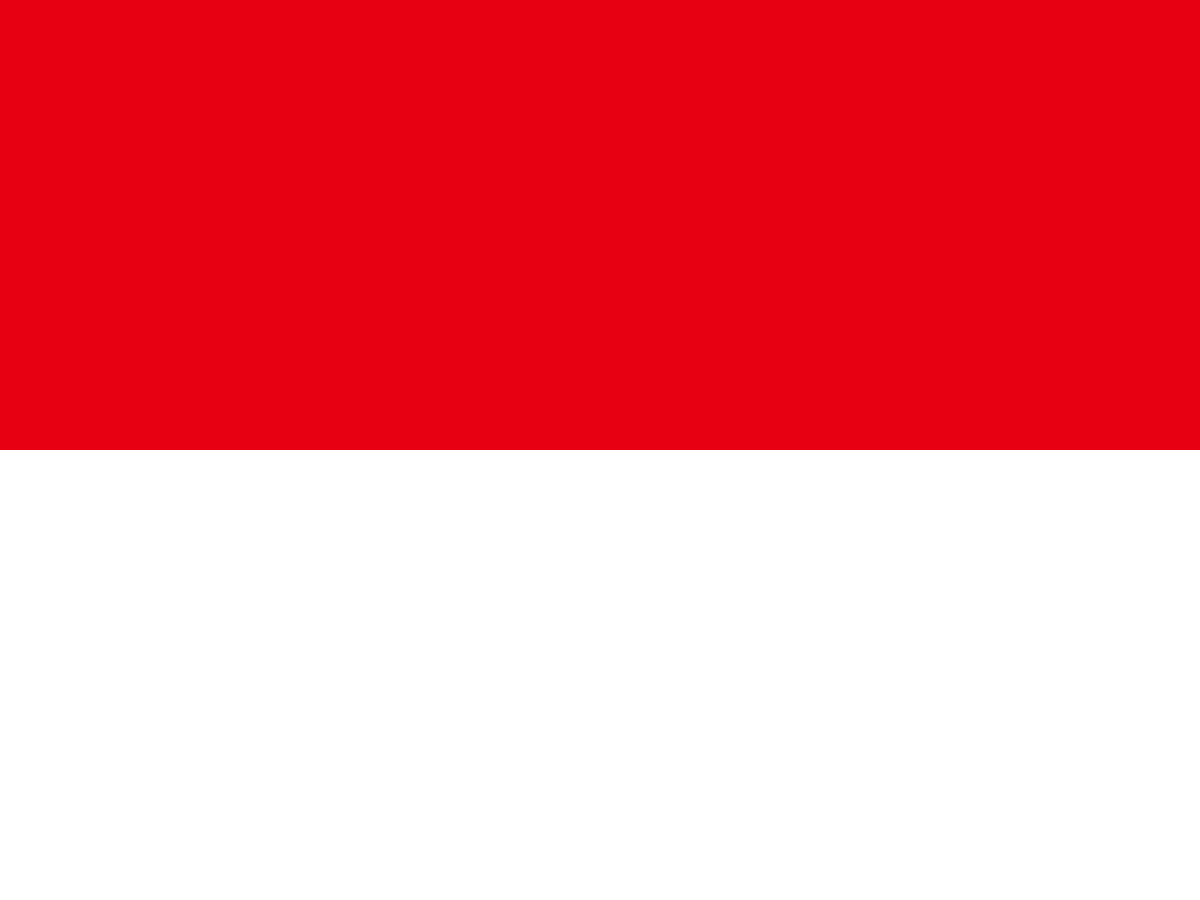
The flag of Indonesia
Indonesia's national flag is a simple horizontal red and white bicolour. The upper half is red and the lower half is white.
The colours have a long history.
Red and white were important colours in Indonesian tradition long before the modern republic. They are strongly associated with the Majapahit Empire and were later adopted by the Indonesian independence movement.
The modern flag was formally adopted when Indonesia proclaimed independence on 17 August 1945.
What do the colours mean?
The traditional interpretation gives red the meaning of human life, courage or the physical world, while white represents the spiritual life, purity or the soul.
These colours also have older cultural and historical associations, so the symbolism of the Indonesian flag connects the modern republic with much earlier Indonesian traditions.
The red stripe
Red is traditionally associated with human life and the physical world. It also suggests courage and the determination of the independence movement.
Red has been paired with white in Indonesian cultural and political symbolism for centuries.
The white stripe
White is traditionally associated with spiritual life, purity and the soul. Together with red, it creates one of the world's simplest national flag designs.
The strong contrast makes the Indonesian flag instantly recognisable.
The Majapahit connection
Red and white have a long history in the Indonesian archipelago. They are associated particularly with the Majapahit Empire, which dominated much of the region in the fourteenth and fifteenth centuries.
Although the modern flag is not simply a direct copy of a medieval banner, the historical association helped give red and white powerful national meaning.
Indonesia and Monaco
Indonesia's flag is visually very similar to the flag of Monaco: both use red over white. The proportions and historical contexts differ, however.
The Indonesian flag is generally longer in proportion than Monaco's and has its own distinct historical development.
Indonesia and Poland
Indonesia's red-over-white flag is the reverse of Poland's white-over-red flag. The two designs are therefore easy to confuse when seen from a distance.
The different order of the colours is the key visual distinction.
A short history of Indonesia
Indonesia's history stretches from ancient maritime kingdoms and trading networks to European colonial rule, Japanese occupation and the independence struggle that created the modern republic.
The islands have long been connected by trade, religion and migration, bringing Indian, Chinese, Arab, European and other influences into local societies.
History timeline
Ancient period — early kingdomsIndian cultural and religious influences helped shape Hindu and Buddhist kingdoms across the archipelago.
7th–13th centuries — SrivijayaThe maritime Srivijaya kingdom became an important centre of trade and Buddhism in Southeast Asia.
13th–15th centuries — MajapahitMajapahit became one of the region's most influential Hindu-Buddhist empires and helped establish the historical importance of red and white.
15th–16th centuries — spread of IslamIslam spread through trading networks and coastal sultanates, becoming the dominant religion across much of the archipelago.
17th century onward — Dutch expansionThe Dutch East India Company and later the Dutch state expanded colonial control over the islands.
1942–45 — Japanese occupationJapan occupied the Dutch East Indies during the Second World War.
17 August 1945 — independence proclaimedSukarno and Mohammad Hatta proclaimed Indonesian independence.
1949 — Dutch recognitionAfter armed and diplomatic struggle, the Netherlands formally recognised Indonesian sovereignty.
1967 — ASEAN eraIndonesia became a founding member of the Association of Southeast Asian Nations.
TodayIndonesia is a major Southeast Asian democracy and one of the world's largest economies by population.
Srivijaya
Srivijaya was a powerful maritime kingdom centred on Sumatra. From roughly the seventh century onward it controlled or influenced important trade routes through the Strait of Malacca.
It became a major centre of Buddhist learning and international commerce.
Majapahit
The Majapahit Empire flourished mainly in Java from the late thirteenth to fifteenth centuries. At its height it exerted influence across much of the Indonesian archipelago.
Majapahit is particularly important to the history of the modern flag because red and white were associated with its banners and royal symbolism.
The spread of Islam
Islam spread gradually through the Indonesian archipelago, particularly via trade networks and coastal communities. By the early modern period, numerous Islamic sultanates had emerged.
Indonesia is now home to the world's largest Muslim population, while remaining religiously diverse.
Dutch colonial rule
The Dutch East India Company established a major trading presence in the archipelago before the Dutch state took direct control of the colony.
The colonial economy focused heavily on commodities such as spices, coffee, sugar and later rubber and other plantation products.
The spice trade
Indonesia's Maluku Islands were historically famous for cloves, nutmeg and mace. These spices attracted traders from across Asia and later European colonial powers.
Control of the spice trade was one of the main reasons European powers became deeply involved in the Indonesian archipelago.
The Indonesian independence movement
During the twentieth century, Indonesian nationalists increasingly demanded independence from Dutch colonial rule. Sukarno became one of the movement's most prominent leaders.
The movement brought together people from different islands, languages and religious traditions around the idea of an Indonesian nation.
Sukarno
Sukarno was a leading figure in the independence movement and became Indonesia's first president. Alongside Mohammad Hatta, he proclaimed independence on 17 August 1945.
Sukarno also helped articulate Pancasila, the philosophical foundation of the Indonesian state.
Mohammad Hatta
Mohammad Hatta was Indonesia's first vice president and one of the country's key independence leaders. He worked closely with Sukarno during the struggle for independence.
Hatta was also an important economist and advocate of cooperative economic ideas.
Independence in 1945
Indonesia proclaimed independence on 17 August 1945, shortly after Japan surrendered at the end of the Second World War.
The Dutch attempted to re-establish colonial control, leading to several years of armed conflict and diplomacy before sovereignty was formally recognised in 1949.
Pancasila
Pancasila is the philosophical foundation of the Indonesian state. Its five principles emphasise belief in God, humanitarianism, Indonesian unity, democracy and social justice.
The concept was central to the creation of a national identity capable of encompassing Indonesia's enormous religious, ethnic and linguistic diversity.
Jakarta
Jakarta is Indonesia's largest city and its main economic and political centre. The metropolitan area is one of the largest urban regions in Southeast Asia.
The city faces challenges including flooding, congestion, subsidence and rapid urban growth.
Nusantara
Nusantara is the planned new national capital in East Kalimantan on the island of Borneo. The project is intended to reduce the concentration of political and economic activity on Java.
The capital transition is being implemented gradually, so Jakarta remains a hugely important national centre.
The Indonesian archipelago
Indonesia is made up of thousands of islands spread across a huge area between Asia and Australia. The country's geography includes major islands such as Java, Sumatra, Borneo, Sulawesi and New Guinea.
The archipelago's geography has helped create extraordinary cultural and biological diversity.
Java
Java is Indonesia's most populous island and contains Jakarta, Bandung, Surabaya and many other major cities. It has fertile volcanic soils and a high population density.
Java has also been a major centre of Indonesian political and cultural history for centuries.
Sumatra
Sumatra is one of Indonesia's largest islands and contains rainforests, mountains, plantations and major cities. It is famous for coffee, palm oil and rich biodiversity.
Sumatra is home to critically endangered species including the Sumatran tiger, orangutan and rhinoceros.
Borneo and Kalimantan
The Indonesian part of Borneo is known as Kalimantan. It contains enormous tropical forests, rivers and peatlands and is an important centre of biodiversity.
Deforestation, mining and plantation expansion have created major environmental pressures.
Papua
Indonesia's easternmost region includes the Indonesian part of the island of New Guinea, commonly known as Papua. It contains some of the country's most remote mountains and forests.
The region is exceptionally diverse culturally and biologically.
Volcanoes
Indonesia lies on the Pacific Ring of Fire and has more active volcanoes than almost any other country. Volcanoes have shaped the islands' landscapes, soils and communities.
Major volcanoes include Krakatoa, Merapi, Bromo and Semeru.
Krakatoa
Krakatoa became internationally famous after the catastrophic 1883 eruption. The eruption produced enormous explosions, tsunamis and atmospheric effects that were recorded around the world.
The volcanic island system remains active today through Anak Krakatau, or “Child of Krakatoa”.
Climate
Indonesia has a predominantly tropical climate with high temperatures and humidity throughout much of the country. Many regions have distinct wet and dry seasons.
Mountain elevations create cooler local climates, while equatorial areas can receive rainfall throughout much of the year.
Rainforests
Indonesia contains some of the world's most important tropical rainforests, particularly on Sumatra, Borneo and New Guinea.
These forests store carbon and provide habitat for thousands of species, but face pressure from logging, agriculture, mining and plantation expansion.
Wildlife
Indonesia's wildlife includes orangutans, Sumatran tigers, Komodo dragons, Javan rhinos, elephants, birds-of-paradise and countless marine species.
The country's islands have produced many species found nowhere else on Earth.
The Komodo dragon
The Komodo dragon is the world's largest living lizard and is found naturally on several Indonesian islands, particularly Komodo, Rinca and nearby islands.
It can grow to around three metres long and is a major symbol of Indonesian wildlife conservation.
Orangutans
Indonesia is home to three species of orangutan: the Sumatran, Tapanuli and Bornean orangutans. They are among the world's most endangered great apes.
Habitat loss, particularly from forest conversion, is a major threat to their survival.
Marine life and coral reefs
Indonesia lies within the Coral Triangle, one of the world's richest marine biodiversity regions. Its waters contain extensive coral reefs, mangroves, sea turtles and thousands of fish species.
Marine ecosystems support fishing, tourism and coastal communities but face pollution, overfishing and climate pressures.
Languages
Indonesia has an extraordinary number of local languages. Indonesian (Bahasa Indonesia) is the national language and provides a common means of communication across the archipelago.
Hundreds of regional languages continue to be spoken, including Javanese, Sundanese, Madurese, Balinese and many languages of eastern Indonesia.
Indonesian culture
Indonesian culture combines Indigenous traditions with Hindu-Buddhist, Islamic, Chinese and European influences. Music, dance, textiles, architecture and food vary dramatically between islands.
Despite the diversity, national identity is strongly expressed through the idea of unity in diversity.
Bhinneka Tunggal Ika
Bhinneka Tunggal Ika means “Unity in Diversity” and is Indonesia's national motto. The phrase comes from a fourteenth-century Javanese text associated with the Majapahit period.
It captures the challenge and ideal of bringing together thousands of islands, ethnic groups, languages and religious traditions within one state.
Batik
Batik is a traditional Indonesian textile art using wax-resist dyeing. Different regions have developed distinctive patterns and colours.
Indonesian batik was recognised by UNESCO as an important element of intangible cultural heritage.
Gamelan
Gamelan is a traditional ensemble music from Indonesia, especially associated with Java and Bali. It uses instruments such as gongs, metallophones and drums.
Gamelan is closely connected with ceremonies, theatre, dance and community life.
Indonesian food
Indonesian cuisine includes dishes such as nasi goreng, rendang, satay, gado-gado, nasi padang and sambal. Rice is a staple food across much of the country.
Spices, chilli, coconut, seafood and regional cooking traditions produce enormous variety from island to island.
Rendang
Rendang is a slow-cooked dish traditionally associated with the Minangkabau people of West Sumatra. Beef is cooked with coconut milk and a complex mixture of spices until intensely flavoured.
It has become one of Indonesia's best-known dishes internationally.
Economy
Indonesia has one of Southeast Asia's largest economies, based on manufacturing, services, agriculture, mining, energy, tourism and digital industries.
Major exports include palm oil, coal, natural resources, manufactured goods and a wide range of agricultural products.
Palm oil
Indonesia is one of the world's largest producers and exporters of palm oil. The industry provides employment and export income but has also been linked to deforestation and habitat loss.
Balancing economic development with forest conservation is one of Indonesia's major environmental challenges.
Tourism
Indonesia attracts visitors with Bali, tropical beaches, volcanoes, rainforests, diving, temples and cultural heritage. Tourism is an important source of employment and foreign income.
Beyond Bali, destinations such as Java, Lombok, Flores, Raja Ampat and Komodo offer very different landscapes and experiences.
Bali
Bali is one of Indonesia's best-known islands and is famous for Hindu temples, rice terraces, dance, art, beaches and tourism.
Bali's Hindu cultural tradition is distinctive within Indonesia, where Islam is the majority religion.
Borobudur
Borobudur in Central Java is one of the world's largest Buddhist monuments. Built around the eighth or ninth century, it consists of terraces decorated with reliefs and Buddha statues.
It is a UNESCO World Heritage Site and one of Indonesia's most important cultural landmarks.
Prambanan
Prambanan is a spectacular Hindu temple complex in Java built during the medieval period. Its tall towers are dedicated to Hindu deities including Shiva, Vishnu and Brahma.
Prambanan and Borobudur together demonstrate the rich Hindu-Buddhist heritage of Java.
Indonesia today
Modern Indonesia is a large, diverse republic stretching across thousands of islands. It is a major Southeast Asian economy and an important regional power.
The country's red-and-white flag remains a simple but powerful symbol of national unity across extraordinary geographic and cultural diversity.
Why is Indonesia's flag interesting?
Indonesia's flag is deceptively simple. Its red-and-white colours connect the modern republic with centuries of Indonesian history, including the Majapahit tradition, while also expressing the human and spiritual sides of national identity.
Few flags demonstrate so clearly how a simple two-colour design can carry a much deeper historical story.
Explore Indonesia on FlagAtlas
Continue exploring Indonesia and the world's flags with these FlagAtlas resources.