About Iran
Iran, officially the Islamic Republic of Iran, is a large country in Western Asia. Tehran is the capital and largest city.
Iran occupies a strategically important position between the Persian Gulf, Caspian Sea and Central Asia. It has an exceptionally long history, stretching back through ancient Persian civilisations, and a rich tradition of literature, art, science and architecture.
CapitalTehran
RegionWestern Asia
PopulationAbout 85 million
CurrencyIranian rial
Official languagePersian
Modern republic1979
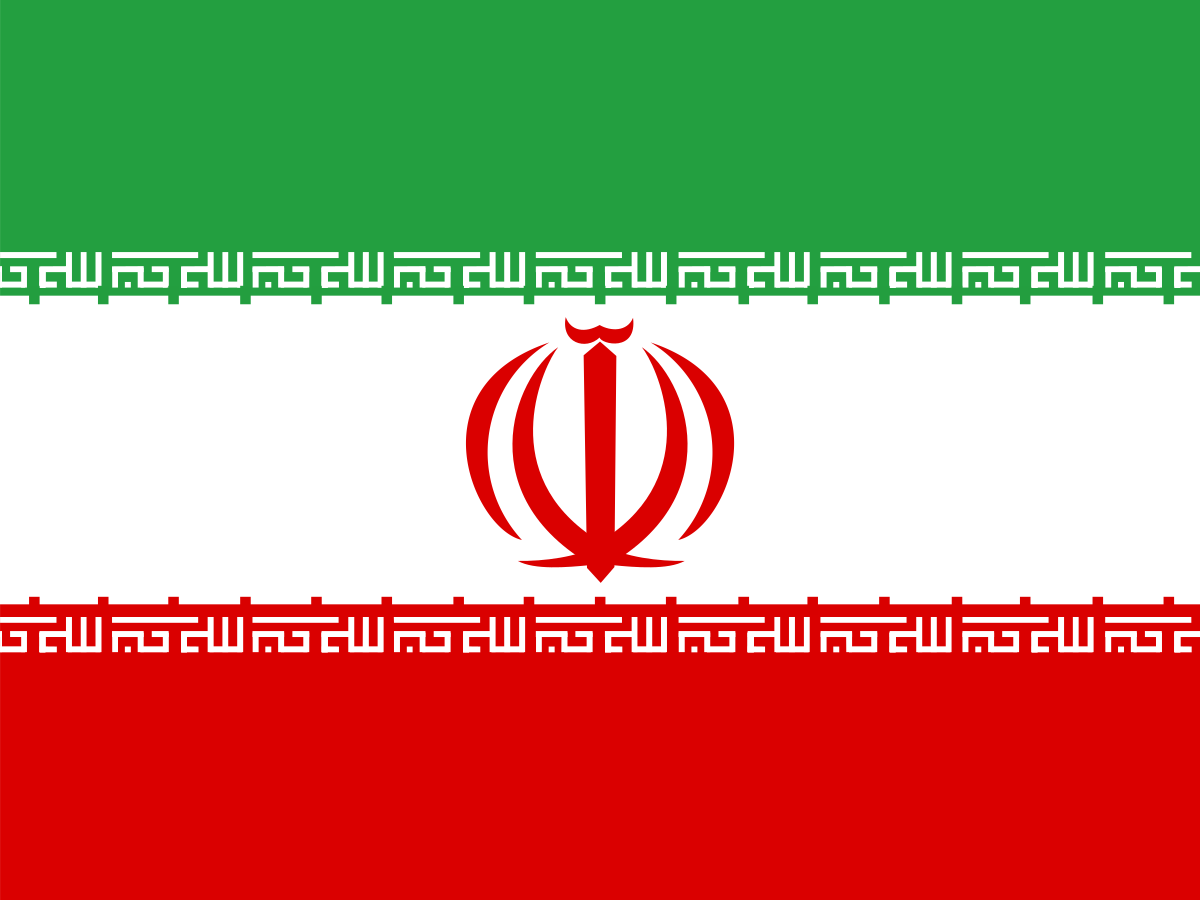
The flag of Iran
Iran's current national flag has three equal horizontal bands of green, white and red. A red emblem representing “Allah” is centred on the white band, while a stylised Kufic inscription of “Allah Akbar” is repeated along the borders between the coloured bands.
The central emblem is deliberately distinctive.
It is designed as a stylised form of the word Allah and also resembles a tulip, a traditional Persian symbol associated with martyrdom.
The present design dates from the period of the Islamic Republic established after the 1979 revolution.
What do the colours mean?
The flag's green is associated with Islam, growth and vitality; white with peace; and red with courage, sacrifice and the blood of martyrs.
The colours have also had wider cultural and historical associations in Persian and Iranian tradition.
The green band
Green is strongly associated with Islam and is traditionally linked with growth, life and prosperity. It forms the upper band of the Iranian tricolour.
Green has long carried religious and cultural significance across the Islamic world.
The white band
White represents peace and forms the centre of the flag. It also provides the background for the distinctive red national emblem.
The combination of green, white and red gives the flag a strong visual connection with Iranian national symbolism.
The red band
Red is associated with courage, sacrifice and the blood of martyrs. It forms the lower band of the flag and matches the colour of the central emblem.
Red has been an important colour in Iranian historical and cultural symbolism for centuries.
The central emblem
The central emblem is a stylised representation of “Allah”. Its design can also be interpreted as a tulip, a traditional Persian symbol associated with martyrdom.
The emblem replaced the former Lion and Sun symbol following the 1979 Islamic Revolution.
Allah Akbar inscription
Along the borders between the green and white and white and red bands is a repeated stylised inscription of “Allah Akbar”, meaning “God is Greatest”.
The phrase is repeated 22 times on each side of the central white band, giving 44 repetitions in total.
The Lion and Sun
Before 1979, Iran's flag featured the Lion and Sun, an emblem with a long and complicated history. It became strongly associated with the monarchy during the twentieth century.
The emblem was removed after the Islamic Revolution and replaced by the present stylised Allah symbol.
A short history of Iran
Iran has one of the world's great continuous cultural histories. Ancient Persia produced powerful empires, sophisticated administration, monumental architecture and major contributions to art, literature and science.
Later Iranian history was shaped by the Arab conquest and Islam, Turkic dynasties, the Mongol invasions, the Safavid dynasty, Qajar rule, constitutional reform, the Pahlavi monarchy and the 1979 Islamic Revolution.
History timeline
c. 550 BCE — Achaemenid EmpireCyrus the Great established the Achaemenid Persian Empire, which became one of the largest empires of the ancient world.
5th century BCE — PersepolisDarius I and Xerxes developed Persepolis into a magnificent ceremonial capital.
330 BCE — Alexander's conquestAlexander the Great conquered the Achaemenid Empire.
224 CE — Sasanian EmpireThe Sasanians created another powerful Persian empire and became major rivals of Rome and Byzantium.
7th century — Arab conquestMuslim Arab armies conquered the Sasanian Empire and Islam gradually became dominant.
1258 — Mongol conquestThe Mongol invasions devastated parts of Iran but were followed by new periods of Persian cultural development.
1501 — Safavid dynastyShah Ismail I established the Safavid state and made Twelver Shiism the state religion.
1906 — Constitutional RevolutionIran established a constitution and parliament after a major political movement for constitutional government.
1925 — Pahlavi dynastyReza Shah established the Pahlavi monarchy and pursued rapid state modernisation.
1979 — Islamic RevolutionThe monarchy was overthrown and the Islamic Republic was established.
TodayIran remains a major regional state with a large population, substantial energy resources and a distinctive Persian cultural identity.
Cyrus the Great
Cyrus the Great founded the Achaemenid Empire in the sixth century BCE. His empire grew rapidly and incorporated peoples across a huge territory.
Cyrus is remembered in Iranian history as a major founder of Persian imperial power and appears prominently in modern Iranian historical identity.
The Achaemenid Empire
The Achaemenid Empire was one of the largest empires of the ancient world. It stretched from parts of southeastern Europe and Egypt across Western and Central Asia.
The empire developed sophisticated systems of administration, taxation, roads and imperial communication.
Persepolis
Persepolis was a ceremonial capital of the Achaemenid Empire. Its monumental stairways, reliefs and palaces depict representatives of many peoples of the empire.
The site is one of the most important archaeological symbols of ancient Persian civilisation.
The Sasanian Empire
The Sasanian Empire ruled Persia from the third to seventh centuries CE. It was a major power and frequent rival of the Roman and Byzantine empires.
Sasanian Iran was an important centre of administration, scholarship, art and Zoroastrian religious culture.
Zoroastrianism
Zoroastrianism is an ancient Iranian religion associated with the prophet Zarathustra. It was particularly important during the pre-Islamic Persian empires.
Although the number of Zoroastrians in Iran is now much smaller, the religion remains an important part of Iranian history and cultural heritage.
The Islamic conquest
Arab Muslim armies conquered the Sasanian Empire during the seventh century. Over subsequent centuries, Islam became the dominant religion in Iran.
Iran later developed a distinctive Persian Islamic culture, producing major scholars, poets, philosophers and artists.
The Persian language
Persian (Farsi) is Iran's official language and one of the world's major literary languages. It belongs to the Indo-Iranian branch of the Indo-European language family.
Persian literature has had enormous influence across Iran, Central Asia, Afghanistan and the wider region.
Ferdowsi and the Shahnameh
Ferdowsi's Shahnameh, or Book of Kings, is one of the greatest works of Persian literature. Completed around the year 1000, it tells stories of Persian kings, heroes and legendary history.
The epic played an important role in preserving Persian cultural identity and language.
The Mongol invasions
The Mongol invasions of the thirteenth century caused enormous destruction across Iran. Cities and irrigation systems suffered badly.
Despite the devastation, Persian culture survived and later flourished under Mongol and post-Mongol rulers.
The Safavid dynasty
The Safavid dynasty came to power in 1501 and transformed Iran's religious and political identity. Safavid rulers established Twelver Shiism as the state religion.
The dynasty also supported architecture, art and Persian culture and helped create a more unified Iranian state.
Shah Abbas and Isfahan
Shah Abbas I was one of the most important Safavid rulers. He strengthened the state and transformed Isfahan into a spectacular capital.
Isfahan's mosques, bridges, palaces and squares remain among the finest examples of Safavid architecture.
The Constitutional Revolution
The Constitutional Revolution of 1905–1911 established a parliament and constitutional limits on royal power. It was one of the most important political movements in modern Iranian history.
The revolution reflected demands for accountable government, law and national sovereignty.
The Pahlavi era
The Pahlavi dynasty ruled Iran from 1925 to 1979. Reza Shah and later Mohammad Reza Shah pursued modernisation, industrialisation and major changes to education, law and infrastructure.
The period also saw strong centralisation and political repression, contributing to opposition that eventually helped bring about the 1979 revolution.
The 1979 Islamic Revolution
The Iranian Revolution of 1979 overthrew the monarchy and established the Islamic Republic. Ayatollah Ruhollah Khomeini became the revolution's central political and religious leader.
The revolution fundamentally changed Iran's political system and foreign relations.
Iran-Iraq War
From 1980 to 1988, Iran fought a devastating war against Iraq. The conflict caused enormous casualties and economic damage on both sides.
The war remains a major part of modern Iranian national memory.
Tehran
Tehran is Iran's capital and largest city, situated at the foot of the Alborz Mountains. It is the country's main political, economic, cultural and educational centre.
The city contains major museums, universities, government institutions and modern commercial districts.
The Alborz Mountains
The Alborz Mountains stretch across northern Iran and rise dramatically north of Tehran. Mount Damavand, Iran's highest peak, is part of the range.
The mountains influence climate, provide water and are deeply embedded in Persian mythology and literature.
Mount Damavand
Mount Damavand rises to about 5,610 metres and is the highest mountain in Iran and the highest volcano in Asia.
It has an important place in Persian mythology, particularly in the Shahnameh.
The Zagros Mountains
The Zagros Mountains run across western and southwestern Iran. They contain major valleys, forests and mineral resources and form an important geographic barrier.
The region has also been home to numerous Iranian ethnic and linguistic communities.
The Persian Gulf
Iran has a long coastline along the Persian Gulf and Gulf of Oman. The Strait of Hormuz, between Iran and Oman, is one of the world's most strategically important maritime passages.
Iran's southern coastline is central to its energy exports and regional trade.
Climate
Iran has a highly varied climate. Much of the country is arid or semi-arid, while the Caspian coast is much wetter and mountain regions can experience heavy snow.
Large deserts, high plateaus and mountain ranges create significant regional differences in temperature and rainfall.
The Dasht-e Kavir
The Dasht-e Kavir, or Great Salt Desert, covers a large area of central Iran. It contains salt flats, dry basins and extremely arid landscapes.
It is one of the country's most distinctive desert environments.
The Lut Desert
The Dasht-e Lut, or Lut Desert, is one of the hottest and driest places on Earth. Its extraordinary wind-carved landforms are known as kaluts.
The Lut Desert is a UNESCO World Heritage Site.
Wildlife
Iran's varied landscapes support Persian leopards, Asiatic cheetahs, wild goats, gazelles, wolves, bears and many bird species.
Habitat loss, water shortages, hunting and human development have created serious conservation challenges.
The Asiatic cheetah
The Asiatic cheetah is one of the world's rarest large cats and survives mainly in Iran. Its population is critically small.
Conservation programmes have worked to protect remaining habitat and reduce threats to the species.
Persian culture
Iranian culture has been shaped by thousands of years of history and includes Persian literature, poetry, music, miniature painting, carpets, architecture and cuisine.
Ancient Persian traditions coexist with Islamic culture and a vibrant modern arts scene.
Persian poetry
Iran has produced some of the world's most celebrated poets, including Rumi, Hafez, Saadi and Omar Khayyam.
Poetry remains an important part of Iranian cultural life and is widely quoted, recited and studied.
Persian carpets
Persian carpets are famous worldwide for intricate patterns, craftsmanship and regional styles. Carpet weaving has a history stretching back centuries.
Traditional carpets are an important part of Iran's artistic heritage and remain a significant export.
Iranian food
Iranian cuisine includes kebabs, rice dishes, stews, herbs, saffron, pomegranates, pistachios and flatbreads. Regional traditions vary considerably.
Rice cooked with saffron and herbs is a particularly important part of Persian cuisine.
Persian saffron
Iran is one of the world's major producers of saffron, the intensely coloured and flavoured spice obtained from crocus flowers.
Saffron is used extensively in Persian cooking and is also an important agricultural export.
Science and scholarship
Iran has a long tradition of mathematics, astronomy, medicine and philosophy. Medieval Persian scholars made important contributions to science and learning.
Modern Iran also has substantial university and research sectors, particularly in engineering, medicine and the physical sciences.
The economy
Iran's economy is strongly influenced by its large oil and natural gas reserves, alongside manufacturing, agriculture, mining, services and trade.
International sanctions and restrictions on energy exports have had major effects on the economy, while domestic industries remain substantial.
Iran today
Modern Iran combines an ancient Persian cultural identity with the political and religious system created by the Islamic Republic. It is a large regional power with major energy resources and a highly educated population.
Iranian society is diverse, with Persian, Azerbaijani, Kurdish, Arab, Lur, Baloch and other communities contributing to the country's identity.
Why is Iran's flag interesting?
Iran's flag is unusual because its modern design carries multiple layers of history and symbolism. The green, white and red tricolour sits alongside the Islamic Republic's central emblem and repeated “Allah Akbar” inscription.
The design therefore reflects both long-standing Iranian colour traditions and the political transformation of 1979.
Explore Iran on FlagAtlas
Continue exploring Iran and the world's flags with these FlagAtlas resources.