About Ireland
Ireland is an island in north-western Europe. The sovereign state is officially called Ireland (Éire), while Northern Ireland is part of the United Kingdom.
Dublin is the capital and largest city of the Republic of Ireland. Ireland is famous for its landscapes, Celtic heritage, literature, music, sport and strong cultural traditions.
CapitalDublin
RegionEurope
PopulationAbout 5 million
CurrencyEuro (€)
Official languagesIrish & English
National day17 March
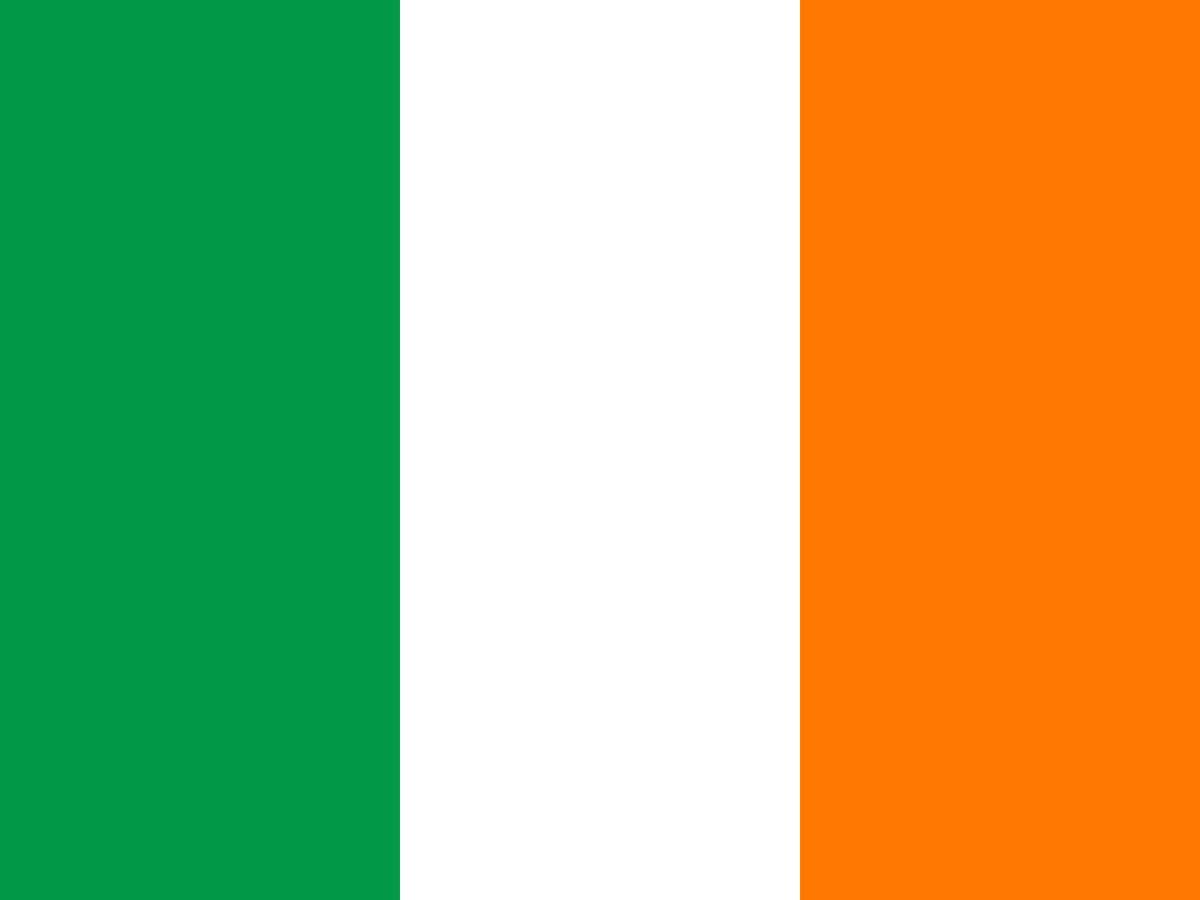
The flag of Ireland
Ireland's national flag is a vertical tricolour of green, white and orange. The green stripe is nearest the flagpole when the flag is displayed vertically in its normal orientation.
The white stripe is the key to the flag's symbolism.
It represents peace and reconciliation between the traditions associated with the green and orange sides of Irish society.
The tricolour became an important symbol of Irish nationalism during the nineteenth century and was adopted as the national flag after independence.
What do the colours mean?
The traditional interpretation is that green represents the older Gaelic and nationalist tradition, orange represents the Protestant tradition associated historically with supporters of William of Orange, and white represents the hope for lasting peace between them.
The meaning is particularly important because the flag was intended to symbolise reconciliation rather than simply one political or religious group.
The green stripe
Green is strongly associated with Irish nationalism and the Gaelic tradition. It also became connected with the wider image of Ireland as the “Emerald Isle”.
The green side of the tricolour therefore carries both political and cultural associations.
The white stripe
White represents peace and truce between the traditions represented by green and orange.
It is the central stripe deliberately placed between the two colours, making reconciliation one of the most important ideas contained in the flag.
The orange stripe
Orange represents the Protestant tradition in Ireland, particularly the followers of William III, Prince of Orange.
Including orange was significant because it made the flag broader than a symbol of Catholic or nationalist Ireland alone.
The story of William of Orange
William III of England, known as William of Orange, defeated James II at the Battle of the Boyne in 1690. The victory became a major event in Irish Protestant and unionist history.
The orange colour on Ireland's flag refers to this historical tradition rather than simply to the colour orange itself.
The Irish tricolour and reconciliation
The tricolour was designed to express the idea that different Irish traditions could exist together. The white centre symbolises the hope that green and orange can live in lasting peace.
This gives Ireland's flag a particularly strong political and historical message compared with many simple tricolours.
A short history of Ireland
Ireland's history stretches from prehistoric monuments and Celtic societies through Christianisation, Viking settlement, Norman invasion, English and British rule, rebellion, partition and independence.
The relationship between Ireland and Britain has shaped much of the island's modern political history.
History timeline
c. 3200 BCE — NewgrangeThe Neolithic monument at Newgrange was built thousands of years ago and is aligned with the winter solstice sunrise.
Ancient Ireland — Celtic cultureIron Age Irish society developed distinctive languages, art, mythology and political traditions.
5th century — ChristianityChristianity became established across Ireland, with monasteries becoming important centres of learning.
795 onward — Viking settlementViking raiders and settlers established coastal settlements, including the foundations of Dublin.
1170–72 — Norman invasionAnglo-Norman forces invaded Ireland and established areas of English control.
1534–41 — Tudor conquestHenry VIII's government expanded English control and declared him King of Ireland.
1690 — Battle of the BoyneWilliam III defeated James II, becoming a defining event in Irish Protestant and unionist history.
1798 — United Irishmen rebellionA major rebellion sought to challenge British rule and establish a more independent political system.
1801 — Act of UnionThe Kingdom of Ireland became part of the United Kingdom of Great Britain and Ireland.
1845–52 — Great FaminePotato blight and the resulting famine caused enormous death and emigration.
1916 — Easter RisingIrish republicans staged an armed uprising in Dublin, becoming a turning point in the independence movement.
1922 — Irish Free StateMost of Ireland became the Irish Free State following the Anglo-Irish Treaty, while Northern Ireland remained in the UK.
1937 — New constitutionIreland adopted a new constitution and increasingly asserted its sovereignty.
1949 — Republic of IrelandIreland formally became a republic and left the Commonwealth.
1998 — Good Friday AgreementThe agreement created a major framework for peace and political cooperation in Northern Ireland.
TodayIreland is a parliamentary democracy and member of the European Union with a highly developed economy.
Prehistoric Ireland
Ireland has an extraordinary prehistoric heritage. Newgrange, Knowth and Dowth form part of the Brú na Bóinne complex and are associated with Neolithic communities.
Newgrange is particularly famous because its passage and chamber are illuminated by the rising sun around the winter solstice.
Celtic Ireland
The idea of a single ancient “Celtic” Ireland can oversimplify a complex past, but Iron Age Irish societies developed distinctive languages, art, mythology and social traditions.
Many modern symbols of Irish identity draw on this older Gaelic heritage.
Saint Patrick
Saint Patrick is Ireland's most famous patron saint. Christian tradition credits him with helping spread Christianity in Ireland during the fifth century.
His feast day, 17 March, has become a major Irish cultural celebration around the world.
Irish monasteries and learning
Early medieval Ireland became known for its monasteries, manuscripts and scholarship. Irish monks and scribes helped preserve and transmit Christian and classical learning.
Illuminated manuscripts such as the Book of Kells are among the best-known surviving examples.
The Vikings and Dublin
Viking raiders began attacking Ireland in the late eighth century. Norse settlers later established permanent communities, including Dublin, which grew into an important trading centre.
Viking influence became part of the complex cultural history of medieval Ireland.
The Norman invasion
Anglo-Norman forces arrived in Ireland in 1169 after being invited into a local political dispute. English kings subsequently expanded their authority.
The invasion began centuries of changing relationships between Irish rulers, Anglo-Norman lords and the English Crown.
Tudor Ireland
During the sixteenth century, the Tudor monarchy pursued a more direct policy of control over Ireland. Henry VIII declared himself King of Ireland in 1541.
Religious change following the English Reformation added another major source of conflict between the English state and many Irish communities.
The Battle of the Boyne
The Battle of the Boyne was fought in 1690 between William III and James II. William's victory helped secure his position in Ireland and Britain.
The battle remains an important symbol in Northern Irish unionist and Protestant traditions.
The Act of Union
The Act of Union 1800 came into effect in 1801 and united the Kingdom of Ireland with Great Britain to form the United Kingdom of Great Britain and Ireland.
Irish MPs subsequently sat in the Parliament at Westminster, while opposition to the union continued.
The Great Famine
The Great Famine of 1845–52 was one of the most devastating events in Irish history. Potato blight destroyed a crucial food crop while poverty and disease caused enormous suffering.
About one million people died and a further million or more emigrated, contributing to a long-term population decline.
Irish emigration
Large-scale Irish emigration during and after the nineteenth century created enormous Irish communities overseas, particularly in the United States, Britain, Canada and Australia.
The Irish diaspora remains an important part of Ireland's cultural identity and international relationships.
The Easter Rising
In 1916, Irish republicans launched the Easter Rising in Dublin. The rebellion was defeated, but the execution of its leaders helped transform public opinion.
The rising became a major milestone on the road to Irish independence.
The War of Independence
From 1919 to 1921, the Irish War of Independence was fought between the Irish Republican Army and British forces.
The conflict ended with a truce and negotiations that produced the Anglo-Irish Treaty.
The Irish Free State
The Irish Free State was established in 1922 following the Anglo-Irish Treaty. It covered most of the island, while Northern Ireland exercised its option to remain within the United Kingdom.
The treaty also led to the Irish Civil War between pro- and anti-Treaty forces.
The Republic of Ireland
Ireland adopted a new constitution in 1937, and in 1949 the state formally became the Republic of Ireland.
The republic is a parliamentary democracy and has been a member of the European Union since 1973.
Northern Ireland and partition
The island of Ireland is politically divided between the Republic of Ireland and Northern Ireland, which remains part of the United Kingdom.
The partition of Ireland has shaped politics and identity on both sides of the border.
The Troubles
The Troubles were a period of conflict in Northern Ireland from the late 1960s until the 1990s. Violence involved republican and loyalist paramilitaries as well as British security forces.
More than 3,500 people were killed before the peace process led to the Good Friday Agreement.
The Good Friday Agreement
The Good Friday Agreement of 1998 established a framework for devolved government, cooperation between communities and relations between Northern Ireland, the Republic of Ireland and Britain.
It was a major milestone in the Northern Ireland peace process.
Dublin
Dublin is Ireland's capital and largest city, situated on the east coast. It has been a major settlement and port for centuries.
The city is famous for Trinity College, Georgian architecture, literature, pubs, technology companies and the River Liffey.
The Irish landscape
Ireland is famous for its green countryside, mountains, lakes, Atlantic coastline and rugged cliffs. The island's mild maritime climate helps create its famously lush landscapes.
Major natural landmarks include the Cliffs of Moher, the Ring of Kerry, Connemara and the Giant's Causeway in Northern Ireland.
The Atlantic coast
Ireland's western coastline faces the Atlantic Ocean and contains some of Europe's most dramatic cliffs, beaches and headlands.
The Atlantic strongly influences Irish weather, bringing frequent rain and relatively mild temperatures compared with places at similar latitudes.
Climate
Ireland has a temperate oceanic climate. Summers are generally cool to mild and winters are relatively mild, although rainfall occurs throughout the year.
The Atlantic Ocean and the Gulf Stream help moderate temperatures.
Irish wildlife
Ireland's wildlife includes red deer, otters, badgers, foxes, seals, dolphins and many seabirds. Its surrounding seas are particularly rich in marine life.
Ireland's isolated island geography also means that its native wildlife differs from mainland Britain and continental Europe.
Irish culture
Irish culture is famous for music, storytelling, poetry, dance, sport and a strong tradition of community life.
Gaelic traditions remain important alongside English-language culture and modern Irish life.
The Irish language
Irish (Gaeilge) is a Celtic language and an official language of Ireland. It is taught throughout the education system and remains a community language in Gaeltacht areas.
English is the other major language spoken across the country.
Irish literature
Ireland has produced an extraordinary number of major writers, including W. B. Yeats, James Joyce, Oscar Wilde, Samuel Beckett and Seamus Heaney.
Irish literature has had an influence far beyond the island's size, with several Irish writers receiving the Nobel Prize in Literature.
Irish music
Traditional Irish music features instruments such as the fiddle, tin whistle, uilleann pipes, bodhrán and concertina.
Irish folk music has influenced popular music around the world and remains a living tradition.
Gaelic games
The Gaelic Athletic Association promotes traditional Irish sports including Gaelic football and hurling.
Hurling is one of the world's oldest field sports and is closely associated with Irish cultural identity.
Irish food
Irish cuisine includes stews, soda bread, potatoes, seafood, dairy products and traditional breakfast foods. Modern Irish cooking also makes extensive use of high-quality local produce.
Potatoes became an important staple from the early modern period, although modern Irish food is much more varied.
St Patrick's Day
St Patrick's Day is celebrated on 17 March and has become an international celebration of Irish culture. Parades and festivals take place in Ireland and around the world.
The day is named after Saint Patrick, one of Ireland's patron saints.
The Irish economy
Ireland has a highly developed, open economy with major sectors including technology, pharmaceuticals, financial services, manufacturing, agriculture and tourism.
International companies play a particularly important role in Ireland's modern economy.
Ireland and the European Union
Ireland joined the European Economic Community in 1973, which later became the European Union.
EU membership has played an important role in Ireland's trade, infrastructure and economic development.
Why is Ireland's flag interesting?
Ireland's flag is more than a simple tricolour. Green and orange deliberately represent different historical traditions, while the white centre expresses the hope for peace and reconciliation.
That makes the flag a particularly powerful symbol of Ireland's complicated history and its aspiration to bring different traditions together.
Explore Ireland on FlagAtlas
Continue exploring Ireland and the world's flags with these FlagAtlas resources.