About Israel
Israel is a country on the eastern Mediterranean coast of Western Asia. Jerusalem is the seat of the country's government and is Israel's declared capital; the status of Jerusalem is internationally disputed.
Israel is a geographically small but highly diverse country, with Mediterranean coastline, fertile northern areas, the Negev Desert, the Jordan Valley and the Dead Sea.
Seat of governmentJerusalem
RegionWestern Asia
PopulationAbout 10 million
CurrencyNew Israeli shekel
Official languageHebrew
Independence14 May 1948
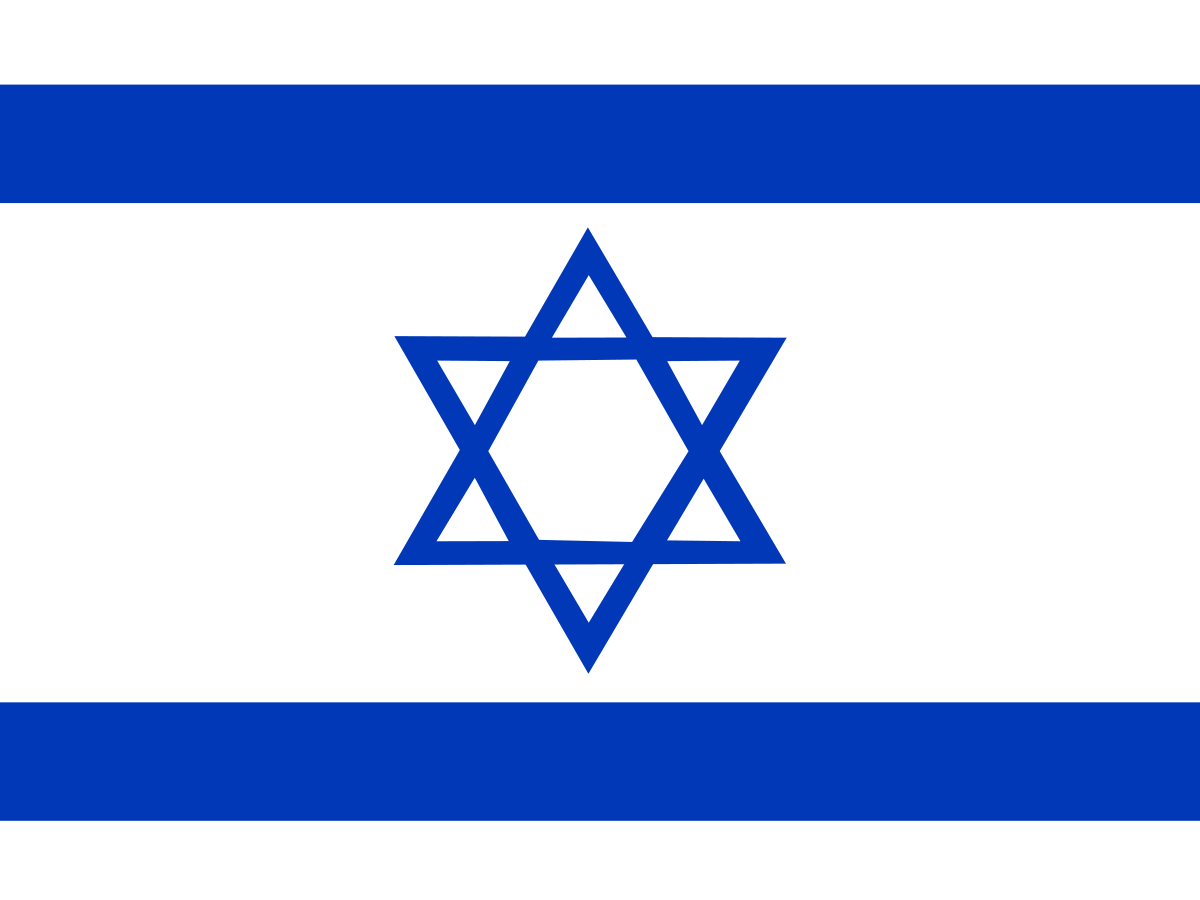
The flag of Israel
Israel's national flag is white with two horizontal blue stripes and a blue Star of David (Magen David) in the centre.
The design draws on Jewish tradition.
The blue-and-white colour scheme was inspired by the traditional Jewish prayer shawl, the tallit, while the Magen David had become a widely recognised Jewish symbol by the time the flag was created.
The flag was formally adopted by the State of Israel in October 1948, several months after independence.
What do the colours mean?
The flag's blue and white combination is closely associated with Jewish tradition. The blue stripes were inspired by the appearance of the tallit, while white forms the main field of the flag.
The shade of blue used on the flag is often described as “tekhelet” in connection with Jewish tradition, although the precise historical colour of tekhelet is a matter of scholarship and debate.
The blue stripes
The two blue stripes are commonly explained as being inspired by the tallit, the Jewish prayer shawl traditionally decorated with blue or blue-and-white stripes.
The stripes frame the central Star of David and give the flag its distinctive visual appearance.
The white field
White forms the main background of the flag and creates a strong contrast with the blue stripes and Magen David.
The blue-and-white combination is one of the most recognisable visual expressions of modern Jewish national identity.
The Magen David
The Magen David, or Star of David, is a six-pointed geometric symbol that became widely associated with Jewish identity, particularly in Europe during the nineteenth and twentieth centuries.
It is not an exclusively ancient biblical symbol; its widespread use as a Jewish emblem developed over many centuries and became especially important to modern Jewish communities.
The tallit connection
A major inspiration for the flag was the tallit, the Jewish prayer shawl. The white fabric and blue stripes of the tallit helped inspire the colour scheme proposed for the Zionist flag.
The flag therefore connects modern Israeli statehood with an older Jewish religious tradition.
The Zionist flag
The basic blue-and-white design was developed by the Zionist movement in the late nineteenth century. The flag became an important symbol at Zionist congresses and gatherings before the State of Israel existed.
The modern Israeli flag evolved from this earlier Zionist design.
A short history of Israel
The history of the land and peoples of modern Israel is exceptionally complex, encompassing ancient Israelite and Jewish kingdoms, Roman rule, Byzantine and Islamic periods, Crusader states, Ottoman rule, the British Mandate, the Zionist movement, the creation of Israel and the Israeli-Palestinian conflict.
Jewish, Arab, Christian, Muslim, Druze and other communities have all contributed to the region's history.
History timeline
c. 1000 BCE — Ancient Israelite kingdomsAncient Israelite and Judahite kingdoms emerged in the southern Levant.
586 BCE — Babylonian conquestJerusalem and the First Temple were destroyed and many inhabitants of Judah were exiled.
Second Temple periodJewish life and institutions developed under successive Persian, Hellenistic and Hasmonean rule.
63 BCE — Roman ruleRoman influence and control expanded over the region.
70 CE — Second Temple destroyedRoman forces destroyed the Second Temple in Jerusalem during the First Jewish-Roman War.
4th–7th centuries — Byzantine periodThe region became part of the Christian Byzantine Empire.
7th century — Muslim conquestThe region became part of the expanding Islamic world.
1099 — Crusader JerusalemCrusader forces captured Jerusalem during the First Crusade.
1517 — Ottoman ruleThe region became part of the Ottoman Empire and remained so for about four centuries.
1880s onward — modern ZionismModern Zionist political movements promoted Jewish national self-determination and immigration to the historic Land of Israel.
1917 — Balfour DeclarationBritain declared support for a national home for the Jewish people in Palestine while stating that existing non-Jewish communities should not have their civil and religious rights prejudiced.
1920–48 — British MandateBritain administered Palestine under a League of Nations Mandate.
1947 — UN partition proposalThe UN General Assembly recommended partitioning Mandatory Palestine into Arab and Jewish states, with Jerusalem under a special international regime.
14 May 1948 — State of Israel declaredDavid Ben-Gurion proclaimed the establishment of the State of Israel.
1948–49 — First Arab-Israeli WarWar followed the declaration of independence, producing major territorial and demographic changes.
1967 — Six-Day WarIsrael captured the West Bank, East Jerusalem, Gaza Strip, Sinai Peninsula and Golan Heights during the war; the status of several of these territories remains disputed or unresolved.
1978–79 — Egypt-Israel peaceThe Camp David Accords and subsequent treaty led to peace between Israel and Egypt and Israel's withdrawal from Sinai.
1993–95 — Oslo processIsrael and the Palestine Liberation Organization reached agreements establishing the Palestinian Authority and limited self-government arrangements.
TodayIsrael is a parliamentary democracy and a major regional centre for technology, science, agriculture and innovation, while the Israeli-Palestinian conflict remains unresolved.
Ancient Israel and Judah
The ancient kingdoms of Israel and Judah formed part of the wider Iron Age societies of the southern Levant. Jerusalem became the political and religious centre of Judah.
The Hebrew Bible and archaeological evidence provide important, though sometimes debated, sources for understanding this period.
The First and Second Temples
The First Temple in Jerusalem is traditionally associated with the ancient Kingdom of Judah and was destroyed by the Babylonians in 586 BCE. A Second Temple was later built and expanded.
The Second Temple was destroyed by Roman forces in 70 CE and became one of the defining events of Jewish history.
Jerusalem
Jerusalem is one of the world's most significant religious cities and is sacred to Judaism, Christianity and Islam. Its Old City contains major sites including the Western Wall, Church of the Holy Sepulchre and Dome of the Rock.
Jerusalem is Israel's declared capital and seat of government, while its status remains one of the most contested issues in the Israeli-Palestinian conflict.
The Roman and Byzantine periods
Roman rule reshaped the region after the first century BCE. Following the division of the Roman Empire, the area became part of the Byzantine Empire.
Jewish, Samaritan and Christian communities lived across the region, alongside changing imperial and local political structures.
The Islamic period
Following the seventh-century Muslim conquest, the region became part of successive Islamic caliphates and dynasties. Arabic language and Islamic culture became increasingly influential.
Jerusalem remained a major religious centre, particularly because of the Al-Aqsa Mosque and Dome of the Rock.
The Crusades
Crusader forces captured Jerusalem in 1099 during the First Crusade. The city and surrounding territories subsequently changed hands during centuries of conflict between Crusader and Muslim powers.
Saladin recaptured Jerusalem in 1187.
Ottoman Palestine
The region was incorporated into the Ottoman Empire in 1517 and remained under Ottoman rule until the First World War.
During this period, towns such as Jerusalem, Jaffa, Haifa and Nablus developed within the wider Ottoman administrative system.
The rise of modern Zionism
Modern Zionism emerged in late nineteenth-century Europe as a movement advocating Jewish national self-determination and a homeland in the historic Land of Israel.
The movement developed amid European nationalism and widespread antisemitism, including violent persecution of Jewish communities.
The Balfour Declaration
In 1917, the British government issued the Balfour Declaration supporting “the establishment in Palestine of a national home for the Jewish people”, while also stating that the civil and religious rights of existing non-Jewish communities should not be prejudiced.
The declaration became a major milestone in the political history of Mandatory Palestine.
The British Mandate
After the First World War, Britain administered Palestine under a League of Nations Mandate. During the Mandate period, Jewish immigration increased while Arab opposition to Zionism and British policy also grew.
Communal tensions, violence and competing national aspirations intensified.
The Holocaust and Jewish immigration
The Holocaust destroyed much of Europe's Jewish population during the Second World War. Its aftermath increased international support for Jewish refugees and intensified the political urgency surrounding a Jewish state.
Large numbers of Jewish survivors sought to reach Palestine, while British immigration restrictions and Arab opposition created further conflict.
The UN partition plan
In 1947, the UN General Assembly adopted Resolution 181, recommending the partition of Mandatory Palestine into separate Arab and Jewish states, with Jerusalem under a special international regime.
The Jewish community accepted the plan with reservations, while Arab leaders rejected it. The proposal was not implemented as written.
Israeli independence
On 14 May 1948, David Ben-Gurion declared the establishment of the State of Israel. The declaration came as the British Mandate was ending.
War followed immediately, involving neighbouring Arab states and Palestinian Arab forces.
The 1948 war and Palestinian displacement
The 1948 Arab-Israeli War resulted in Israel controlling territory beyond the area proposed for the Jewish state in the UN partition plan. Hundreds of thousands of Palestinians became refugees in what Palestinians call the Nakba.
The displacement of Palestinians and the unresolved refugee question remain central to the conflict.
The Six-Day War
In 1967, Israel fought Egypt, Jordan and Syria in the Six-Day War. Israel captured the West Bank, East Jerusalem, Gaza Strip, Sinai Peninsula and Golan Heights.
Israel later returned the Sinai to Egypt under the peace treaty, while the status of the other territories remains a major international and political issue.
Israel and Egypt
The Camp David Accords of 1978 were followed by the 1979 Egypt-Israel peace treaty. Israel subsequently withdrew from the Sinai Peninsula.
Egypt became the first Arab state to establish a formal peace treaty with Israel.
The Oslo Accords
The Oslo process in the 1990s produced agreements between Israel and the Palestine Liberation Organization. The Palestinian Authority was established with limited self-government powers in parts of the West Bank and Gaza.
The process did not produce a final peace agreement, and negotiations later broke down.
The Israeli-Palestinian conflict today
The Israeli-Palestinian conflict remains unresolved, involving disputes over borders, Jerusalem, settlements, Palestinian statehood, refugees and security.
Both Israelis and Palestinians have deep historical, national and religious connections to the land. The conflict has caused repeated wars, attacks, displacement and humanitarian suffering.
The geography of Israel
Israel contains a remarkable range of landscapes for a relatively small country, including the Mediterranean coast, Galilee, central highlands, Jordan Valley and Negev Desert.
The country also borders Lebanon, Syria, Jordan and Egypt.
The Negev Desert
The Negev covers more than half of Israel's land area. It contains arid mountains, dry valleys and dramatic desert landscapes.
Israel has developed sophisticated irrigation and water-management technologies to support agriculture in this dry region.
The Dead Sea
The Dead Sea lies at one of the lowest points on Earth's land surface. Its extremely salty water makes swimming unusually buoyant.
The Dead Sea is shrinking as inflows decline and water is diverted, creating a major environmental challenge.
The Mediterranean coast
Israel's Mediterranean coastline includes major cities such as Tel Aviv, Haifa and Ashdod. The coast supports tourism, ports, industry and dense urban development.
The Mediterranean climate creates hot, dry summers and mild, wetter winters.
Climate
Israel's climate ranges from Mediterranean in the north and along the coast to arid and desert conditions in the south. The north receives substantially more rainfall than the Negev.
Water management is therefore a major national issue.
Wildlife
Israel lies at a crossroads between Europe, Asia and Africa, giving it a diverse range of habitats and migratory routes. Wildlife includes ibex, gazelles, foxes, jackals, hyenas and many migratory birds.
Conservation areas protect important habitats across the country.
The Nubian ibex
The Nubian ibex is a distinctive mountain goat found in Israel's desert regions. It is particularly associated with the Negev and Judean Desert.
It has adapted to steep rocky terrain and very dry conditions.
Israeli culture
Israeli society is highly diverse, shaped by Jewish communities from around the world as well as Arab, Druze, Christian and other communities. Cultural life includes music, film, literature, food, art and religious traditions.
Hebrew has been revitalised as a modern spoken language and is central to contemporary Israeli identity.
Hebrew
Hebrew is a Semitic language with an ancient literary and religious history. Modern Hebrew was revived as a spoken national language in the late nineteenth and early twentieth centuries.
The revival of Hebrew is one of the most remarkable examples of a classical language becoming a modern everyday language.
Israeli food
Israeli cuisine reflects Jewish communities from Europe, North Africa, the Middle East and elsewhere alongside Arab and wider Mediterranean traditions. Popular foods include falafel, hummus, shakshuka, sabich and fresh salads.
There is no single traditional “Israeli cuisine”; modern food culture is a blend of many regional and diaspora traditions.
Science and technology
Israel has developed a strong reputation in technology, cybersecurity, medicine, agriculture, water management and scientific research. Tel Aviv is a major startup and technology hub.
Universities, research institutions and technology companies contribute significantly to the country's economy.
Water technology
Because Israel has limited natural freshwater resources, it has invested heavily in desalination, wastewater recycling, drip irrigation and water management.
These technologies have helped reduce dependence on rainfall and have become important exports and areas of international cooperation.
The economy
Israel has a highly developed economy with major sectors including technology, pharmaceuticals, defence, finance, manufacturing, agriculture and tourism.
The technology sector is particularly important, with strong activity in software, cybersecurity, artificial intelligence and medical technology.
Israel today
Modern Israel is a parliamentary democracy with a highly developed economy and a diverse population. It is also a country at the centre of one of the world's most enduring political conflicts.
Its modern identity combines Jewish national history, immigration from many countries, Hebrew culture, Middle Eastern geography and continuing debate about borders, security and relations with Palestinians and neighbouring states.
Why is Israel's flag interesting?
Israel's flag combines religious symbolism and modern national identity. The blue-and-white design draws inspiration from the tallit, while the Magen David became a widely recognised symbol of Jewish identity.
The flag therefore connects a modern state with much older Jewish cultural and religious traditions.
Explore Israel on FlagAtlas
Continue exploring Israel and the world's flags with these FlagAtlas resources.