About Italy
Italy is a country in Southern Europe occupying most of the Italian Peninsula and extending into the Mediterranean. Rome is the capital and largest city.
Italy has an extraordinary concentration of history, art, architecture, food and cultural heritage, from ancient Rome and Pompeii to the Renaissance and the modern republic.
CapitalRome
RegionSouthern Europe
PopulationAbout 59 million
CurrencyEuro (€)
Official languageItalian
Republic1946
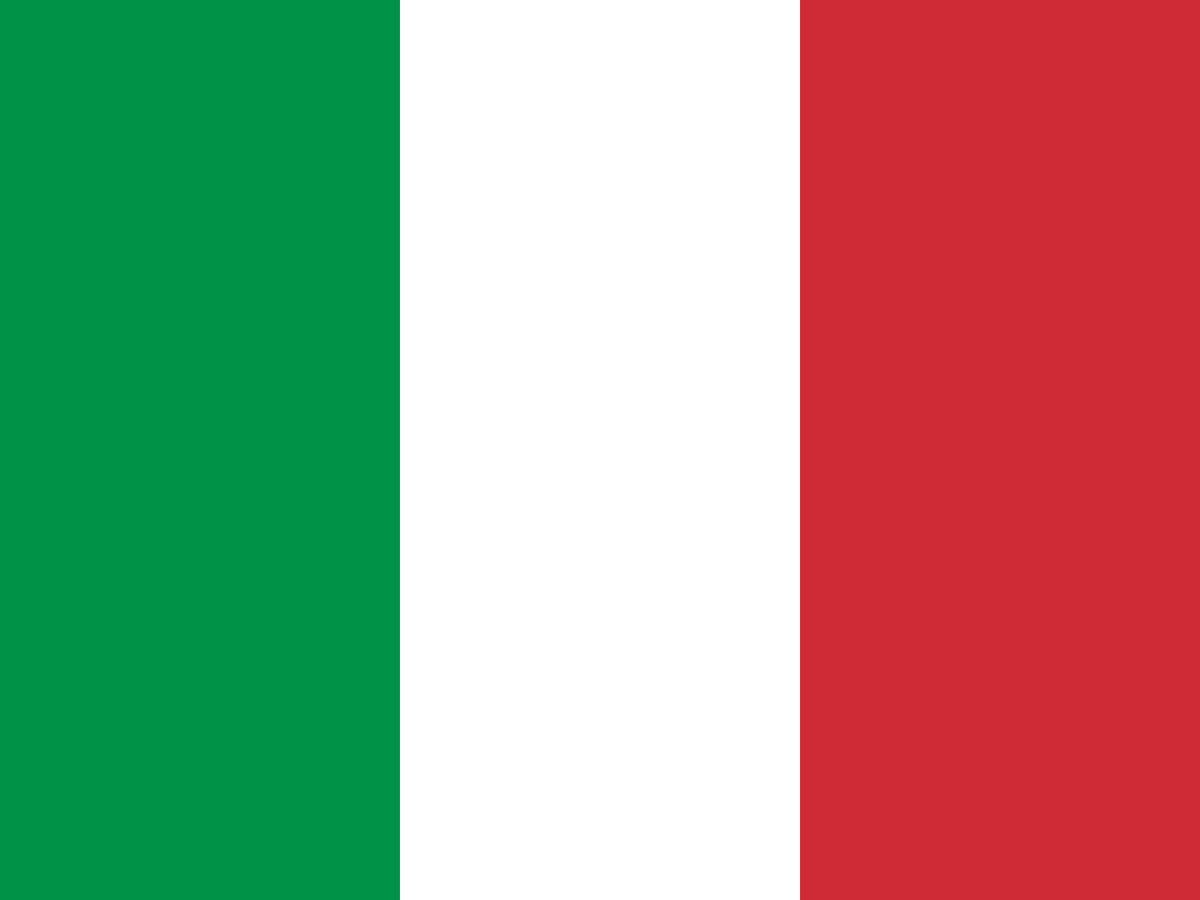
The flag of Italy
Italy's national flag is a vertical tricolour of green, white and red. The colours are arranged from the hoist side to the fly as green, white and red.
The Italian tricolore has its roots in the revolutionary era.
Its design developed from the French tricolour during the Napoleonic period and later became a powerful symbol of Italian nationalism and unification.
The modern Italian Republic formally adopted the tricolour after the Second World War, while the three colours had already been associated with Italy for more than a century and a half.
What do the colours mean?
There are many popular interpretations of the three colours, including green for the country's landscapes, white for the Alps or peace, and red for sacrifice and blood. These are useful symbolic associations but are not the original official meaning of the flag.
The more historically secure explanation is that the Italian tricolour developed from revolutionary European flag traditions and became a symbol of Italian national identity.
The green stripe
Green is the first colour of the tricolour when displayed from the hoist. Popular modern interpretations connect it with Italy's green landscapes, although this was not the original historical meaning assigned to the colour.
The green stripe has become one of the defining elements of Italian national identity.
The white stripe
White forms the centre of the flag. It is often popularly associated with the snow of the Alps or peace, but these interpretations developed later rather than defining the flag's original creation.
Its central position creates the familiar green-white-red tricolour.
The red stripe
Red is the fly-side colour. Popular explanations often associate it with the blood of patriots and sacrifice, while historically it formed part of the revolutionary tricolour tradition from which the Italian flag developed.
The French connection
The Italian tricolour was strongly influenced by the French tricolore during the Napoleonic era. French revolutionary symbolism spread across Europe and influenced several new national and republican flags.
Italian revolutionaries and Napoleonic states adapted the three-colour design to their own political identity.
The Cispadane Republic flag
In 1797, the Cispadane Republic adopted a green, white and red flag, one of the earliest important uses of the Italian tricolour.
The colours subsequently appeared in other Napoleonic-era Italian states and became increasingly associated with the idea of an Italian nation.
The Risorgimento
During the Risorgimento, the nineteenth-century movement for Italian unification, the tricolour became a powerful symbol of national independence and unity.
Patriots, revolutionaries and supporters of unification used the flag to represent the idea of a single Italian nation.
A short history of Italy
Italy's history includes the Roman Empire, medieval city-states, powerful maritime republics, the Renaissance, foreign dynasties, the Papal States, the Risorgimento, fascism, the Second World War and the modern Italian Republic.
The country was not politically unified until the nineteenth century, despite the long-standing cultural and linguistic connections among its regions.
History timeline
c. 753 BCE — Traditional founding of RomeRoman tradition dates the foundation of Rome to 753 BCE.
509 BCE — Roman RepublicRoman tradition places the establishment of the Republic after the overthrow of the monarchy.
27 BCE — Roman EmpireAugustus became the first Roman emperor and began a new imperial era.
79 CE — Pompeii buriedMount Vesuvius erupted and buried Pompeii and nearby settlements.
476 CE — Western Roman Empire endsThe conventional date for the fall of the Western Roman Empire in Italy.
11th–15th centuries — Medieval city-statesItalian cities such as Venice, Florence, Genoa and Milan became powerful centres of commerce and politics.
14th–16th centuries — RenaissanceItalian cities became the centre of a major European cultural, artistic and intellectual transformation.
1797 — Italian tricolourThe Cispadane Republic adopted a green, white and red flag inspired by revolutionary European flag traditions.
1848 — RevolutionsRevolutionary movements spread across the Italian states and strengthened the cause of national unification.
1861 — Kingdom of ItalyVictor Emmanuel II became king of a newly unified Kingdom of Italy.
1870 — Rome incorporatedItalian forces captured Rome and made it the capital of the Kingdom of Italy.
1922 — Mussolini comes to powerBenito Mussolini became prime minister and gradually established a fascist dictatorship.
1946 — Italian RepublicA referendum abolished the monarchy and established the Republic of Italy.
1948 — ConstitutionThe Constitution of the Italian Republic came into force.
1957 — Treaty of RomeItaly was one of the founding states of the European Economic Community.
TodayItaly is a parliamentary republic and a major European economy known for manufacturing, design, culture, tourism and food.
Ancient Rome
Ancient Rome developed from a city-state into a vast Mediterranean empire. Roman law, engineering, roads, government and architecture had an enormous influence on Europe and the wider world.
Rome's legacy can still be seen in Italy's cities, monuments, legal traditions and languages.
The Roman Republic
The Roman Republic developed institutions including elected magistrates, the Senate and popular assemblies. Rome expanded across Italy and eventually the Mediterranean.
Political conflict between social groups and ambitious generals eventually contributed to the transition from republic to empire.
The Roman Empire
Under Augustus, Rome became an imperial state. The empire controlled territory across Europe, North Africa and Western Asia.
Italy was the political heart of the empire, while Rome became one of the largest cities of the ancient world.
Pompeii and Vesuvius
In 79 CE, Mount Vesuvius erupted, burying Pompeii and other settlements beneath volcanic material. The preservation of buildings, streets and everyday objects gives archaeologists an extraordinary view of Roman life.
Pompeii is now one of Italy's most important archaeological sites.
The fall of the Western Roman Empire
The conventional date for the end of the Western Roman Empire is 476 CE, when the emperor Romulus Augustulus was deposed.
Roman political structures continued in different forms, and the Eastern Roman or Byzantine Empire retained influence over parts of Italy for centuries.
Medieval Italy
After Rome's western empire collapsed, Italy became politically fragmented. The peninsula was divided among kingdoms, duchies, city-states, the Papal States and foreign powers.
This fragmentation later helped create the fiercely independent urban cultures that shaped the Renaissance.
Venice and the maritime republics
Venice, Genoa, Pisa and Amalfi became powerful maritime republics. They built commercial networks across the Mediterranean and beyond.
Venice in particular became one of Europe's richest trading powers and developed a distinctive political system.
Florence and the Renaissance
Florence became one of the great centres of the Renaissance. Wealthy families such as the Medici supported artists, architects, scholars and scientists.
The city is associated with figures including Leonardo da Vinci, Michelangelo and Botticelli.
Leonardo da Vinci
Leonardo da Vinci was a painter, engineer, scientist and inventor whose work epitomised the Renaissance ideal of combining art and scientific curiosity.
His best-known paintings include the Mona Lisa and The Last Supper.
Michelangelo
Michelangelo was one of the greatest artists of the Renaissance. His works include the sculpture David and the ceiling of the Sistine Chapel.
He worked across sculpture, painting and architecture.
Galileo Galilei
Galileo Galilei made major contributions to astronomy and physics. His telescopic observations supported the idea that Earth and other planets orbit the Sun.
His work became part of the wider scientific revolution of the seventeenth century.
The Papal States
For centuries, the Papal States controlled large parts of central Italy under the authority of the pope.
Their political existence was closely connected to the temporal power of the papacy and ended during Italian unification in the nineteenth century.
The Risorgimento
The Risorgimento was the movement that led to Italian political unification. It involved figures including Giuseppe Mazzini, Count Camillo di Cavour, Giuseppe Garibaldi and Victor Emmanuel II.
The process combined diplomacy, popular movements and military campaigns.
Garibaldi and the Expedition of the Thousand
In 1860, Giuseppe Garibaldi led the Expedition of the Thousand, a volunteer force that conquered Sicily and much of southern Italy.
Garibaldi's campaign helped bring the Kingdom of the Two Sicilies into the emerging unified Italian state.
Italian unification
The Kingdom of Italy was proclaimed in 1861 under Victor Emmanuel II. Venice joined in 1866 and Rome in 1870, completing the major territorial stages of unification.
Political unification did not immediately erase Italy's strong regional identities, dialects and economic differences.
Fascist Italy
Benito Mussolini came to power in 1922 and established a fascist dictatorship. Italy became an ally of Nazi Germany and entered the Second World War.
The regime collapsed in 1943, and Italy's subsequent civil conflict ended with the defeat of fascism.
The Italian Republic
In a 1946 referendum, Italian voters chose a republic rather than a monarchy. The new republic's constitution came into force in 1948.
The modern Italian state is a parliamentary republic with a president as head of state and a prime minister leading the government.
Italy and European integration
Italy was one of the founding members of the European Economic Community and signed the Treaty of Rome in 1957.
European integration has been central to Italy's economic and political development since the post-war period.
Rome
Rome is Italy's capital and one of the world's most historically important cities. It contains ancient Roman monuments, Renaissance and Baroque architecture, and the Vatican City.
The city has been a political and cultural centre for more than two millennia.
The Italian Peninsula
Italy occupies a long peninsula extending into the Mediterranean Sea, with major islands including Sicily and Sardinia.
Its distinctive boot-shaped outline is one of the most recognisable national silhouettes in the world.
The Alps
The Alps form Italy's northern frontier with France, Switzerland, Austria and Slovenia. The mountains contain major ski resorts, valleys and lakes.
Mont Blanc is on the France-Italy border, although the exact location of the summit boundary is disputed by the two countries.
The Apennines
The Apennine Mountains run along much of the length of the Italian Peninsula. They form the backbone of the country and influence local climates and landscapes.
Many historic towns and villages developed in the mountain regions.
Mount Etna
Mount Etna in Sicily is Europe's largest active volcano and one of the world's most closely monitored volcanoes.
Its volcanic soils are fertile and support agriculture, while eruptions periodically reshape the landscape.
The Mediterranean climate
Much of Italy has a Mediterranean or temperate climate, although conditions vary considerably between the Alps, Po Valley, central mountains and southern islands.
Italy's long coastline gives many regions relatively mild winters and hot, dry summers.
Italian wildlife
Italy's varied habitats support Alpine ibex, chamois, wolves, brown bears, wild boar, deer and many bird species.
National parks and protected areas help conserve wildlife in the Alps, Apennines and Mediterranean environments.
Italian culture
Italian culture has had an enormous global influence in art, architecture, music, fashion, cinema, literature, design and cuisine.
Regional identity remains extremely strong, with traditions varying significantly between northern, central and southern Italy.
The Italian language
Italian developed from varieties of spoken Latin. Dante Alighieri's Tuscan literary language became particularly influential in the development of standard Italian.
Italy still has many regional languages and dialects, reflecting the peninsula's long political fragmentation.
Italian food
Italian cuisine is famous worldwide, but there is no single Italian menu. Regional dishes include pizza from Naples, risotto from northern Italy, pasta traditions from across the country, pesto from Liguria and many regional cheeses and cured meats.
Italian food is strongly based on local ingredients and traditional preparation.
Pizza
Pizza developed in its modern form in Naples and became one of Italy's most famous global exports.
Neapolitan pizza traditionally uses a simple combination of dough, tomato, mozzarella and basil, although countless regional and international variations now exist.
Italian fashion and design
Italy is one of the world's major centres of fashion, furniture, architecture and industrial design. Milan is particularly famous for its fashion industry and design events.
Italian brands and designers have helped make “Made in Italy” a global symbol of craftsmanship and style.
The Italian economy
Italy has a large diversified economy based on manufacturing, machinery, automotive industries, fashion, food, tourism, finance and services.
Small and medium-sized businesses are particularly important to many regional economies.
UNESCO heritage
Italy has an exceptionally large collection of UNESCO World Heritage Sites, reflecting its archaeological, architectural, artistic and natural heritage.
Sites include the historic centres of Rome, Florence and Venice, Pompeii, the Dolomites and many others.
Italy today
Modern Italy combines a strong national identity with powerful regional traditions. It is a major European economy, a member of the G7 and EU, and one of the world's most visited countries.
Its influence extends far beyond its size through art, design, food, fashion, science, engineering and cultural heritage.
Why is Italy's flag interesting?
Italy's flag looks simple, but its story is closely tied to revolution, Napoleon, the Risorgimento and Italian unification.
The green, white and red tricolour began as a political symbol during a period of upheaval and eventually became the national flag of a unified Italy.
Explore Italy on FlagAtlas
Continue exploring Italy and the world's flags with these FlagAtlas resources.