About Jamaica
Jamaica is an island country in the Caribbean Sea. Kingston is the capital and largest city.
Jamaica is internationally famous for reggae music, sprinting, Blue Mountain coffee, its tropical landscapes and a distinctive culture shaped by African, European, Asian and Caribbean influences.
CapitalKingston
RegionCaribbean
PopulationAbout 3 million
CurrencyJamaican dollar
Official languageEnglish
Independence6 August 1962
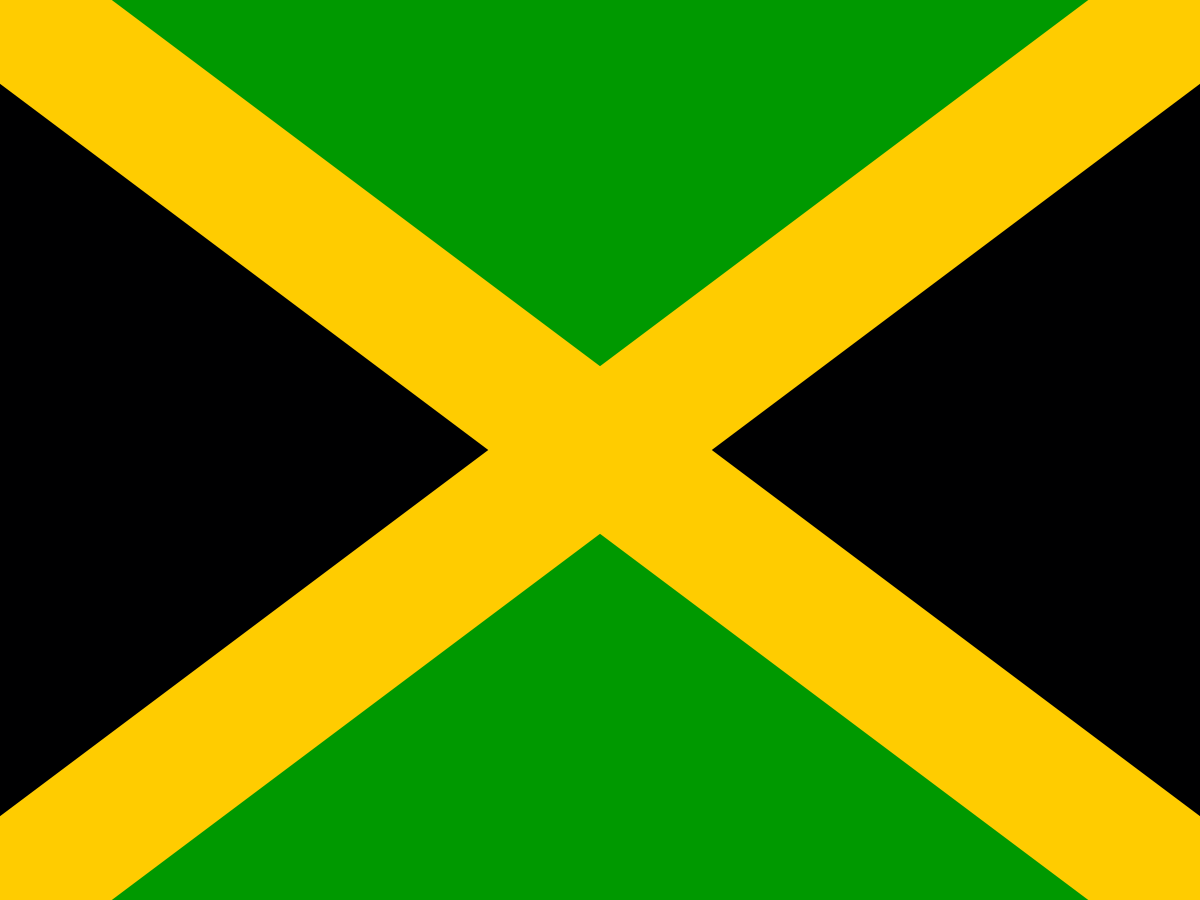
The flag of Jamaica
Jamaica's national flag is a striking gold saltire dividing four triangles of black and green. It is one of the world's most recognisable flags and, unusually, contains none of the colours red, white or blue.
The flag's three colours have official meanings.
Black represents the strength and creativity of the people; gold represents the natural wealth and beauty of sunlight; and green represents hope and the country's agricultural resources.
The current design was adopted at independence in 1962.
What do the colours mean?
Jamaica's official symbolism is unusually clear: black represents the strength and creativity of the people, gold represents the natural wealth and beauty of sunlight, and green represents hope and agricultural resources.
These meanings were established as part of the national symbolism surrounding independence.
The black triangles
Black represents the strength and creativity of the Jamaican people.
It occupies the four triangular areas formed by the gold saltire and gives the flag its dramatic contrast.
The gold saltire
Gold represents the natural wealth and beauty of sunlight. The diagonal cross, or saltire, divides the flag into four triangular sections.
The gold cross is the central structural feature of the Jamaican flag.
The green triangles
Green represents hope and the island's agricultural resources.
Jamaica's tropical climate supports crops including sugar cane, bananas, coffee and other agricultural products.
Why Jamaica has no red, white or blue
Jamaica is famous for being one of only two sovereign national flags that contain none of red, white or blue. The other is Mauritania.
This makes Jamaica's black, gold and green combination particularly distinctive among national flags.
The saltire
A saltire is a diagonal cross shaped like the letter X. Jamaica's flag uses a gold saltire extending from corner to corner.
The design gives the flag a strong geometric appearance that remains instantly recognisable when displayed at a distance.
A short history of Jamaica
Jamaica's history begins with Indigenous Taíno communities and continues through Spanish and British colonial rule, plantation slavery, emancipation, the growth of Jamaican nationalism and independence in 1962.
The island's modern culture was shaped by African heritage, Caribbean traditions and migration from many parts of the world.
History timeline
Before 1494 — Taíno JamaicaTaíno communities lived across the island before European colonisation.
1494 — Columbus arrivesChristopher Columbus reached Jamaica during his second voyage to the Americas.
1509 — Spanish settlementSpain established colonial control and settlements on the island.
1655 — English conquestEnglish forces captured Jamaica from Spain.
17th–18th centuries — Plantation economySugar plantations and enslaved African labour became central to the colonial economy.
1807 — Slave trade abolishedBritain abolished the transatlantic slave trade, although slavery itself continued in the British Caribbean.
1834–38 — EmancipationSlavery was abolished in Jamaica, followed by a period of apprenticeship and full freedom.
1865 — Morant Bay RebellionA major uprising exposed severe social and political inequality and led to important changes in colonial government.
1938 — Labour unrestWidespread strikes and protests helped accelerate the development of Jamaican trade unionism and party politics.
1944 — Universal adult suffrageJamaica introduced universal adult suffrage and moved towards representative self-government.
1958 — West Indies FederationJamaica joined the short-lived West Indies Federation.
1962 — IndependenceJamaica became independent from the United Kingdom on 6 August 1962.
1960s–70s — Reggae emergesJamaican popular music developed ska, rocksteady and reggae, with worldwide influence.
1980 — Political changeA major election brought a change of government after a period of intense political conflict.
2000s–todayJamaica has continued to develop as a democratic Caribbean state with major tourism, cultural and sporting influence.
The Taíno
Before European colonisation, Jamaica was inhabited by the Taíno, an Indigenous Caribbean people. Their communities farmed crops, fished and traded across the region.
Taíno cultural influence survives in Jamaican place names and words, including terms that entered English through Caribbean languages.
Christopher Columbus and Spain
Christopher Columbus reached Jamaica in 1494. Spain subsequently colonised the island, establishing settlements and bringing profound demographic and cultural change.
European diseases, violence and forced labour devastated Indigenous populations.
British Jamaica
English forces captured Jamaica from Spain in 1655. Jamaica subsequently became one of Britain's most important Caribbean colonies.
The island's economy became heavily dependent on sugar plantations and enslaved labour.
Slavery and the plantation economy
For centuries, Jamaica's plantation economy depended on the forced labour of enslaved Africans. Sugar became the colony's most important export.
The legacy of slavery remains fundamental to understanding Jamaica's population, culture, economy and social history.
The abolition of slavery
Britain abolished the slave trade in 1807, but slavery continued. The Slavery Abolition Act of 1833 brought legal emancipation into effect in 1834, followed by an apprenticeship system before full freedom in 1838.
Formerly enslaved Jamaicans continued to face severe economic and political inequality.
The Morant Bay Rebellion
The Morant Bay Rebellion of 1865 was a protest against poverty, land shortages and political inequality. It was brutally suppressed.
The aftermath led Britain to replace Jamaica's elected assembly with Crown Colony government, increasing direct colonial control.
Jamaican nationalism
During the twentieth century, Jamaican workers and political activists pushed for better working conditions, greater representation and self-government.
Leaders including Norman Manley and Alexander Bustamante played major roles in the development of modern Jamaican politics.
Independence in 1962
Jamaica became an independent country on 6 August 1962. The new national flag was raised and the country joined the Commonwealth.
The black, gold and green flag became a powerful symbol of the new nation.
The Jamaican flag at independence
The flag was developed specifically for the newly independent nation. Its gold saltire and black-and-green triangles created a design that was clearly distinct from the British colonial flags that had preceded it.
The colours were given meanings reflecting the people, natural wealth and hope of Jamaica.
Reggae
Reggae developed in Jamaica from earlier musical forms including ska and rocksteady. Its rhythms, bass lines and socially conscious lyrics gave Jamaican music worldwide influence.
Reggae became one of the country's most important cultural exports.
Bob Marley
Bob Marley became the most internationally famous Jamaican musician and a global ambassador for reggae. His music combined spirituality, social commentary and themes of peace and resistance.
Marley's influence helped introduce reggae to audiences around the world.
Ska and rocksteady
Before reggae, Jamaica developed ska and rocksteady, influential musical styles that emerged in the 1960s.
These genres helped create the rhythmic foundations and musical culture from which reggae developed.
Dancehall
Dancehall developed from reggae during the late twentieth century and became another major Jamaican musical export.
Its rhythms, DJs and sound-system culture have influenced hip-hop, pop and electronic music worldwide.
Usain Bolt
Usain Bolt is one of the greatest sprinters in athletics history. He won multiple Olympic and world titles and set world records in the 100 metres and 200 metres.
His success helped reinforce Jamaica's reputation as a powerhouse of sprinting.
Jamaican culture
Jamaican culture blends African heritage, Caribbean traditions, European influences and later migration from Asia and the Middle East.
Music, food, religion, language, sport and community traditions all reflect this complex history.
Jamaican English and Patois
English is Jamaica's official language, while Jamaican Patois (Patwa) is widely spoken in everyday life. Patwa developed through the interaction of English with West African languages and other linguistic influences.
It is an important part of Jamaican cultural identity and music.
Jamaican religion
Christianity is widespread in Jamaica, alongside Rastafari and other religious traditions. Jamaica's religious life has been shaped by African heritage, Christianity and later cultural movements.
Rastafari emerged in Jamaica during the twentieth century and became globally influential through reggae.
The Rastafari movement
Rastafari developed in Jamaica in the 1930s and is a spiritual and cultural movement with strong connections to Ethiopia, African identity and the teachings associated with Marcus Garvey and Haile Selassie.
Rastafari had a major influence on reggae and global perceptions of Jamaican culture.
Kingston
Kingston is Jamaica's capital and largest urban area. It is the country's political, economic and cultural centre.
The city is strongly associated with Jamaican music and contains important institutions including the Bob Marley Museum.
The Blue Mountains
The Blue Mountains rise in eastern Jamaica and contain some of the island's most spectacular scenery. The region is famous for Blue Mountain coffee.
Blue Mountain Peak is the highest point in Jamaica at about 2,256 metres.
Montego Bay
Montego Bay is one of Jamaica's major tourist destinations. Its beaches, resorts and international airport make it an important gateway for visitors.
The wider north coast is famous for coral reefs, clear waters and tropical scenery.
Jamaica's climate
Jamaica has a tropical climate moderated by altitude and the surrounding Caribbean Sea. Coastal areas are warm throughout the year, while mountain regions are cooler.
The island experiences distinct wetter and drier periods and can be affected by tropical storms and hurricanes.
Jamaican wildlife
Jamaica has many distinctive species because of its island geography. Wildlife includes Jamaican iguanas, hutias, crocodiles, hummingbirds and many endemic birds.
Forests, wetlands, mountains and coral reefs provide a wide range of habitats.
The Jamaican iguana
The Jamaican iguana is one of the island's most important conservation species. Once thought to be extinct, it was rediscovered in the 1990s.
Conservation programmes have helped protect its remaining habitat and population.
Jamaican food
Jamaican cuisine is famous for bold flavours and dishes including jerk chicken, ackee and saltfish, curry goat, rice and peas, patties and festival.
The food reflects African, European, Indigenous and Asian influences developed over centuries.
Ackee and saltfish
Ackee and saltfish is Jamaica's national dish. Ackee is a tropical fruit originally from West Africa, while salted cod provides the savoury element.
The dish is usually served with vegetables, breadfruit, fried dumplings or other traditional accompaniments.
Jerk cooking
Jerk is one of Jamaica's best-known culinary traditions. Meat is seasoned with a mixture often including allspice, Scotch bonnet peppers, thyme and other spices before being cooked.
The technique has deep historical connections to Jamaica's African and Maroon communities.
Jamaica's economy
Jamaica's economy includes tourism, bauxite and alumina, agriculture, remittances, manufacturing and services.
Tourism is particularly important, while Jamaican music, sport and culture also contribute significantly to the country's international profile.
Coffee and agriculture
Jamaica is famous for Blue Mountain coffee, one of its best-known agricultural exports. The island also produces sugar, bananas, citrus and other crops.
Agriculture remains important to rural communities and the national economy.
Tourism
Jamaica is one of the Caribbean's major tourist destinations, attracting visitors to its beaches, mountains, waterfalls, music, food and resorts.
Tourism provides employment and foreign exchange but also creates challenges around environmental protection and sustainable development.
Jamaica today
Modern Jamaica is an independent parliamentary democracy and a major cultural force in the Caribbean. Its global reputation is closely linked to reggae, athletics, food, tourism and its distinctive black-gold-green identity.
The island continues to balance economic development, environmental protection and the preservation of its rich cultural heritage.
Why is Jamaica's flag interesting?
Jamaica's flag is instantly recognisable because of its gold saltire and black-and-green triangles. Its official symbolism also makes it unusual: black represents the people, gold the country's natural wealth and sunlight, and green hope and agricultural resources.
Most strikingly, Jamaica is one of only two national flags in the world without red, white or blue.
Explore Jamaica on FlagAtlas
Continue exploring Jamaica and the world's flags with these FlagAtlas resources.