About Japan
Japan is an island country in East Asia made up of four main islands — Honshu, Hokkaido, Kyushu and Shikoku — together with many smaller islands. Tokyo is the capital and largest metropolitan area.
Japan combines a very old cultural tradition with a highly developed modern economy and is famous for technology, engineering, animation, food, literature, architecture and popular culture.
CapitalTokyo
RegionEast Asia
PopulationAbout 125 million
CurrencyJapanese yen
LanguageJapanese
Modern constitution1947
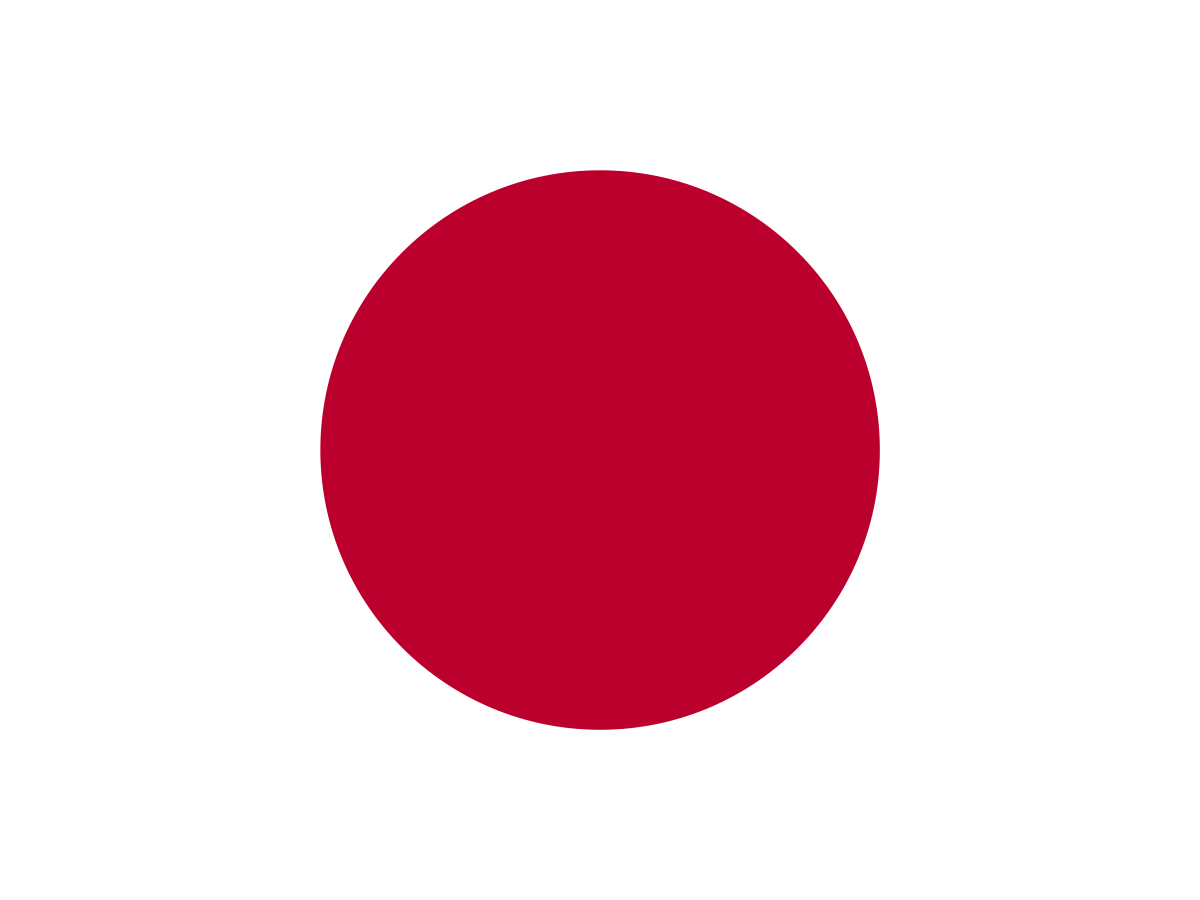
The flag of Japan
Japan's national flag is a simple white field with a large red disc in the centre. The design is known as the Hinomaru, meaning “circle of the sun”.
The red disc represents the sun.
Japan is traditionally associated with the rising sun, and the country's name in Japanese, 日本 (Nihon or Nippon), is commonly interpreted as “origin of the sun” or “where the sun originates”.
The modern national flag was formally defined in law in 1999, although the design had been used as a Japanese symbol for centuries.
What do the colours mean?
The flag uses only white and red. Popular explanations associate white with purity and honesty and red with the sun, vitality or sincerity.
The strongest historical symbolism, however, is the red sun itself. The flag's simplicity reflects the long-standing importance of the rising sun in Japanese identity.
The white field
The white background provides a clean field for the central sun disc. It is often popularly associated with purity, honesty and sincerity.
These interpretations are cultural associations rather than a detailed official colour code.
The red sun
The central red disc represents the sun. Japan's location east of the Asian mainland helped create a long-standing association with the rising sun.
The symbol is known as the Hinomaru, literally “sun disc” or “circle of the sun”.
Japan — the Land of the Rising Sun
Japan is often called the Land of the Rising Sun. The name Japan itself comes from Chinese readings of characters that mean “sun origin”.
The rising-sun idea is deeply embedded in Japanese history, imperial symbolism and national imagery.
The Hinomaru
The Hinomaru became a widely recognised Japanese national symbol long before the modern constitution. Its use can be traced through Japanese history, particularly from the nineteenth century onwards.
The same sun-disc motif also appears in Japan's naval and military rising-sun designs, which are visually different from the national flag.
A short history of Japan
Japan's history spans prehistoric Jōmon communities, the development of rice agriculture, imperial courts, samurai rule, shogunates, centuries of relative isolation, rapid modernisation during the Meiji period, militarism and war, and the peaceful democratic state that emerged after 1945.
Japanese history is particularly notable for the way older traditions survived alongside dramatic technological and social change.
History timeline
c. 14,000–300 BCE — Jōmon periodHunter-gatherer communities developed distinctive pottery and settled communities across the Japanese islands.
c. 300 BCE–300 CE — Yayoi periodWet-rice agriculture, metalworking and new cultural influences spread through Japan.
3rd–7th centuries — Early statesPolitical centres developed and the Yamato court became increasingly influential.
710 — Nara capitalHeijō-kyō, modern Nara, became the permanent capital and Buddhism became increasingly influential.
794 — Heian period beginsThe capital moved to Heian-kyō, modern Kyoto, beginning a long era of court culture.
1185–1333 — Kamakura shogunateWarrior governments became dominant and the samurai class gained political power.
1274 & 1281 — Mongol invasionsKublai Khan's forces attempted to invade Japan twice; both campaigns failed, with major storms contributing to the outcomes.
1336–1573 — Muromachi periodThe Ashikaga shogunate ruled while regional warfare and cultural developments transformed Japan.
1467–1600 — Sengoku periodJapan experienced prolonged civil wars between competing warlords.
1603 — Tokugawa shogunateTokugawa Ieyasu established a shogunate that brought long-term political stability.
1630s–1850s — Sakoku policiesThe Tokugawa government heavily restricted foreign relations and overseas travel, although Japan continued limited trade.
1853 — Perry arrivesAmerican ships led by Commodore Matthew Perry pressured Japan to open its ports to foreign trade.
1868 — Meiji RestorationPolitical power was restored to the emperor and Japan began rapid state-building and industrialisation.
1894–95 — Sino-Japanese WarJapan defeated Qing China and emerged as a major East Asian power.
1904–05 — Russo-Japanese WarJapan defeated Russia, becoming the first modern Asian power to defeat a major European imperial power in war.
1931–45 — Expansion and warJapan expanded its empire across East Asia and the Pacific, culminating in the Second World War.
1945 — Defeat in World War IIJapan surrendered in August 1945 after atomic bombings of Hiroshima and Nagasaki and the Soviet declaration of war.
1947 — New constitutionJapan's post-war constitution came into force, establishing parliamentary democracy and renouncing war as a sovereign right.
1950s–80s — Economic miracleJapan experienced rapid industrial growth and became one of the world's largest economies.
TodayJapan is a highly developed parliamentary democracy and major global economy known for technology, manufacturing and culture.
Jōmon Japan
The Jōmon period is one of the world's earliest pottery traditions. Communities lived from hunting, fishing and gathering and developed relatively permanent settlements.
Jōmon archaeology provides important evidence about the early peoples of the Japanese archipelago.
The Yayoi period
During the Yayoi period, wet-rice farming, bronze and iron technologies and new cultural influences spread through Japan.
Agriculture supported larger settlements and helped create more complex political societies.
The Yamato court
The Yamato polity became an increasingly powerful political centre during the first millennium CE. Its rulers developed relationships with Korea and China and adopted elements of continental writing, government and Buddhism.
The Japanese imperial institution traces its traditional lineage through this early political history.
Nara and the arrival of Buddhism
Japan's adoption and development of Buddhism transformed religion, art, architecture and government. Nara became the capital in 710 and major temple complexes were built.
Shinto traditions continued alongside Buddhism, creating a distinctive religious landscape.
Heian Japan
The Heian period began when the capital moved to Kyoto in 794. Court culture flourished and produced some of Japan's greatest classical literature.
Murasaki Shikibu's The Tale of Genji is often described as one of the world's earliest novels.
The samurai
Samurai were members of Japan's warrior class. Over time they became an influential political and social group, serving powerful lords and military governments.
The popular image of the samurai combines historical warrior traditions with later literature, theatre, film and modern popular culture.
The shogunates
A shogunate was a military government headed by a shogun. The Kamakura, Ashikaga and Tokugawa shogunates dominated different periods of Japanese history.
The emperor remained an important institution, but political power was often exercised by warrior governments.
The Mongol invasions
Mongol forces attempted to invade Japan in 1274 and 1281. Both expeditions failed. Severe storms contributed to the destruction of parts of the invading fleets.
The storms later became associated with the idea of a kamikaze, or “divine wind”.
The Sengoku period
The Sengoku period was an era of intense civil warfare among regional warlords. Figures such as Oda Nobunaga, Toyotomi Hideyoshi and Tokugawa Ieyasu eventually brought the country towards unification.
The period inspired countless Japanese works of literature, film, television and games.
Tokugawa Japan
Tokugawa Ieyasu established the Tokugawa shogunate in 1603. The government brought political stability that lasted for more than two centuries.
Japanese cities grew, literacy expanded and distinctive arts such as kabuki, ukiyo-e and haiku flourished.
Japan's isolation policies
The Tokugawa government adopted policies that heavily restricted foreign contact and Japanese overseas travel. These are often described as sakoku, although Japan was not completely cut off from the outside world.
Trade and diplomatic contacts continued through controlled channels, including relations with the Dutch, Chinese and Koreans.
Commodore Perry and the opening of Japan
In 1853, American naval vessels under Commodore Matthew Perry arrived in Japanese waters and demanded greater access for foreign ships.
The resulting treaties contributed to the political crisis that brought down the Tokugawa shogunate.
The Meiji Restoration
The Meiji Restoration of 1868 ended the Tokugawa shogunate and restored political authority to the emperor. Japan rapidly modernised its government, military, education, industry and infrastructure.
Within a few decades Japan had transformed into a major industrial and military power.
Industrialisation
During the Meiji period and early twentieth century, Japan built railways, factories, shipyards, modern universities and a national education system.
Industrialisation helped Japan compete with European and American powers but also supported imperial expansion.
The Sino-Japanese War
Japan defeated Qing China in the First Sino-Japanese War of 1894–95. The conflict strengthened Japan's regional position and marked the decline of Qing influence.
The victory also contributed to Japan's later imperial expansion.
The Russo-Japanese War
In 1904–05, Japan defeated the Russian Empire in the Russo-Japanese War. Japan's victory shocked the world because a modern Asian state had defeated a major European power.
The war established Japan as a major international military power.
Japan and the Second World War
Japan expanded across East Asia during the 1930s and entered a wider Pacific war after the attack on Pearl Harbor in 1941.
The war ended in 1945 with Japan's surrender after devastating fighting, the atomic bombings of Hiroshima and Nagasaki, and the Soviet Union's entry into the war against Japan.
Hiroshima and Nagasaki
The United States dropped atomic bombs on Hiroshima on 6 August 1945 and Nagasaki on 9 August. Large numbers of civilians died immediately and in the aftermath.
The bombings remain among the most consequential and debated events of the twentieth century.
Post-war Japan
After 1945, Japan underwent major political and social reforms under Allied occupation. The 1947 constitution established parliamentary democracy and included Article 9, under which Japan renounces war as a sovereign right.
Japan subsequently rebuilt and developed into a major industrial economy.
Japan's economic miracle
From the 1950s through the 1980s, Japan experienced spectacular economic growth. Companies became global leaders in cars, electronics, cameras, machinery and consumer technology.
The period transformed living standards and helped make Japan one of the world's largest economies.
Tokyo
Tokyo is Japan's capital and one of the world's largest metropolitan areas. It combines historic districts and temples with dense modern architecture, railways, technology and finance.
The wider Tokyo metropolitan area is one of the world's most important urban and economic regions.
Mount Fuji
Mount Fuji is Japan's highest mountain at 3,776 metres and one of the country's most recognisable symbols.
Its symmetrical volcanic cone has inspired Japanese artists and writers for centuries and remains an important cultural and spiritual landmark.
The Japanese archipelago
Japan consists of four main islands — Honshu, Hokkaido, Kyushu and Shikoku — plus thousands of smaller islands.
The country lies along the Pacific Ring of Fire, making earthquakes and volcanic activity important features of Japanese geography.
Earthquakes and tsunamis
Japan experiences frequent earthquakes because several tectonic plates meet around the archipelago. The country has developed advanced building codes, warning systems and disaster-preparedness programmes.
Large undersea earthquakes can also generate tsunamis, as demonstrated dramatically by the 2011 Tōhoku disaster.
The 2011 Tōhoku disaster
On 11 March 2011, a magnitude 9.0 earthquake struck off northeastern Japan, generating a devastating tsunami. More than 18,000 people were killed or remained missing.
The Fukushima Daiichi nuclear accident followed the tsunami and became one of the most serious nuclear accidents in history.
Japan's climate
Japan's climate ranges from cold and snowy conditions in Hokkaido to subtropical conditions in Okinawa. Much of the country has four distinct seasons.
Japan also experiences typhoons, heavy rainfall and significant snowfall in some regions.
Japanese wildlife
Japan's varied mountains, forests and islands support species including Japanese macaques, sika deer, red-crowned cranes, bears and many marine animals.
Some species are endemic to particular Japanese islands.
The Japanese macaque
The Japanese macaque, or snow monkey, is famous for living in cold mountain regions and bathing in natural hot springs.
It is one of Japan's best-known native animals and has adapted to a wide range of climates.
Japanese culture
Japanese culture includes tea ceremony, calligraphy, martial arts, gardens, theatre, literature, manga, anime, fashion and modern pop culture.
Traditional practices continue alongside highly modern urban lifestyles.
Shinto and Buddhism
Japan's religious traditions have long included both Shinto and Buddhism. Many people participate in customs associated with both rather than treating them as mutually exclusive.
Shinto shrines and Buddhist temples remain important parts of Japanese landscapes and cultural life.
Japanese writing
Japanese uses several writing systems, including kanji, hiragana and katakana. Kanji characters originated from Chinese writing, while kana were developed in Japan.
The combination allows Japanese to express native words, grammatical endings and foreign terms efficiently.
Japanese food
Japanese cuisine, or washoku, is famous for careful presentation, seasonal ingredients and balanced flavours. Popular foods include sushi, ramen, tempura, soba, udon and many regional dishes.
Washoku was added to UNESCO's Intangible Cultural Heritage list in 2013.
Sushi
Sushi developed from older preserved-fish traditions and evolved into the forms known around the world today. Edo, modern Tokyo, played an important role in the development of modern sushi.
Japanese sushi culture places strong emphasis on freshness, technique and seasonality.
Anime and manga
Anime and manga are among Japan's most influential cultural exports. They encompass genres for children and adults and cover subjects ranging from fantasy and science fiction to history and everyday life.
Japanese animation and comics have influenced artists, filmmakers and games worldwide.
Technology and engineering
Japan is a global leader in areas including automotive engineering, robotics, electronics, precision manufacturing and transport.
Japan's bullet train, or Shinkansen, became a symbol of high-speed rail engineering and reliable public transport.
The Shinkansen
The Shinkansen high-speed railway began operating in 1964, linking Tokyo and Osaka. It became famous for speed, punctuality and safety.
The network has since expanded across much of Japan and remains one of the world's best-known high-speed rail systems.
Japan's economy
Japan has a highly developed economy based on manufacturing, automobiles, electronics, machinery, finance, services and technology.
Major Japanese companies have become global brands, particularly in cars, consumer electronics, industrial equipment and entertainment.
Japan today
Modern Japan combines ancient cultural traditions with one of the world's most technologically advanced societies. It is a parliamentary democracy, a major industrial economy and a leading cultural exporter.
Japan also faces long-term challenges including population ageing, low birth rates, regional depopulation and the need to maintain economic growth.
Why is Japan's flag interesting?
Japan's flag is one of the world's simplest, yet its symbolism is remarkably deep. The red sun disc connects the modern national flag to the ancient idea of Japan as the land where the sun originates.
The Hinomaru's simplicity has made it instantly recognisable around the world.
Explore Japan on FlagAtlas
Continue exploring Japan and the world's flags with these FlagAtlas resources.