About Kazakhstan
Kazakhstan is the world's largest landlocked country and the largest country in Central Asia. Astana is the capital.
It stretches from the Caspian Sea region across vast steppe and desert landscapes to the mountains near China and Kyrgyzstan. Kazakhstan has a distinctive nomadic heritage and enormous reserves of oil, gas, uranium and minerals.
CapitalAstana
RegionCentral Asia
PopulationAbout 19 million
CurrencyTenge
LanguagesKazakh & Russian
Independence16 December 1991
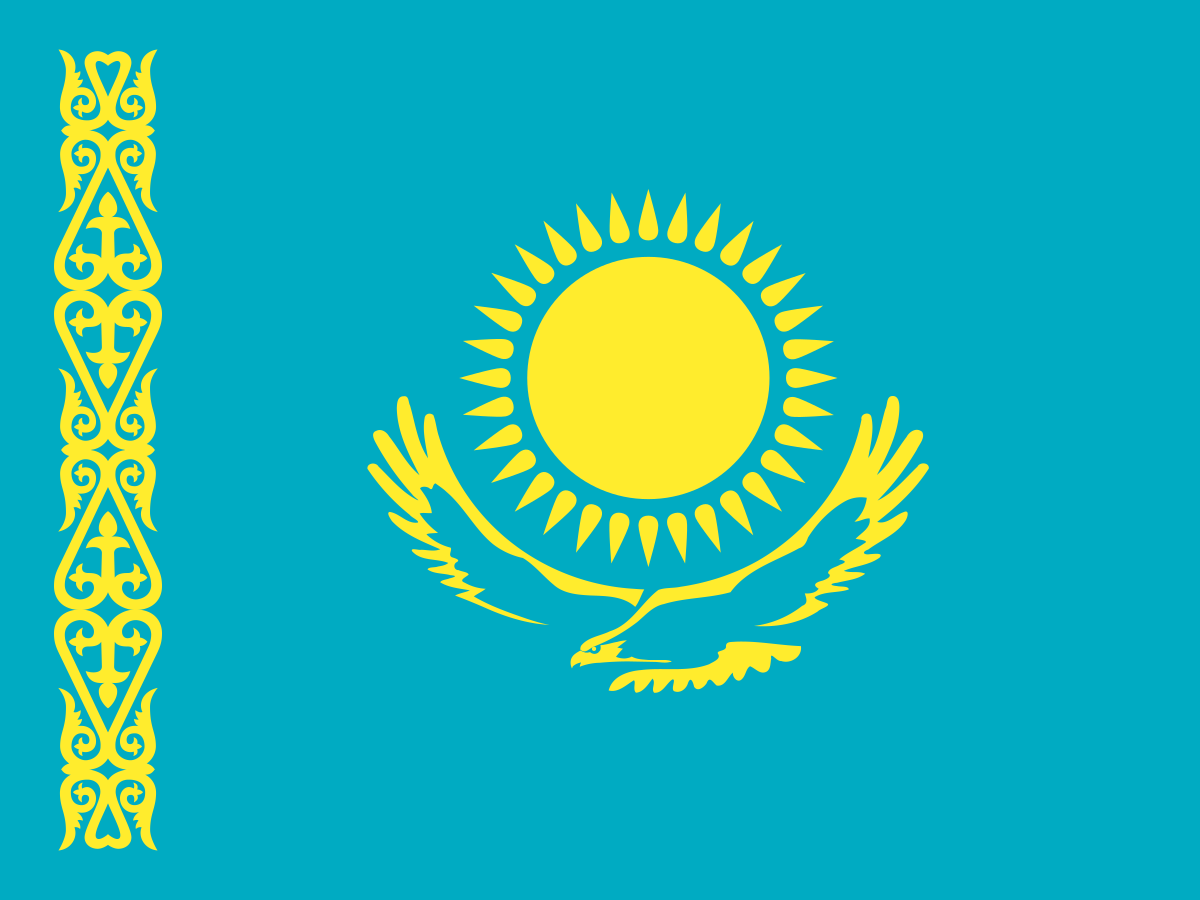
The flag of Kazakhstan
Kazakhstan's national flag is a sky-blue field featuring a golden sun above a golden steppe eagle, with a vertical ornamental pattern at the hoist.
The blue background is central to the flag's identity.
It represents the clear sky, peace and unity and also connects with the country's Turkic cultural heritage. The golden sun symbolises life and energy, while the eagle represents freedom, power and independence.
The current flag was adopted on 4 June 1992, shortly after Kazakhstan became independent from the Soviet Union.
What do the colours mean?
The flag's dominant sky blue represents the clear sky, peace and unity. The golden elements represent life, energy, wealth and prosperity.
Blue also has deep significance across Turkic cultures and helps distinguish Kazakhstan's flag from the red-dominated Soviet imagery that preceded independence.
The sky-blue field
The blue field represents the clear sky, peace and unity. It is also associated with the traditional symbolism of Turkic peoples.
The uninterrupted blue background gives the flag a particularly clean and spacious appearance, reflecting Kazakhstan's enormous landscapes.
The golden sun
The golden sun represents life, energy and abundance. Its rays are stylised as grain-like forms, connecting the sun with prosperity and the agricultural heritage of the steppe.
The sun sits directly above the eagle at the centre of the flag.
The steppe eagle
The golden steppe eagle, or berkut, represents freedom, power, independence and foresight.
The eagle is especially appropriate for Kazakhstan because the vast steppe has a long tradition of eagle hunting and nomadic culture.
The national ornament
The vertical golden pattern beside the flagpole is a traditional national ornamental motif. It reflects Kazakh artistic and cultural traditions.
The ornament gives the flag a distinctive national identity beyond the sun and eagle symbols.
The sun's rays
The sun's rays are shaped like grain, linking the symbol of the sun with abundance, prosperity and Kazakhstan's agricultural heritage.
The stylised rays are one of the details that distinguish Kazakhstan's flag from other blue-and-gold designs.
A short history of Kazakhstan
Kazakhstan's history is closely connected with the peoples and empires of the Eurasian steppe. Nomadic societies, Turkic khanates, the Mongol Empire, the Kazakh Khanate, Russian expansion and the Soviet Union all shaped the region.
Modern Kazakhstan became independent in 1991 and has since developed into a major Central Asian state with a resource-rich economy.
History timeline
Ancient period — Steppe culturesNomadic and semi-nomadic peoples inhabited the vast grasslands of present-day Kazakhstan for thousands of years.
c. 1st millennium BCE — Scythian/Saka culturesIron Age steppe societies developed sophisticated horse culture, metalwork and trade networks.
6th–8th centuries — Turkic KhaganatesTurkic-speaking states dominated much of the Central Asian steppe.
8th–12th centuries — Islamic and Turkic influenceIslam gradually spread into southern parts of the region while Turkic political and cultural traditions expanded.
13th century — Mongol conquestThe region was incorporated into the Mongol Empire under Genghis Khan and his successors.
15th century — Kazakh KhanateThe Kazakh Khanate emerged and became an important political entity on the steppe.
18th–19th centuries — Russian expansionThe Russian Empire gradually extended control over the Kazakh steppe.
1917–20s — Revolution and Soviet ruleAfter the Russian Revolution, Kazakhstan became part of the Soviet political system.
1930s — Collectivisation and famineForced collectivisation caused catastrophic disruption and famine, with enormous loss of life and displacement.
1936 — Kazakh SSRThe Kazakh Soviet Socialist Republic became a union republic of the USSR.
1949–89 — Nuclear testing at SemipalatinskThe Soviet Union conducted hundreds of nuclear tests at the Semipalatinsk test site.
1950s–60s — Virgin Lands campaignLarge areas of northern Kazakhstan were cultivated as part of a major Soviet agricultural programme.
1991 — IndependenceKazakhstan declared independence on 16 December 1991 following the dissolution of the Soviet Union.
1997 — Capital moves to AstanaThe capital was moved from Almaty to Akmola, later renamed Astana.
2019 — Political transitionNursultan Nazarbayev resigned as president and was succeeded by Kassym-Jomart Tokayev.
2022 — January unrest and constitutional changesLarge protests were followed by political reforms and constitutional changes.
TodayKazakhstan is an independent republic and a major economic and geopolitical power in Central Asia.
The steppe peoples
The Eurasian steppe supported mobile societies skilled in horse riding, herding, hunting and long-distance trade. These communities could move across enormous distances and developed distinctive weapons, clothing and art.
Nomadic life remains a powerful part of Kazakhstan's national heritage.
Saka and Scythian heritage
The Saka peoples were Iron Age nomads who lived across Central Asia. Archaeological finds show sophisticated gold-working and animal-style art.
The famous Golden Man discovered near Almaty has become an important symbol of Kazakhstan's ancient heritage.
Turkic Kazakhstan
Turkic peoples shaped the languages and cultures of the Central Asian steppe. A succession of Turkic khaganates controlled large territories and connected East and West.
Modern Kazakh language and culture belong to this wider Turkic heritage.
The Mongol Empire
In the thirteenth century, the armies of Genghis Khan conquered much of Central Asia. The territory of modern Kazakhstan became part of the Mongol imperial world and later successor states.
The conquest transformed political structures and trade routes across Eurasia.
The Kazakh Khanate
The Kazakh Khanate emerged during the fifteenth century and became the principal political framework for the Kazakh people.
Its history is central to modern Kazakh national identity.
Russian expansion
The Russian Empire gradually extended its authority across the Kazakh steppe during the eighteenth and nineteenth centuries. Forts, settlements and administrative reforms changed traditional patterns of life.
Russian migration into the region also increased substantially.
Soviet Kazakhstan
After the Russian Revolution, Kazakhstan became part of the Soviet Union. Soviet policies transformed agriculture, industry, education and urban life.
The period also brought severe repression, forced collectivisation, famine and large-scale population movements.
The Kazakh famine
Forced collectivisation and the destruction of traditional nomadic livelihoods contributed to a devastating famine in 1930–33. Millions across the Soviet Union were affected, with Kazakhstan suffering an especially severe demographic catastrophe.
The famine remains a major and deeply significant part of modern Kazakh historical memory.
Semipalatinsk nuclear testing
The Soviet Union conducted hundreds of nuclear tests at the Semipalatinsk test site in northeastern Kazakhstan between 1949 and 1989.
Radiation exposure caused long-term health and environmental consequences. Kazakhstan closed the test site after independence.
The Virgin Lands campaign
Beginning in the 1950s, the Soviet Virgin Lands campaign brought huge areas of northern Kazakhstan under cultivation.
The programme dramatically increased grain production but also caused soil erosion and other environmental problems.
Kazakhstan's independence
Kazakhstan declared independence on 16 December 1991, becoming the final Soviet republic to do so. Nursultan Nazarbayev became the country's first president.
The new state adopted national symbols including the current blue-and-gold flag in 1992.
The capital — Astana
Astana is Kazakhstan's capital and a showcase for modern architecture. The city was moved from Almaty in 1997 and has since expanded rapidly across the northern steppe.
Astana has been known by several names, including Akmola, Astana and Nur-Sultan, before returning to the name Astana in 2022.
Almaty
Almaty is Kazakhstan's largest city and remains its major commercial and cultural centre. It lies near the Tian Shan mountains in the southeast.
The city served as Kazakhstan's capital until 1997.
The Kazakh steppe
The steppe covers enormous areas of Kazakhstan and has shaped the country's history, economy and identity.
Its open grasslands supported nomadic pastoralism and helped create one of the world's great horse cultures.
The Caspian Sea
Kazakhstan has a coastline on the Caspian Sea, the world's largest inland body of water. The western region contains major oil and gas resources.
The Caspian is also important for fishing, shipping and regional energy infrastructure.
The Tian Shan mountains
The Tian Shan mountain system reaches into southeastern Kazakhstan. The region contains high peaks, glaciers, alpine lakes and important wildlife habitats.
The mountains are particularly important around Almaty.
Lake Balkhash
Lake Balkhash is one of the world's largest lakes and is unusual because its western and eastern sections have markedly different water characteristics.
The lake is an important ecosystem but faces environmental pressures from water use and industrial activity.
The Aral Sea disaster
The Aral Sea, once one of the world's largest inland lakes, suffered catastrophic shrinkage after Soviet irrigation projects diverted rivers feeding it.
The disaster caused ecological, economic and health problems across the region. Parts of the northern Aral have recovered following water-management projects involving Kazakhstan and its neighbours.
Kazakhstan's climate
Kazakhstan has a strongly continental climate, with very cold winters and hot summers. Temperature differences can be extreme because the country lies far from oceans.
Much of the country is semi-arid or arid, while mountain regions receive considerably more precipitation.
Kazakhstan's wildlife
Kazakhstan's huge territory supports saiga antelope, snow leopards, wolves, steppe eagles, wild horses and many migratory birds.
Conservation programmes have helped some threatened species recover.
The saiga antelope
The saiga is one of Kazakhstan's most distinctive animals. Its unusual enlarged nose helps filter dust and regulate the air it breathes in the harsh steppe environment.
Saiga populations have suffered severe declines but have shown major recoveries following conservation efforts.
The snow leopard
The snow leopard lives in the high mountains of southern and eastern Kazakhstan. It is elusive and threatened by habitat loss and other pressures.
Protecting mountain ecosystems is essential for the survival of this iconic species.
Eagle hunting
Traditional eagle hunting with golden eagles is an important part of Kazakh nomadic heritage. Hunters known as berkutchi train eagles to hunt foxes and other prey.
The tradition is celebrated at cultural festivals and remains a powerful symbol of the relationship between people and the steppe.
Kazakh culture
Kazakh culture reflects centuries of nomadic life, Turkic heritage, Islamic influence and interaction with neighbouring peoples.
Horse culture, hospitality, traditional music, felt crafts, yurts and epic storytelling remain important cultural symbols.
The yurt
The yurt is a portable round dwelling traditionally used by nomadic peoples of the steppe. Its wooden frame and felt covering made it practical for a mobile lifestyle.
The yurt remains a powerful symbol of Kazakh identity and is used at celebrations and cultural events.
Kazakh language
Kazakh is a Turkic language and the state language of Kazakhstan. Russian is also widely spoken and remains important in education, business and public life.
Kazakh uses a Cyrillic-based alphabet today, while a gradual transition towards a Latin-based alphabet has been planned and developed by the government.
Kazakh food
Kazakh cuisine reflects nomadic traditions and makes extensive use of meat, dairy products and grains. Popular dishes include beshbarmak, baursak, kuyrdak and fermented mare's milk.
Hospitality and shared meals are central to Kazakh culture.
Beshbarmak
Beshbarmak is one of Kazakhstan's best-known traditional dishes. It typically combines boiled meat with flat noodles and onions.
The name is often translated as “five fingers”, reflecting the traditional way of eating the dish by hand.
Kazakhstan's economy
Kazakhstan has one of Central Asia's largest economies, supported by oil, natural gas, uranium, mining, metals, agriculture and services.
The country has sought to diversify its economy while using its strategic position between China, Russia and Europe.
Oil and gas
Kazakhstan has major oil and natural gas reserves, particularly around the Caspian region. Petroleum exports have been central to the country's economic development since independence.
Large fields such as Tengiz and Kashagan are among the most important energy projects in the region.
Uranium
Kazakhstan is a major global producer of uranium. Its extensive mineral resources have made mining a significant part of the national economy.
The sector also connects Kazakhstan to the global nuclear-energy supply chain.
The Baikonur Cosmodrome
The Baikonur Cosmodrome in Kazakhstan was the launch site for Sputnik 1 and Yuri Gagarin's historic first human spaceflight in 1961.
Russia continues to operate the facility under a long-term lease agreement with Kazakhstan.
Kazakhstan today
Modern Kazakhstan is an independent republic with a large resource-based economy and a strategically important location between Russia, China and the wider Central Asian region.
The country continues to develop its cities, transport links and international trade while managing the environmental and economic legacy of the Soviet period.
Why is Kazakhstan's flag interesting?
Kazakhstan's flag combines modern national identity with ancient steppe symbolism. The sky-blue field, golden sun and steppe eagle evoke peace, freedom, energy and the country's Turkic and nomadic heritage.
The ornamental pattern at the hoist adds a distinctly Kazakh artistic element, making the flag immediately recognisable.
Explore Kazakhstan on FlagAtlas
Continue exploring Kazakhstan and the world's flags with these FlagAtlas resources.