About Kenya
Kenya is an East African country on the Indian Ocean. Nairobi is the capital and largest city.
Kenya is famous for its wildlife, savannah landscapes, Great Rift Valley, long-distance runners, diverse cultures and important role in East African politics and trade.
CapitalNairobi
RegionEast Africa
PopulationAbout 54 million
CurrencyKenyan shilling
Official languagesEnglish & Swahili
Independence12 December 1963
The flag of Kenya
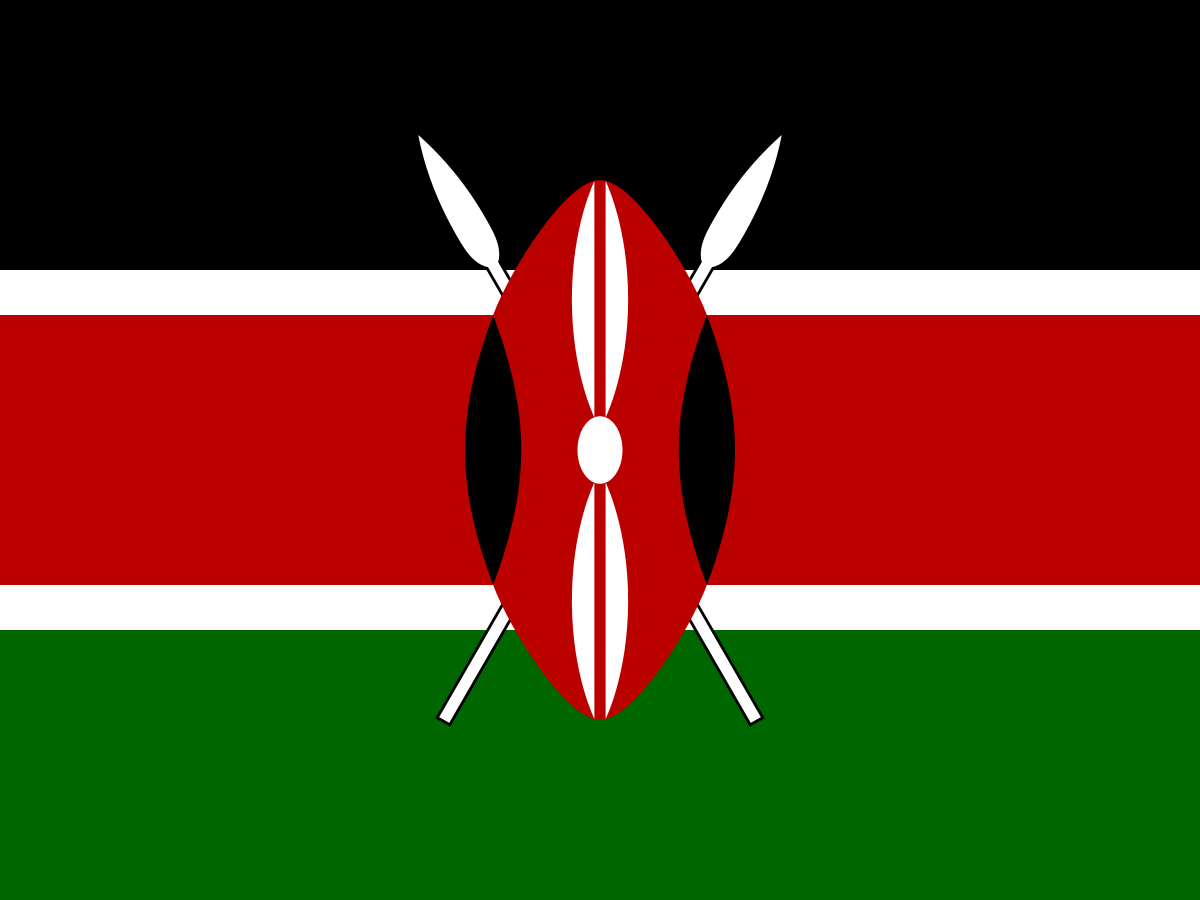
Kenya's national flag has three horizontal bands of black, red and green, separated by narrow white stripes. At the centre is a traditional Maasai shield and two crossed spears.
The flag tells the story of Kenyan identity and independence.
Black represents the people of Kenya, red represents the blood shed during the struggle for independence, and green represents the land and natural wealth. White represents peace and unity.
The shield and spears symbolise the defence of freedom. The flag was adopted on 12 December 1963, when Kenya became independent.
What do the colours mean?
Kenya's flag uses black, red, green and white, each carrying important national symbolism.
Black represents the people, red the blood shed during the struggle for independence, green the land and natural resources, and white peace and unity.
The black band
Black represents the people of Kenya. It sits at the top of the flag and forms part of the strong contrast that makes the central shield immediately visible.
The colour became especially significant in the context of Kenyan nationalism and independence.
The red band
Red represents the blood shed in the struggle for independence. It is placed between the black and green bands and is separated by white borders.
The colour gives the flag a direct connection to Kenya's anti-colonial history.
The green band
Green represents Kenya's land and natural wealth. It reflects the importance of agriculture, fertile regions and the country's famous landscapes.
Kenya's forests, grasslands and agricultural areas make the green symbolism particularly appropriate.
The white stripes
The narrow white stripes represent peace and unity. They separate the black and red and the red and green, helping create the flag's distinctive layered design.
White also provides a visual link between the country's people, struggle and land.
The Maasai shield
The central Maasai shield is one of the flag's most recognisable features. It represents defence and protection and draws on a powerful symbol associated with Kenyan heritage.
The shield is shown front-on, with the crossed spears behind it.
The crossed spears
The two crossed spears behind the shield represent the defence of freedom.
Together, the shield and spears express the idea that independence must be protected and defended.
A short history of Kenya
Kenya has a long history of human settlement, trade and migration. Coastal communities became connected to Indian Ocean trade, while inland societies developed agriculture, pastoralism and regional trading networks.
European colonial rule transformed the country during the nineteenth and twentieth centuries. Kenya gained independence in 1963 after a long nationalist struggle.
History timeline
Prehistory — Early human settlementKenya contains some of the world's most important archaeological evidence for early human evolution, particularly around Lake Turkana.
1st millennium CE — Swahili coastCoastal settlements became part of Indian Ocean trading networks linking East Africa with Arabia, Persia and India.
1498 — Portuguese arrivalVasco da Gama reached the East African coast, beginning a period of Portuguese influence in the region.
17th–18th centuries — Omani influenceOmani rulers and traders became increasingly influential along the Swahili coast.
19th century — European exploration and tradeEuropean explorers and missionaries travelled into the interior while commercial and political competition increased.
1895 — East Africa ProtectorateBritain established the East Africa Protectorate, marking the beginning of formal colonial administration.
1900s–30s — Settler colonialismLarge areas of fertile highland were opened to European settlers, while African communities faced land loss and political restrictions.
1920 — Kenya ColonyThe protectorate became the Colony and Protectorate of Kenya.
1952–60 — Mau Mau EmergencyThe Mau Mau uprising challenged British colonial rule. The conflict involved severe violence, detention and widespread repression.
1960 — Independence negotiationsPolitical reforms and negotiations accelerated as Britain moved towards ending colonial rule.
1963 — IndependenceKenya became independent on 12 December 1963, with Jomo Kenyatta as its first prime minister.
1964 — RepublicKenya became a republic and Jomo Kenyatta became its first president.
1992 — Multiparty politicsKenya restored multiparty politics after decades of one-party dominance.
2007–08 — Post-election crisisDisputed elections were followed by serious political and communal violence, eventually leading to a power-sharing agreement.
2010 — New constitutionA new constitution introduced major political and institutional reforms, including devolved county government.
TodayKenya is a regional economic, political and technological hub in East Africa.
Early human history
Kenya is central to the study of human evolution. Fossils and archaeological discoveries around Lake Turkana and other sites have helped scientists understand early human ancestors.
The East African Rift provided an important environment for human evolution and migration.
The Swahili coast
Kenya's Indian Ocean coast has been part of Swahili civilisation for centuries. Towns such as Mombasa and Lamu became centres of trade connecting East Africa with Arabia, Persia and India.
Swahili culture developed from African foundations alongside centuries of overseas interaction.
Mombasa
Mombasa is one of Kenya's oldest and most important coastal cities. Its history reflects African, Arab, Persian, Portuguese and British influences.
Fort Jesus, built by the Portuguese in the sixteenth century, is one of the city's best-known historic landmarks.
British colonial rule
Britain established the East Africa Protectorate in 1895 and later developed Kenya as a settler colony. Railways, especially the Uganda Railway, connected the coast with the interior.
Colonial rule brought new infrastructure and institutions but also land dispossession, racial inequality and political repression.
The Mau Mau uprising
The Mau Mau uprising began in the early 1950s and became the most significant armed challenge to British rule in Kenya. Many participants came from the Kikuyu community, although the wider independence movement was broader than Mau Mau alone.
The colonial government declared a state of emergency and detained large numbers of people. The conflict was marked by serious abuses and violence on multiple sides.
Jomo Kenyatta
Jomo Kenyatta became Kenya's first prime minister at independence and then its first president when Kenya became a republic in 1964.
He remains one of the most important figures in Kenya's modern history and the country's independence movement.
Kenya's independence
Kenya became independent on 12 December 1963. The date remains a national public holiday known as Jamhuri Day, which also commemorates the creation of the republic in 1964.
The national flag was adopted at independence and became a powerful symbol of the new state.
The new constitution
Kenya adopted a new constitution in 2010. It introduced major institutional reforms and created a system of devolved government with 47 counties.
The constitution also strengthened the bill of rights and changed the structure of executive and legislative government.
Nairobi
Nairobi is Kenya's capital and largest city. It is a major centre for finance, technology, diplomacy, transport and culture.
Nairobi is unusual among world capitals because Nairobi National Park lies immediately beside the city.
The Great Rift Valley
The Great Rift Valley cuts through Kenya from north to south and contains dramatic escarpments, volcanoes and lakes.
It is both a major geological feature and an important region for farming, tourism, wildlife and human history.
Mount Kenya
Mount Kenya is Africa's second-highest mountain after Kilimanjaro, reaching 5,199 metres. It is an ancient extinct volcano with glaciers and dramatic peaks.
The mountain is also culturally important, particularly to the Kikuyu people.
The Kenyan coast
Kenya's coastline stretches along the Indian Ocean and includes coral reefs, beaches, mangrove forests and historic Swahili towns.
Tourism, fishing and maritime trade are important parts of the coastal economy.
Kenya's climate
Kenya has a wide range of climates, from humid tropical conditions on the coast to dry semi-arid and arid areas inland. Highland regions around Nairobi and Mount Kenya have cooler conditions.
Rainfall is strongly seasonal in many parts of the country.
The Big Five
Kenya is famous for its wildlife, including the traditional African safari “Big Five”: lion, leopard, elephant, rhinoceros and buffalo.
Protected areas and conservancies play a major role in wildlife conservation and tourism.
The Maasai
The Maasai are one of East Africa's best-known pastoral communities. Their traditions include cattle herding, distinctive clothing, beadwork and ceremonial practices.
Maasai culture is diverse and continues to change alongside modern Kenyan society.
The Great Migration
The annual movement of huge herds of wildebeest, zebra and other animals between Tanzania's Serengeti and Kenya's Maasai Mara is one of the world's most famous wildlife spectacles.
The timing varies from year to year according to rainfall and grazing conditions.
Kenyan culture
Kenya is home to many ethnic and cultural communities, including the Kikuyu, Luhya, Luo, Kalenjin, Kamba, Kisii, Meru and Maasai, among many others.
Music, dance, storytelling, food, sport and religious traditions vary widely across the country.
Swahili
Swahili is one of Kenya's official languages and is widely used across East Africa. English is also an official language and is important in education, government and business.
Swahili developed along the East African coast and contains vocabulary influenced by Arabic and other languages.
Kenyan food
Kenyan cuisine varies by region and community. Popular foods include ugali, nyama choma, sukuma wiki, chapati, pilau and samosas.
Coastal cooking often contains strong Swahili and Indian Ocean influences, while inland cuisine reflects agricultural and pastoral traditions.
Kenyan athletics
Kenya is one of the world's great distance-running nations. Kenyan athletes have achieved exceptional success in marathon and middle- and long-distance events.
The high-altitude training environment around places such as Iten in the Rift Valley is often associated with the country's running success.
Marathon running
Kenyan runners have won numerous Olympic and world championship medals in distance events. Athletes from the Kalenjin community have been particularly prominent.
Kenya has produced some of the fastest marathon runners in history.
Kenya's economy
Kenya has one of East Africa's largest and most diversified economies, with important sectors including services, agriculture, tourism, manufacturing, finance and technology.
Nairobi has become a major regional business and technology hub.
Tea and coffee
Kenya is internationally known for high-quality tea and coffee. Tea is one of the country's major agricultural exports and is grown especially in the highlands.
Kenyan coffee is valued for its distinctive flavour and acidity.
Technology and M-Pesa
Kenya is famous for innovation in mobile money. M-Pesa transformed everyday financial transactions by allowing people to send, receive and store money using mobile phones.
The success of mobile finance helped establish Kenya as one of Africa's leading technology innovation centres.
Tourism
Tourism is a major part of Kenya's economy, driven by safaris, beaches, mountains, cultural tourism and adventure travel.
Maasai Mara, Amboseli, Tsavo, the Kenyan coast and Mount Kenya are among the country's best-known destinations.
Kenya today
Modern Kenya is a regional economic and diplomatic hub in East Africa. It has a vibrant technology sector, a major port at Mombasa and an influential cultural and sporting identity.
The country also faces challenges including inequality, unemployment, public debt, climate pressures and periodic political tensions.
Why is Kenya's flag interesting?
Kenya's flag is unusually rich in symbolism. The black, red and green colours tell the story of the people, the struggle for independence and the land, while the white represents peace and unity.
The central Maasai shield and crossed spears turn the flag into a visual statement about protecting Kenya's freedom and sovereignty.
Explore Kenya on FlagAtlas
Continue exploring Kenya and the world's flags with these FlagAtlas resources.